

Jewish Israelis: Next Gov't Should Take on Haredi Conscription; State Commission of Inquiry
Passing a law requiring ultra-Orthodox men to serve in the IDF and establishing a State Commission of Inquiry into the Oct. 7 attack get highest level of support among Jews; exploring negotiations with Palestinians gets highest level of support among Arab Israelis.

Photo by Chaim Goldberg/FLASH90
Methodology
The survey was conducted by the Viterbi Family Center for Public Opinion and Policy Research at the Israel Democracy Institute between October 5–8, 2026. It was based on a representative sample of the population in Israel aged 18 and above, comprising 602 Jewish interviewees and 149 Arab interviewees.
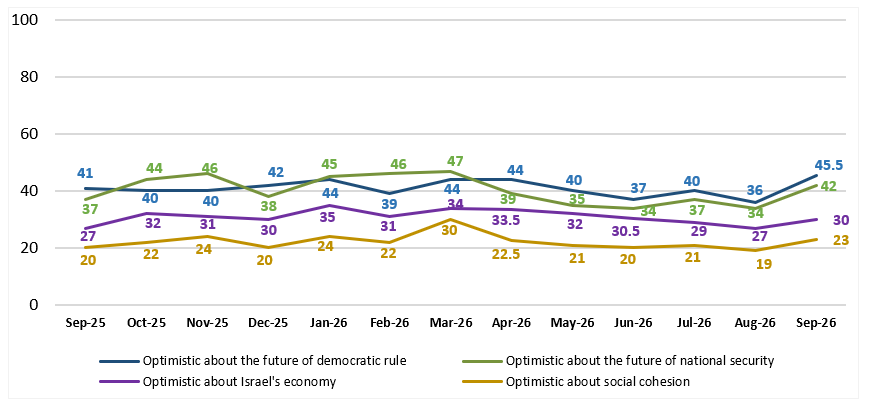
- Seemingly against the backdrop of the upcoming elections, we found a rise in optimism across all four topics this month. In the total sample, the largest increase relative to last month (9.5 percentage points) was in the level of optimism about the future of democratic rule. The second-largest rise was in optimism about the future of national security (8 points), followed by social cohesion (4 points), and finally the future of Israel’s economy (3 points).
Optimistic about the future of democratic rule, national security, the economy, and social cohesion (total sample; %)
- As in previous surveys, the share of optimists in the Jewish sample is larger than that in the Arab sample for all four topics.
Optimistic about the future (Jews and Arabs; %)

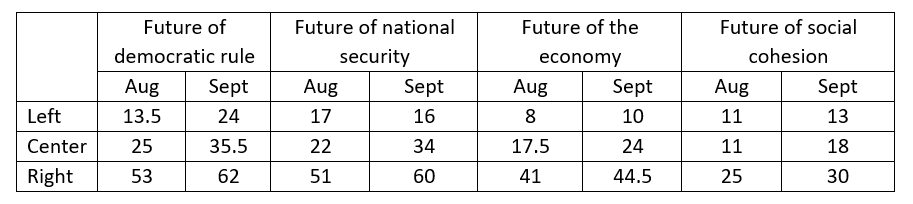
- Breaking down the Jewish sample by political orientation reveals that, as in previous surveys, optimism is higher on the Right than on the Left and in the Center, with regard to all four topics. However, all three camps have seen a rise in optimism about all topics, with the exception of the future of national security on the Left.
Optimistic about the future (Jews, by political orientation; %)
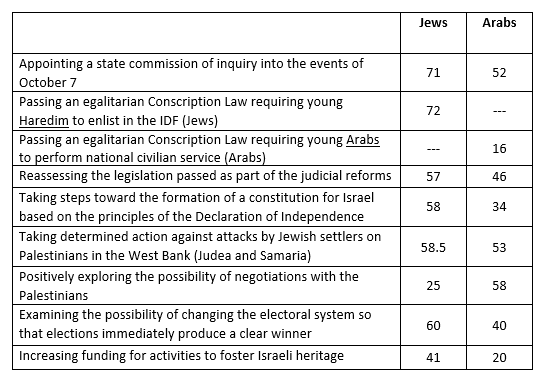
We presented our respondents with a series of actions that the next government could take and asked whether they support or oppose each of them.
- A comparison of the responses in the Jewish and Arab samples shows that, with the exception of exploring the possibility of negotiations with the Palestinians, the level of support for each of these actions is higher among Jews than among Arabs. At the same time, it is worth noting that for some of the actions we asked about, a relatively high percentage of Arab respondents selected the “don’t know” option.
Share of respondents who would support the next government taking the following actions (%)
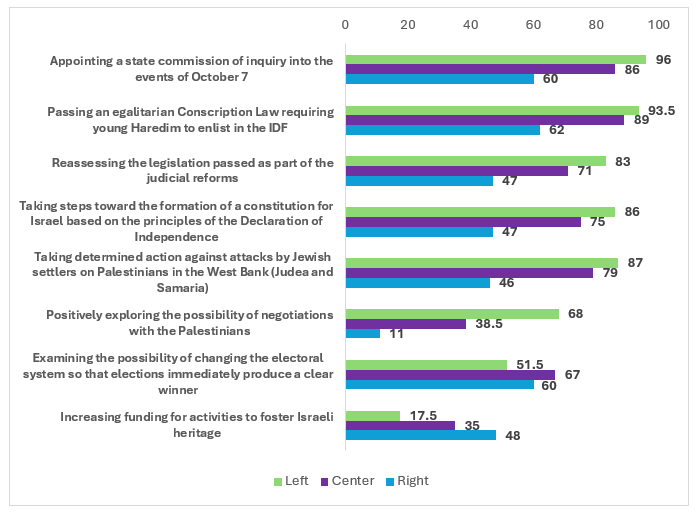
- As shown in the figure below, there are large differences in the degree of support expressed by the three political camps. In most cases, support is lower among respondents on the Right, with the exception of increasing funding for activities to foster Israeli heritage, for which the highest level of support is found on the Right. With regard to the other possible actions, the highest levels of support are expressed by those on the Left, with the exception of examining the possibility of changing the electoral system, for which the greatest support comes from those in the Center.
- The largest difference between Left and Right, as well as between Left and Center, is with regard to positively exploring the possibility of negotiations with the Palestinians (the Center is positioned between the other two camps, but slightly closer to the Right). The highest average support is for passing an egalitarian Conscription Law requiring young Haredim to enlist in the IDF and for appointing a state commission of inquiry (though in both cases, the difference between the Left and the Center, on the one hand, and the Right on the other, remains very large).
Share of respondents who would support the next government taking the following actions (Jews, by political orientation; %)
Credibility of reports:
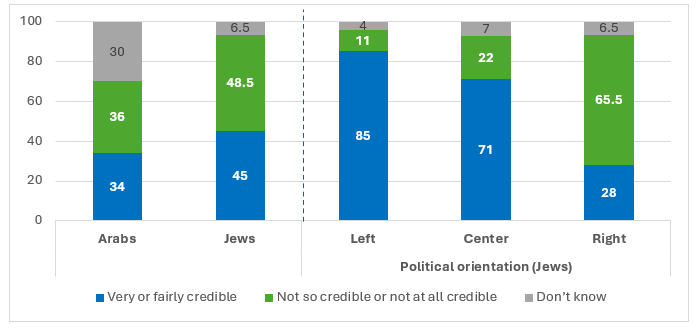
- We asked: “In your opinion, how credible are the recent media reports that during the weeks leading up to October 7, Prime Minister Netanyahu was warned by several senior Arab figures about a planned Hamas attack?”
- The Israeli public is divided on this question: 46% think that the reports are not credible, while 43% think they are.
- Jewish respondents are fairly evenly divided, with a slight advantage for those who think that the reports are not credible. Among Arabs, too, the picture is evenly balanced: slightly more than a third support each position, while a very large share of respondents—close to a third—selected the “don’t know” option.
- The differences between the political camps (Jews) are considerable: In the Center, and to an even greater degree on the Left, a large majority think that the reports are credible. On the Right, meanwhile, some two-thirds think that the reports are not credible, while only around a quarter think they have merit.
How credible are the recent media reports that during the weeks leading up to October 7, Prime Minister Netanyahu was warned by several senior Arab figures about a planned Hamas attack? (%)
Timing of the publication of the reports:
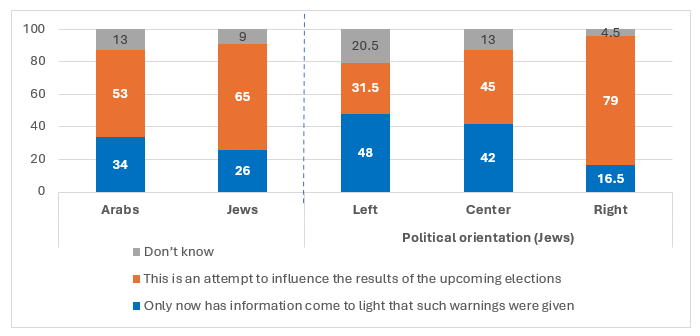
- Almost two-thirds of the total sample (63%) think that the reports have been published specifically in recent weeks in an attempt to influence the results of the upcoming elections, while 27% think that the timing is due to the fact that only now has the information about these warnings come to light.
- Among both Jews (65% versus 26%) and Arabs (53% versus 34%), the majority view the timing of the publications as an attempt to influence the elections.
- On the Right (Jews), more than three-quarters attribute the timing of the publications to an attempt to influence the elections. In the Center, opinions are almost evenly distributed, while on the Left, almost half think that the information has only now come to light, and around one-third see the timing as an attempt to influence the elections.
The main reason for the publication of these reports specifically in recent weeks (%)
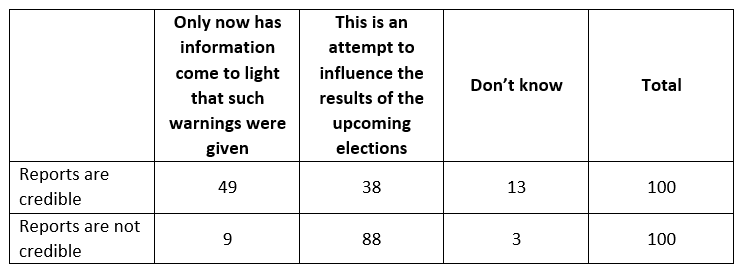
- Cross-tabulating responses to the two questions reveals that among those who think that the reports are not credible, a very large majority think that their publication at the current time represents an attempt to influence the results of the upcoming elections. By contrast, among those who think that the reports are credible, the largest share—and very close to half—think that only now has the information come to light that Netanyahu was given such warnings.
The main reason for the publication of these reports specifically in recent weeks, by credibility of the reports (total sample; %)
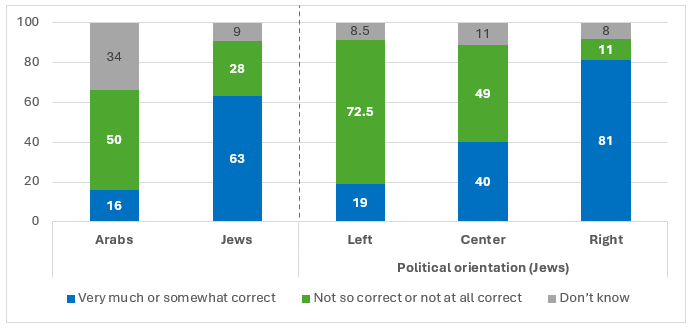
- We asked: “In your opinion, from today’s perspective, was the policy of various Israeli governments to allow, and even encourage, the establishment of settlements in the West Bank correct or not correct?”
- A majority of the total sample (55%) think that the policy of Israeli governments to allow and even encourage the establishment of settlements in the West Bank was correct. By contrast, 32% think that it was not correct.
- Around two-thirds of Jews think that this policy was correct, while 28% think it was not. Among Arabs, the picture is reversed: one-half think the policy was not correct, while only a small minority think it was. It should be noted that around one-third of Arab respondents selected the “don’t know” option.
- On the Right (Jews), a large majority think this policy was correct. In the Center, opinions are more divided: almost half think the policy was not correct, and 40% that it was correct. The Left is a mirror image of the Right: almost three-quarters think the policy was not correct, while only 19% think it was correct.
In your opinion, from today’s perspective, was the policy of various Israeli governments to allow, and even encourage, the establishment of settlements in the West Bank correct or not correct? (%)
- Relative to the last time a similar question was asked (in May 2017), the share of respondents who think that the policy of Israeli governments regarding the settlements was correct has risen by around 10 percentage points. However, this rise is entirely due to an increase in the Jewish sample, while there was a slight decrease in the Arab sample in the share of those who hold this view. In other words, the share of Jews who think that the policy of Israeli governments to allow and even encourage the establishment of settlements is larger today than almost a decade ago.
Share of respondents who think that, from today’s perspective, the policy of various Israeli governments to allow, and even encourage, the establishment of settlements in the West Bank was correct (%)*
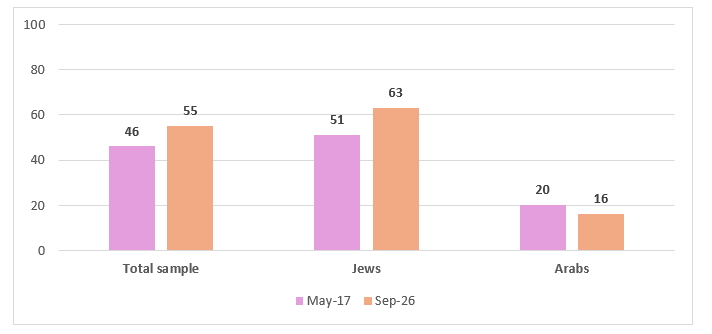
*In May 2017, the question was formulated as follows: In your opinion, from today’s perspective, was the policy of the various Israeli governments to establish settlements in the West Bank correct or not correct in terms of Israel’s national interest?
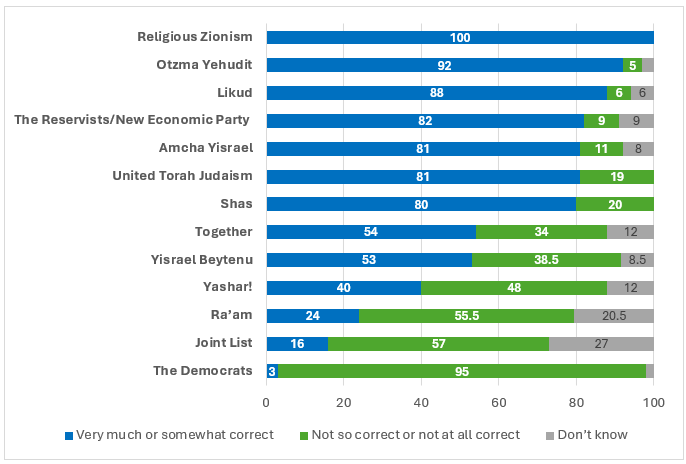
- Breaking down responses in the current survey by voting intentions in the upcoming elections (total sample) reveals that among those who intend to vote for parties currently in the coalition, as well as those planning to vote for Amcha Yisrael and The Reservists/New Economic Party, at least 80% think the policy was correct. Among those who intend to vote for Together and Yisrael Beytenu, more than half think that government policy toward the settlements was correct. Among those who intend to vote for Yashar!, by contrast, 48% think the policy was not correct, compared to 40% who think it was correct. Among voters for the Arab parties, more than half think that the policy was not correct (a high percentage of voters for both Arab parties selected the “don’t know” option), as do an overwhelming majority of voters for The Democrats.
In your opinion, from today’s perspective, was the policy of various Israeli governments to allow, and even encourage, the establishment of settlements in the West Bank correct or not correct? (total sample, by voting intentions at the 2026 elections; %)
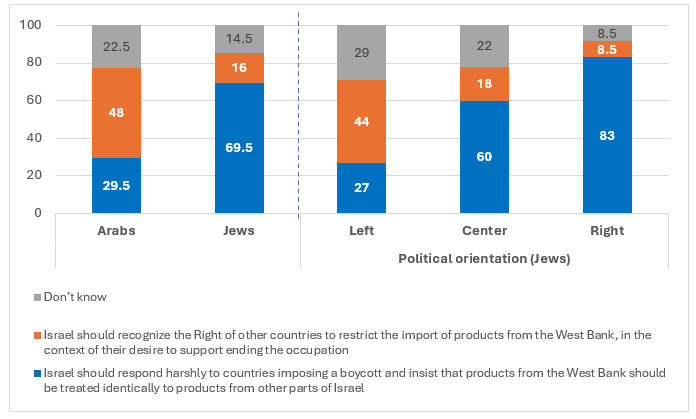
- Around two-thirds of the total sample (63%) think that Israel should respond harshly to those countries that have imposed sanctions, and should insist that products from the settlements are treated identically to products manufactured elsewhere in Israel. By contrast, 21% think that Israel should recognize the right of other countries to restrict the import of products from the West Bank, in the context of their desire to support ending the occupation.
- There is a clear difference of opinion between Jews and Arabs on this issue: Around 70% of Jews think that Israel should respond harshly and demand equal treatment for products from the settlements and products from the rest of the country, while only 16% recognize the right of other countries to restrict imports from the West Bank. Among Arabs, meanwhile, around one-half think that Israel should recognize the right of other countries to restrict the import of products in the context of their desire to support ending the occupation, while slightly less than one-third would prefer a harsh response from Israel. Approximately one-fifth of the Arab respondents selected the “don’t know” option.
- There are also large differences between the political camps (Jews): A large majority of those on the Right, and a more moderate majority of those in the Center, are in favor of Israel demanding the same treatment for products from the settlements as for products from other parts of the country. On the Left, a greater share of respondents recognize the right of other countries to restrict the import of products from the West Bank (44%) than support demanding equal treatment for such products (27%). It should be noted that large shares of respondents on the Left and in the Center selected the “don’t know” option.
Against the backdrop of the sanctions that some European countries have imposed against imports from settlements in the West Bank, with which of the following statements do you agree more? (%)
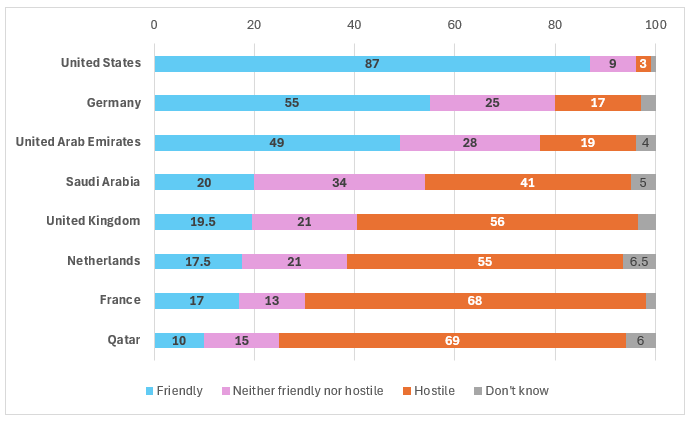
- We revisited a question asked in previous years, about how the public perceives the attitude toward Israel of various countries around the world. Only two countries are viewed as friendly to Israel: the United States, which a vast majority think is friendly, and Germany, considered so by more than half the sample. Moving down the rankings, almost half our respondents think the United Arab Emirates is a friendly country, a much larger share than Saudi Arabia, Qatar, and the other European countries we asked about. Saudi Arabia is perceived mainly as unfriendly, though the share of those who define it as hostile (41%) is significantly smaller than the corresponding share for the United Kingdom, the Netherlands, and France (56%, 55%, and 68%, respectively). Rounding out the list is Qatar, which only 10% view as friendly and 69% consider to be hostile (a share similar to that received by France).
In your opinion, are the following countries friendly or hostile toward Israel today? (total sample; %)
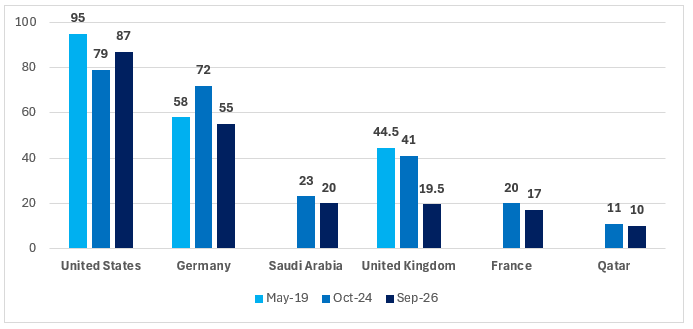
- Comparing the current survey findings with previous measurements reveals a number of differences. First, the United States is the only country for which there has been an increase in the share of respondents who think it is friendly toward Israel (from 79% in 2024 to 87% now), though this share is lower than in 2019 (95%). Second, there has been a sharp drop in the percentage of Israelis who think the United Kingdom is friendly—from more than 40% in both 2019 and 2024, to less than 20% now. Third, the share who think Germany is friendly has also declined significantly since 2024 (from 72% to 55%), and has thus returned close to the level found in 2019 (58%). The shares of respondents who categorize Saudi Arabia, France, and Qatar as friendly to Israel remain similar to those found in 2024.
Share of respondents who say that each of the following countries is friendly toward Israel (total sample; %)
The September 2026 Israeli Voice Index was prepared by the Viterbi Family Center for Public Opinion and Policy Research at the Israel Democracy Institute. The survey was conducted via the internet and by telephone (to include groups that are under-represented on the internet) between October 5-8, 2026, with 602 men and women interviewed in Hebrew and 149 in Arabic, constituting a nationally representative sample of the adult population in Israel aged 18 and over. The maximum sampling error (all sample) was ±3.58 % at a confidence level of 95%. Field work was carried out by Shiluv I2R. The full data file can be found at: https://dataisrael.idi.org.il.