
Flash Survey: If No Party Can Form a Coalition, Highest Share of Israelis Prefer New Elections Over Alternatives
Among both Jewish (35%) and Arab (46%) Israelis, a plurality say that they prefer repeat elections over a unity government with a rotation (Jews: 28% / Arabs: 9%) or a minority government (Jews: 23% / Arabs: 25%).

Photo by Yonatan Sindel/Flash90
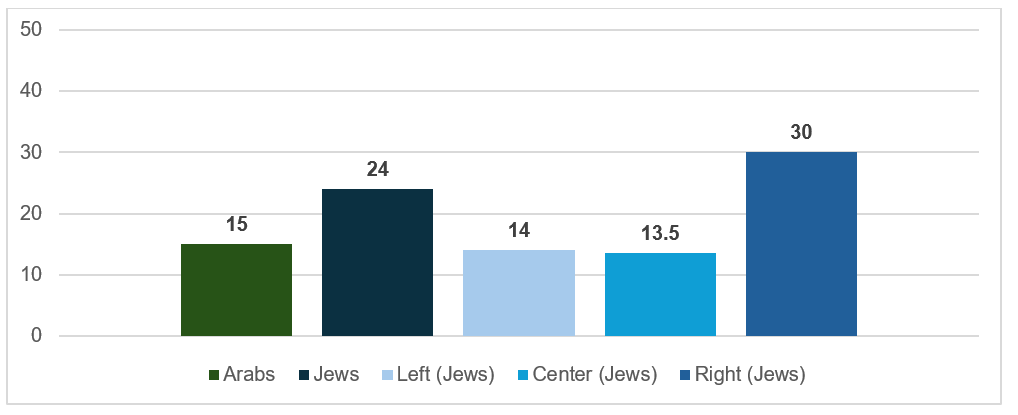
Israel is defined as a Jewish and democratic state. Do you feel there is a good balance today between the Jewish and the democratic components?
- Only around a quarter of the Jewish public (24%) think there is currently a balance in Israel between its Jewish and democratic components. The largest share (41%) think that the Jewish component is too dominant. Around a quarter (23%) consider the democratic component too dominant.
- A breakdown by political orientation (Jews) shows that in none of the camps do a majority think there is currently a balance in Israel between the Jewish and democratic components. Around three-quarters of those on the Left (76%) and two-thirds of those in the Center (66%) think that the Jewish component is too dominant. The Right is divided on this question: 31.5% think the democratic component is too dominant, while 25.5% think the Jewish component is too dominant. A further 30% think the two components are balanced.
- A breakdown by religiosity reveals that a majority of Haredi respondents (69%) think the democratic component is too dominant. Among national religious respondents, the largest share (40%) hold the same view, though a share only slightly smaller (36%) think the two components are balanced. Among traditional religious respondents, the largest share (38.5%) think the two components are balanced, while among traditional non-religious respondents, the largest share (37%) think the Jewish component is too dominant. Among secular respondents, a clear majority (71%) consider the Jewish component too dominant.
- Among the Arab public, a clear majority of around two-thirds (65%) think the Jewish component is too dominant.
Agree that there is currently a good balance between the Jewish and democratic components (%)
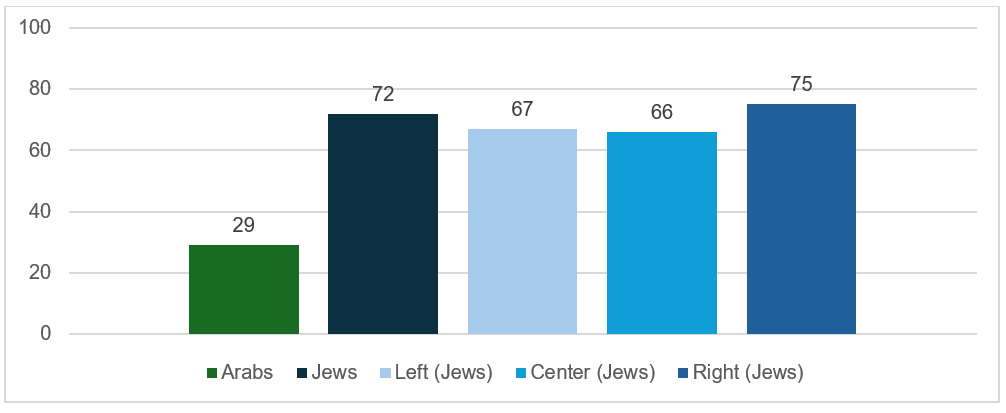
In your opinion, can or cannot the State of Israel be, at the same time, both fully Jewish and fully democratic?
- Despite these findings, a majority of the Jewish public, and indeed a majority in all its constituent groups, think this is possible. By contrast, among the Arab public, fewer than a third (29%) think that Israel can be both fully Jewish and fully democratic.
Think that Israel can be both Jewish and democratic at the same time (%)
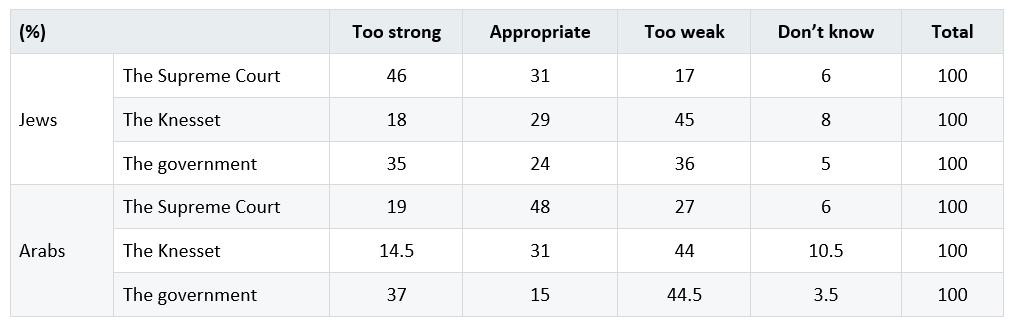
- We asked whether each of the three branches of government (the judiciary, the Knesset, and the government) has an appropriate degree of power, is too strong, or is too weak. In the total sample, the largest shares view the Supreme Court as too strong and the Knesset as too weak.
How would you assess the current strength of each of the following institutions? (%)
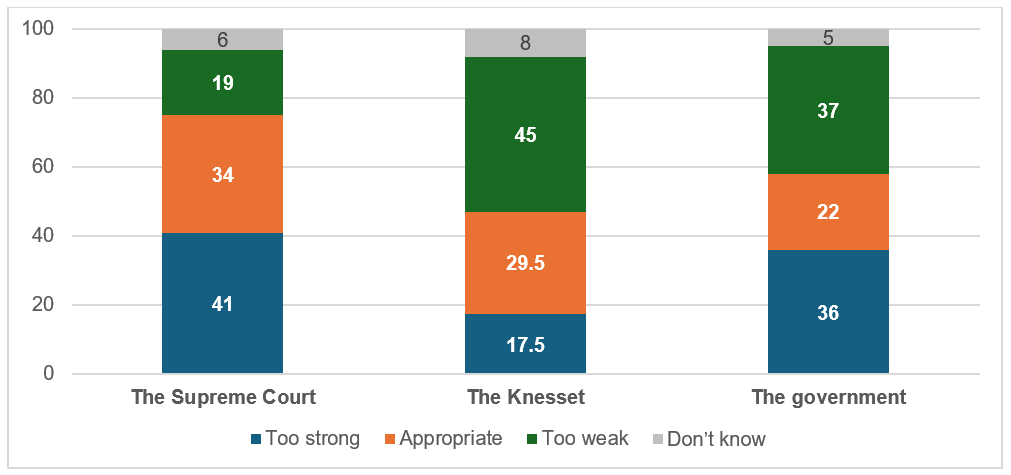
- Among Jews, the largest share think the Supreme Court is too strong, while among Arabs, the largest share consider its strength appropriate. There is broad agreement that the Knesset is too weak. As for the government, the shares of Jewish respondents who consider it too strong and too weak are almost equal, while among Arabs, the largest share think it is too weak.
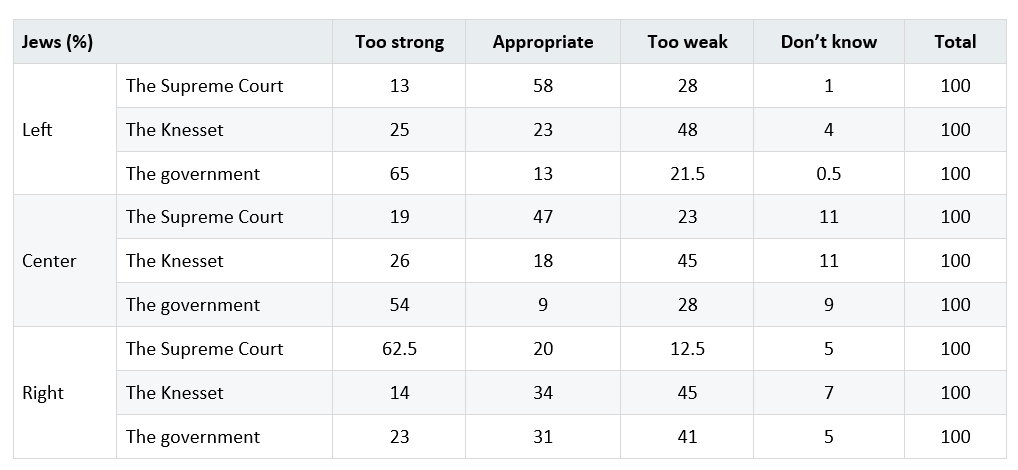
- A breakdown by political orientation (Jews) reveals that a majority on the Left consider the Supreme Court’s strength appropriate. In the Center, this is the view of the largest share, though not a majority, while on the Right, a clear majority consider the Supreme Court too strong. Across all three camps, the prevailing view is that the Knesset is too weak. As for the government, a majority on the Left and in the Center think it is too strong, while on the Right, the largest share consider it too weak.
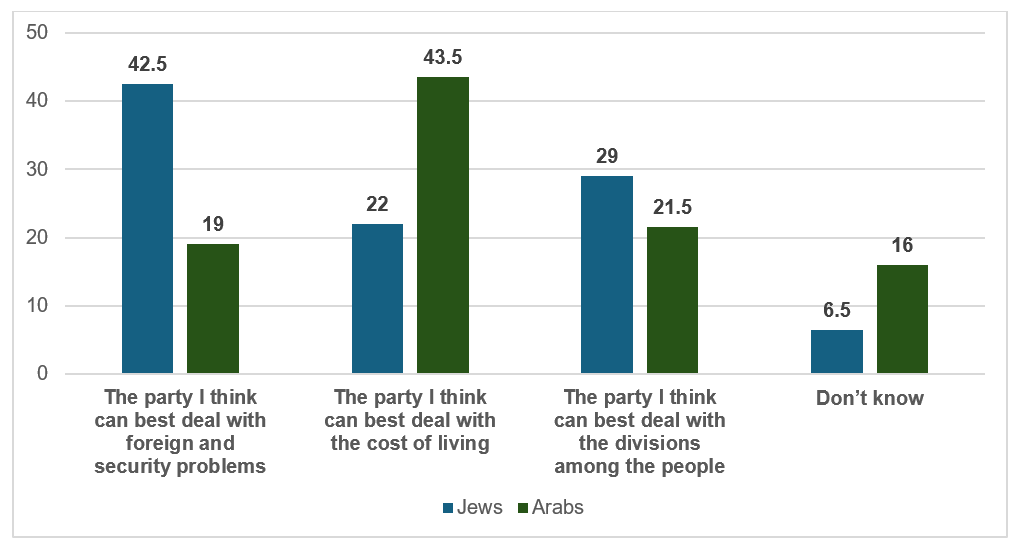
- Among Jews, the largest share say they will vote for the party they think can best address foreign affairs and security challenges. Among Arabs, by contrast, the preference is for the party they think can best address the cost of living.
Considering the various challenges facing the State of Israel, what will most influence your decision on which party to vote for? (%)
- The differences in voting considerations between the political camps (Jews) are striking: On the Left and in the Center, the largest share say they will vote for the party they think can best address the divisions among the people. On the Right, by contrast, the largest share will vote for the party they think can best address foreign affairs and security challenges.
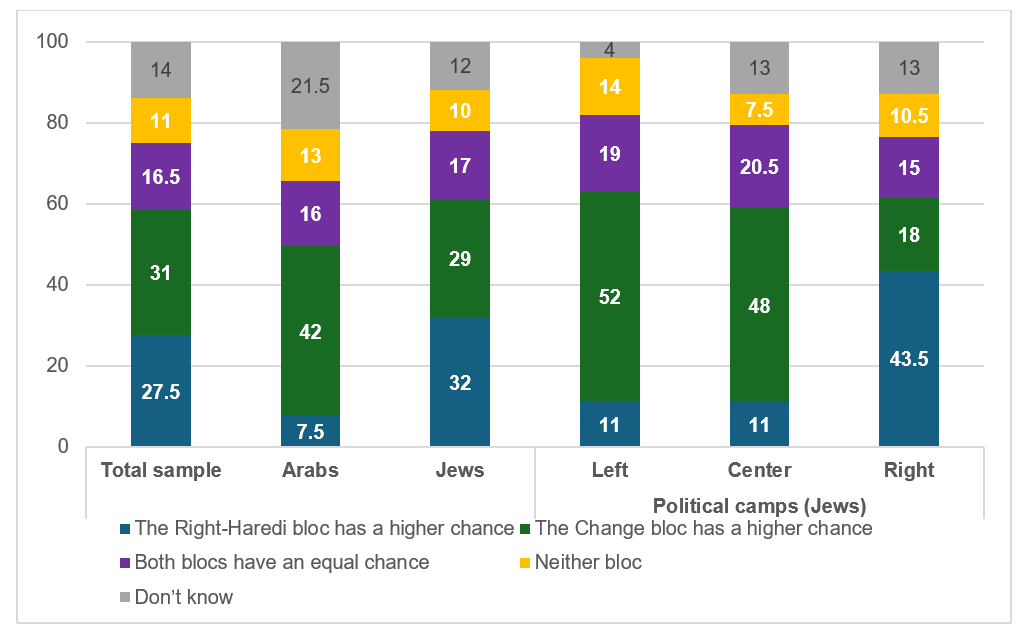
In your opinion, which of the two blocs has the higher chance of forming the next government?
- In the total sample, there is no clear view on which bloc is likely to form the government. The share who think the ‘change bloc’ has a higher chance is slightly larger than the share who think the Right-Haredi bloc does (31% and 27.5%, respectively).
- Assessments among Jews remain relatively evenly divided between the two blocs, with a slight advantage for the Right-Haredi bloc.
- Among Arabs, the prevailing view is that the ‘change bloc’ has a higher chance, while only a small minority think the Right-Haredi bloc has a higher chance.
- A breakdown by political orientation (Jews) reveals that assessments of the blocs’ chances largely align with political identity. Around half of respondents on the Left and in the Center think the ‘change bloc’ has a higher chance, while on the Right, the largest share (43.5%) think the Right-Haredi bloc has a higher chance.
In your opinion, which of the two blocs has the higher chance of forming the next government? (%)
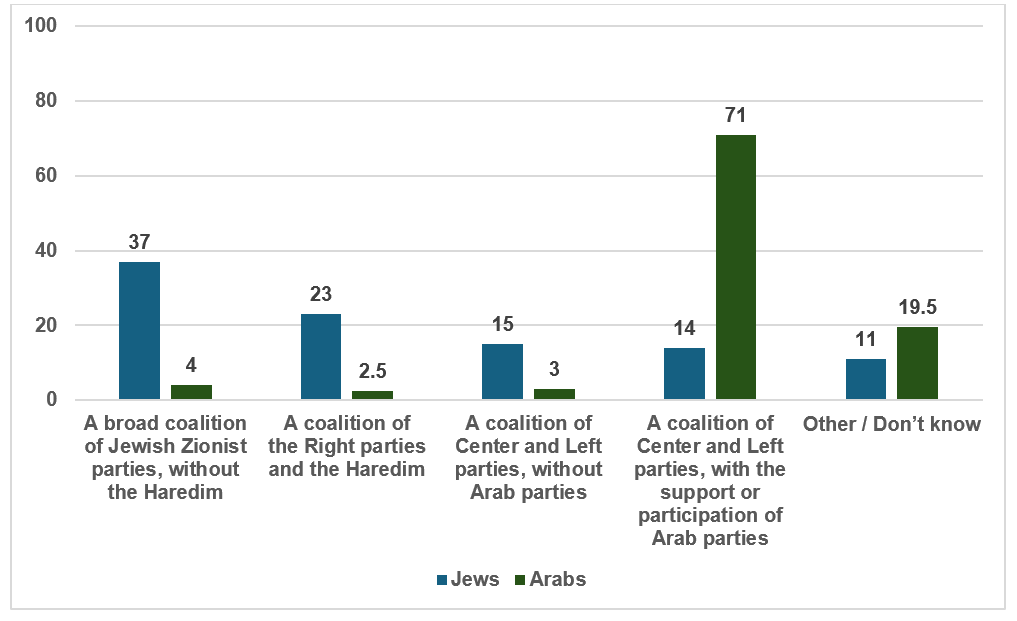
- Among Jews, the largest share would like to see a broad coalition of Jewish Zionist parties without the Haredi parties. Among Arabs, the preference is for a coalition of Center and Left parties, with the support or participation of Arab parties.
- A breakdown by political orientation (Jews) reveals a difference between the Left, where a majority (53%) prefer a coalition of Center and Left parties with the support or participation of Arab parties, and the Center and Right, where the stronger preference is for a broad coalition of Jewish Zionist parties without the Haredi parties.
After the elections, which of the following coalitions would you most want to see formed? (%)
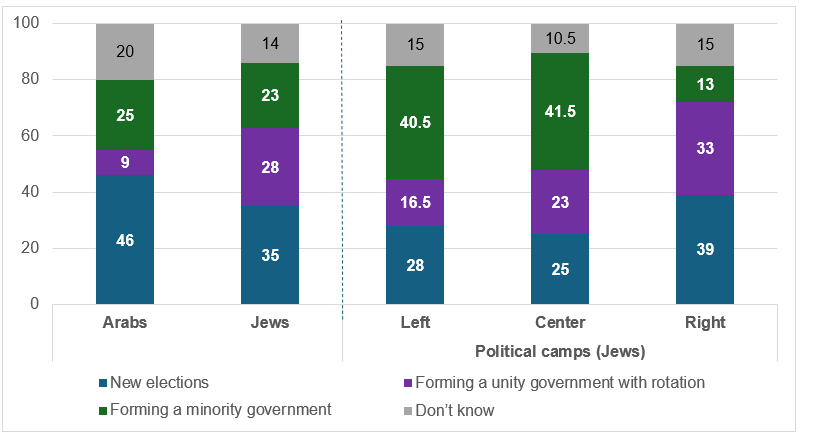
If neither side succeeds in forming a government based on a Knesset majority, which do you think is preferable?
- Among Jews, none of the alternatives commands a majority. New elections are the most popular option (preferred by more than a third), followed by a unity government with rotation. A minority government is the least preferred option.
- Among Arabs, close to half prefer new elections, a quarter prefer forming a minority government, and a small minority support forming a unity government.
- On the Left and in the Center, a minority government is the preferred option (around 41%), while a unity government with rotation is the least preferred option. On the Right, by contrast, new elections are the preferred option (around 40%), followed by a unity government, while a minority government is the least preferred option.
If neither side succeeds in forming a government based on a Knesset majority, which do you think is preferable? (%)
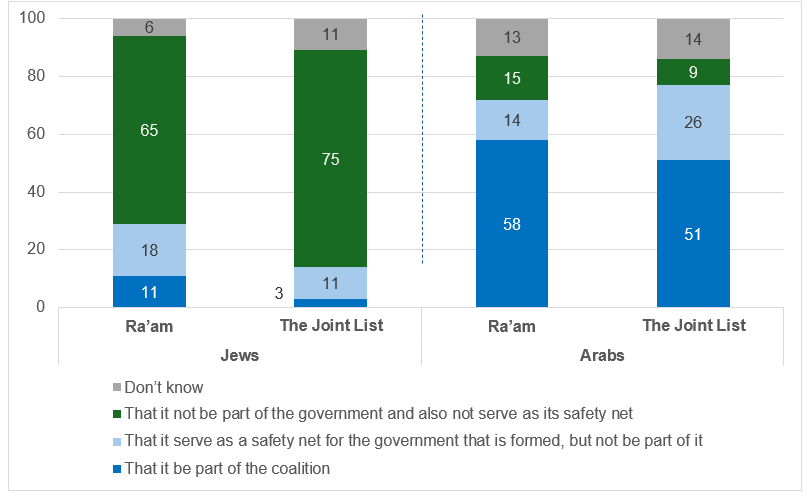
And regarding each of the Arab parties, what would you want to happen after the elections?
- A clear majority of Jews oppose either Arab party playing any role in government, although opposition to the Joint List is stronger than opposition to Ra’am. In other words, a large majority would prefer the Arab parties neither to be part of the government nor to serve as its safety net.
- Around three-quarters of Arabs would like the Arab parties to play a role, either as members of the government or by serving as a safety net from outside it.
And regarding each of the Arab parties, what would you want to happen after the elections? (%)
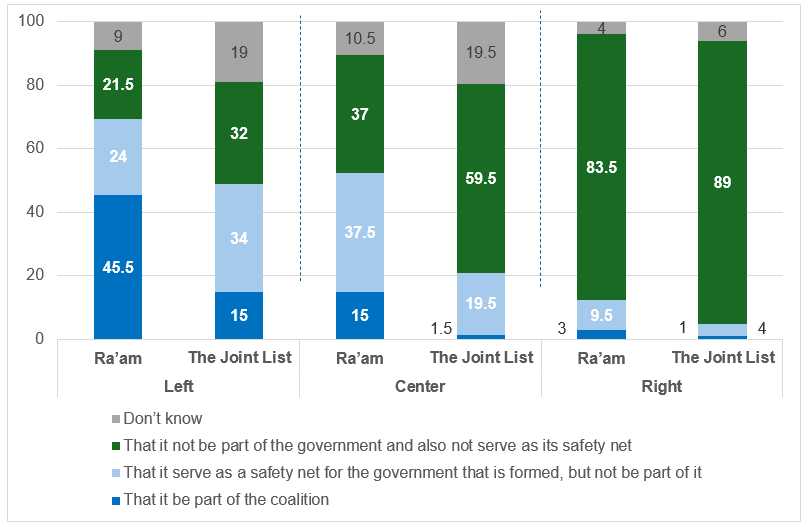
- A breakdown by political orientation (Jews) shows that acceptance of a government involving Arab parties, whether as coalition members or as a safety net, declines from Left to Right. This pattern holds for both parties. On the Left, a majority accept cooperation with Ra’am, either as a member of the government (45.5%) or as a safety net from outside it (24%), while only about a fifth oppose any involvement by Ra’am. In the Center, a small majority accept cooperation with Ra’am, though a larger share prefer it to serve as a safety net than to join the government, and the share who oppose any cooperation is much higher than on the Left. On the Right, opposition to any form of involvement by Ra’am is overwhelming.
- On the Left, and especially in the Center, willingness to include the Joint List, whether as a member of the government or as a safety net, is considerably lower than willingness to include Ra’am. On the Right, overwhelming opposition to involvement applies to both Arab parties.
And regarding each of the Arab parties, what would you want to happen after the elections? (Jews; %)
To increase the stability of the political system in Israel, do you support or oppose the head of the party that received the largest number of votes in the elections being automatically appointed prime minister?
- Around two-thirds of Jews and around half of Arabs support automatically appointing the head of the party that received the largest number of votes as prime minister.
To increase the stability of the political system in Israel, do you support or oppose the head of the party that received the largest number of votes in the elections being automatically appointed prime minister? (%)
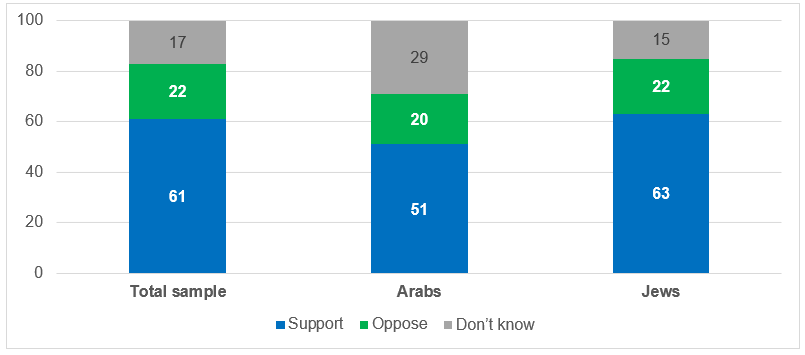
- A breakdown by political orientation reveals a rare similarity between the camps: The share of supporters is similar in all three, at 61% on the Left, 63% in the Center, and 63.5% on the Right.
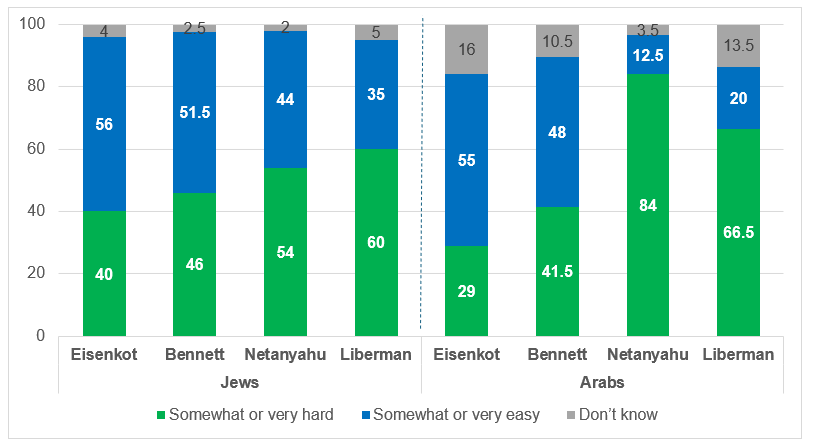
How hard or easy would it be for you to accept each of the following as the next prime minister?
- Among Jews, Gadi Eisenkot is the candidate with the broadest acceptance: A majority (56%) accept the possibility of him becoming prime minister, though a large minority (40%) would find it hard to accept him. Naftali Bennett follows closely: Around half of Jews are willing to accept him, and a slightly smaller share would find it hard to do so. More would find it hard to accept Binyamin Netanyahu as prime minister than would be willing to accept him (54% versus 44%). Last is Avigdor Liberman, whom only around a third are willing to accept as prime minister, while close to two-thirds are unwilling to do so.
- Among Arabs, Gadi Eisenkot is the only candidate whom a majority are willing to accept as prime minister, and his level of acceptance is similar to that among Jews. He also has the lowest level of rejection of all the candidates, lower even than among Jews. Naftali Bennett also enjoys a relatively high level of acceptance, at almost half, which is greater than the share who would find it hard to accept him. An overwhelming majority of the Arab public (84%) would find it hard to accept Binyamin Netanyahu as prime minister, while Avigdor Liberman is also rejected by two-thirds.
How hard or easy would it be for you to accept each of the following as the next prime minister? (%)
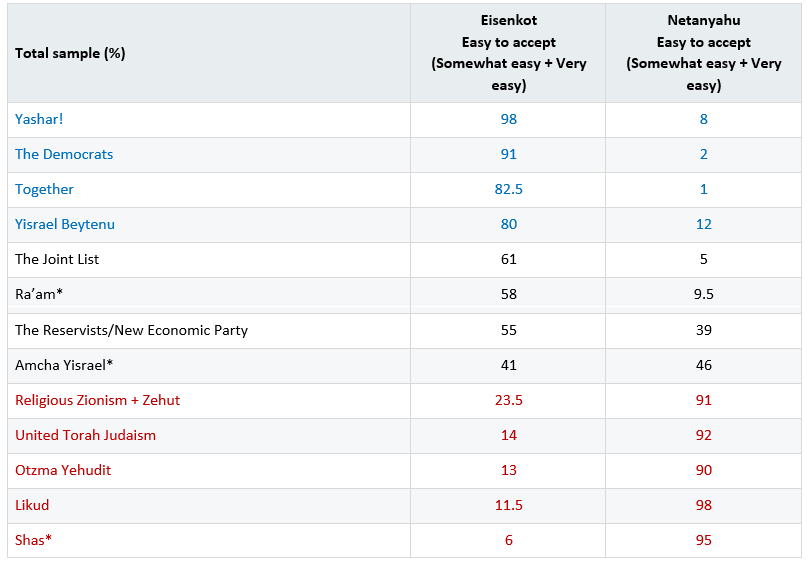
- A breakdown by voting intentions in the upcoming elections, focusing on the two current leading candidates for prime minister, Eisenkot and Netanyahu, shows that acceptance of Eisenkot is very high among those who intend to vote for parties in the ‘change bloc’ (shown in blue in the table), while acceptance of Netanyahu is minimal, ranging from 1% to 12%.
- Among those who intend to vote for parties in the current coalition (shown in red in the table), acceptance of Netanyahu is very high. Although acceptance of Eisenkot among voters for coalition parties is low, it is higher on average than acceptance of Netanyahu among voters for ‘change bloc’ parties. Those who intend to vote for Religious Zionism and Zehut stand out in particular: 23.5% accept Eisenkot.
- The Reservists/New Economic Party and Amcha Yisrael merit attention. A large share of voters for each party are willing to accept both candidates.
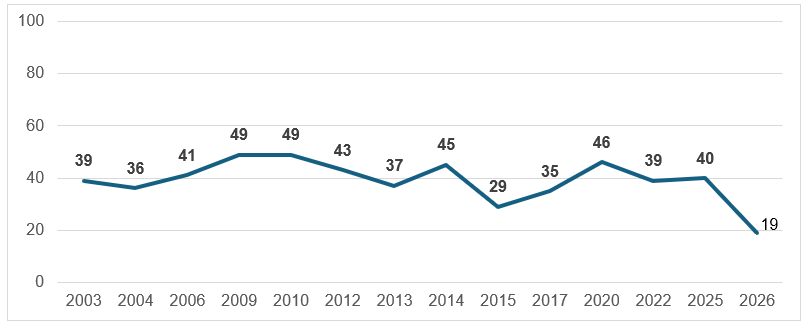
“It makes no difference who you vote for; it does not change the situation.”
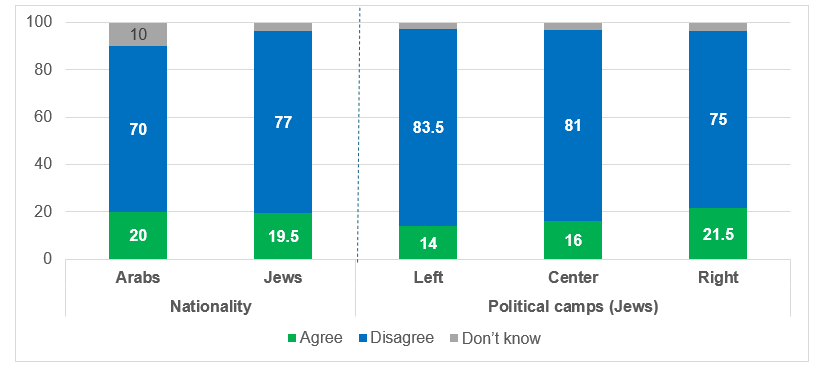
- To conclude, a note of cautious optimism. Over the years, between around a third and half of the public (29%–49%) have agreed that it makes no difference who you vote for and that it does not change the situation. The current finding is a marked departure from this pattern: Only around a fifth agree with this statement, roughly half the share measured in 2025. This may be a sign of optimism: a sense that each vote carries weight and that the current elections could affect the situation.
Agree that it makes no difference who you vote for; it does not change the situation (total sample; %)
- The share who agree that it makes no difference who you vote for and that it does not change the situation is similarly low among both Jews and Arabs, as well as across the three political camps among Jews.
To what extent do you agree or disagree that it makes no difference who you vote for; it does not change the situation? (%)
The Flash Survey on the 2026 Elections was prepared by the Viterbi Family Center for Public Opinion and Policy Research at the Israel Democracy Institute. The survey was conducted via the internet between October 18 and 21, 2026, with 601 men and women interviewed in Hebrew and 127 in Arabic, constituting a nationally representative sample of the adult population in Israel aged 18 and over. The maximum sampling error for the total sample was ±3.63% at a confidence level of 95%. Fieldwork was carried out by i-Panel. The full data file can be found at: https://dataisrael.idi.org.il.
