

What Powers Does a Caretaker Government Have?
During the period after the Knesset has been sworn in but before the government has formed, the outgoing government continues to serve in a caretaker capacity. Statutory law does not restrict the powers of the outgoing government, however, the courts can and have limited its freedom of action in certain circumstances.
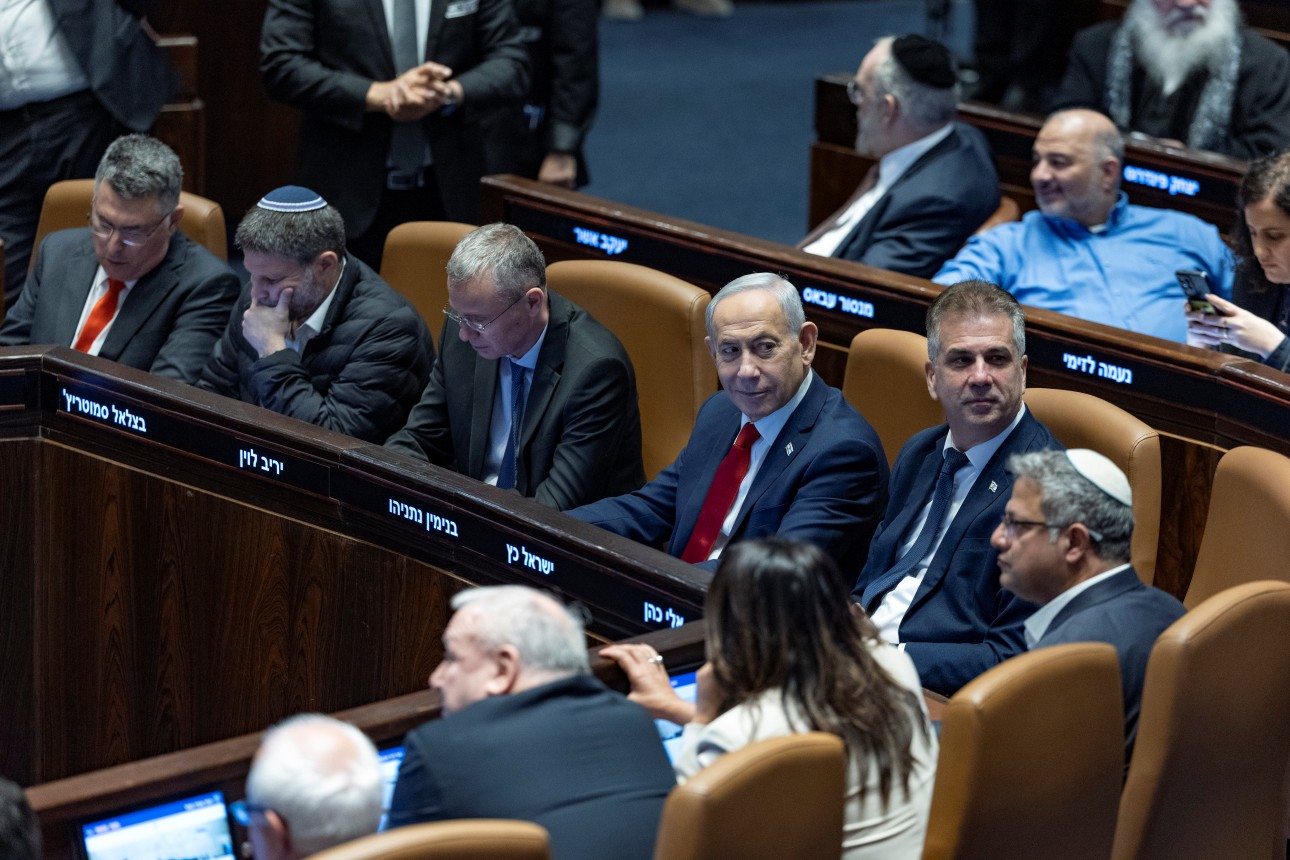
Photo by Chaim Goldberg/Flash90
The 26th Knesset has been sworn in, but negotiations to form a new government are still ongoing. The question of what the current government is permitted to do while continuing to serve in a caretaker capacity—and what it is expected to refrain from doing—is particularly important at a time when Israel may be required to confront a major security development, whether as a result of an escalation leading to military conflict or a decision to launch a military campaign.
Basic Law: The Government provides that "Upon the election of a new Knesset, or the resignation of the Government ... the outgoing Government shall continue to perform its functions until the new Government is formed." According to judicial precedent and guidelines issued by the Attorney General's Office, the restrictions that apply to a caretaker government also apply to a government serving before elections that were triggered not by its resignation, but by the dissolution of the Knesset through legislation or as a result of the failure to pass a state budget.
The law itself imposes no restrictions on a caretaker government. Section 30(b) of Basic Law: The Government simply provides that following elections or the resignation of the government, the outgoing government continues to perform its functions until a new government is formed. The term "caretaker government" does not appear in the law at all. The purpose of this provision is to prevent a governmental vacuum and ensure that there is always a government capable of functioning continuously.
In fact, the only special provision in the law actually expands the government's powers: Under Section 30(d), a caretaker government may appoint a member of Knesset as a minister to replace a minister who has ceased to serve, without obtaining the Knesset's approval.
Nevertheless, the powers of a caretaker government are not unlimited.
The Court's starting point is that a caretaker government retains all the powers of a regular government, but must exercise them with restraint. The principal precedent was established in 2001 in the Weiss v. Prime Minister of Israel case before the High Court of Justice, which concerned diplomatic negotiations conducted by Ehud Barak after his resignation. The Court established the following principles:
- A narrower scope of reasonableness: Decisions made by a caretaker government are subject to a stricter standard of reasonableness than those made by a regular government.
- A duty of restraint: The government must refrain from taking significant actions unless there is a "vital public need for action."
- A heightened duty of restraint following elections: The duty of restraint increases as elections approach and becomes even more stringent after elections, until a new government is formed.
The principles underlying these conditions suggest that restraint is particularly important when the outgoing government has lost its majority in the Knesset.
Consistent with case law and the guidelines of the attorney general, three key considerations underlie this approach:
- The government's democratic legitimacy has eroded, because it no longer enjoys the confidence of the Knesset.
- There is a risk that those in power will exploit their positions to advance political interests, for example, through election-driven economic measures before the elections or last-minute political maneuvers afterward.
- The incoming government should not be bound by long-term decisions or appointments, since it will ultimately bear responsibility for the policies implemented.
The principle that a caretaker government may act only when there is a vital need to do so applies across all areas of government activity. However, the Court has adopted an especially deferential approach toward caretaker governments in matters of foreign affairs and national security, allowing them particularly broad discretion in these areas.
In the Weiss case, the justices ruled that Prime Minister Ehud Barak was permitted to conduct diplomatic negotiations despite having resigned, in part because of a commitment that any agreement reached would be submitted to the Knesset for approval. Subsequently, the Court dismissed a petition challenging negotiations with Syria and the Palestinian Authority. In 2022, it unanimously rejected a petition against the maritime agreement with Lebanon signed by the Lapid government. The Court gave weight to the "window of opportunity" identified by security officials, as well as the fact that negotiations had been underway for years before the elections.
Precisely because the restrictions in this area are limited, it is especially important to adhere strictly to the procedural requirements governing the use of military force. Decisions to go to war or undertake actions that are highly likely to lead to war should be brought before the government or the security cabinet for approval, as required by law. Parliamentary oversight should also be facilitated.
Dismissal of Ministers
There are currently no restrictions on the dismissal of ministers by a caretaker government. The 1968 version of Basic Law: The Government prohibited a caretaker prime minister from dismissing ministers, and the Court interpreted the law at the time as also prohibiting ministers themselves from resigning. The current law (from 1992) contains no such restriction, and therefore the prime minister may dismiss ministers even while heading a caretaker government.
Appointment of Ministers
Section 30(d) allows a caretaker government to appoint a member of Knesset as a minister without Knesset approval, replacing a minister who has "ceased to serve." This authority applies only following elections or the resignation of the government, and not following the dissolution of the Knesset.
In 2019, Naftali Bennett was appointed minister of defense under this provision, replacing Prime Minister Benjamin Netanyahu, who had resigned from that ministerial position. Following petitions filed with the High Court of Justice challenging the appointment, the Court interpreted this provision for the first time and ruled that the phrase "ceased to serve" must be construed narrowly.
According to the ruling, the provision applies only when a minister leaves the government altogether, rather than when a minister vacates a particular position but remains in the government. An exception may be made in unusual circumstances in which a legal prohibition prevents a minister from holding a specific position and requires the minister to resign from that position.
According to the Court, the sole purpose of this provision is to prevent a situation in which a government ministry is left without a responsible minister.
This is the area in which the Court has imposed the most significant restrictions on caretaker governments. The rule established in the Weiss case is that a caretaker government should leave senior appointments to the incoming government unless there is a vital public need to fill a position.
Some have criticized this ruling, arguing that diplomatic negotiations, for example, may have irreversible consequences, whereas certain government appointments may have only a negligible impact.
Attorney General's Guideline No. 1.1501 elaborates on the rule established by the High Court of Justice. Senior appointments involving a search committee and ministerial participation raise legal difficulties, and it is preferable to extend an incumbent's term or appoint an acting official. Professional appointments made without political involvement are assessed according to the circumstances of each case.
- Appointment of the IDF Chief of Staff (2022): The attorney general determined that there was no legal impediment to completing the appointment on the eve of the elections, in part on the basis of classified security assessments, although she acknowledged that the move raised significant legal difficulties.
- Appointment of Meni Mazuz (2022): The High Court of Justice annulled the appointment of the retired Supreme Court justice as chair of the Senior Appointments Advisory Committee for a full eight-year term. The Court ruled that a permanent appointment during an election period is permissible only when there is a vital need to fill the position immediately and no reasonable alternative, such as a temporary appointment, is available.
In 2006, the attorney general determined that the Health Basket Committee could not make decisions until the elections to the 17th Knesset. The Court rejected a petition challenging the attorney general's decision, indicating concern that such a decision on the eve of elections could amount to a form of electoral bribery.
Attorney General's Guideline No. 1.1904 prohibits "election promises": During an election period, specific benefits or budget allocations may not be promised during election campaign visits or in connection with them. Such decisions must be made through proper procedures and in consultation with the relevant professional officials.
For example, in 2014, the attorney general expressed reservations about transferring funds to settlements and raising the minimum wage on the eve of elections. The minimum wage increase was ultimately enacted through primary legislation in the Knesset.
The questions and challenges surrounding the activities and powers of caretaker governments are common to all parliamentary democracies. In such systems, the government's legitimacy to exercise executive power derives from the confidence it enjoys in parliament. When a government must remain in office but no longer enjoys that confidence, and its democratic legitimacy has consequently weakened, the question arises as to whether, and how, it can make decisions on contentious or consequential matters.
The arrangements in most of these countries reflect two central principles:
- A caretaker government cannot resign: This is intended to prevent a situation in which the state is left without a functioning executive branch.
- Caretaker governments are required to exercise self-restraint and preserve the status quo as far as possible: They are expected to refrain from advancing policy initiatives, legislation, senior appointments, and similar measures.
In many of these countries, these are not detailed statutory provisions, but rather constitutional conventions that are regarded as binding.
