

Haredim in Israel 2050: Demographic Projections and Economic and Security Scenarios
The following is an executive summary and key findings from a full study, which can be found in Hebrew here.

Photo by Chaim Goldberg/Flash90
Executive Summary
The rapid growth of the ultra-Orthodox (Haredi) population is expected to have a dramatic impact on Israel’s economy and society, due to the group’s distinctive patterns of education and employment. Public interest in this issue has intensified in recent years following events that highlighted the influence of Haredi characteristics on Israeli society as a whole. These patterns were especially evident during the COVID-19 pandemic, the Meron disaster[1], the coalitionary demands of Haredi political parties, and the ongoing legislative attempt to exempt ultra-Orthodox men from military service during the war that broke out following October 7.
This study presents a new demographic projection based on updated data, in contrast to older projections of the Central Bureau of Statistics (CBS). In addition, the study focuses on the short- and medium-term horizon (2030–2050), rather than the long-term horizon (2065) that is the focus of studies by the Bank of Israel and the Ministry of Finance. The study also presents scenarios for a wide range of outcome variables (matriculation eligibility, military service, higher education, employment and wage levels, taxes, and GDP), unlike existing scenarios that addressed only GDP, direct taxes, and employment.
The continuation of current trends of limited social, economic and military integration of Haredim will lead to a substantial deterioration in Israel’s economy and national resilience. Maintaining the existing trends is expected to result in a matriculation eligibility rate (for the total population) that is 20 percentage points lower than the rate that would be expected if Haredim attained matriculation eligibility at a level similar to that of non-Haredi Jews; the share of individuals with an academic degree in Israel is expected to be 5.5 percentage points lower than its potential; the rate of men enlisting in the Israel Defense Forces is expected to decline by approximately 16 percentage points per cohort compared to today’s rate; and the loss to GDP resulting from the non-integration of Haredim will reach about 10%—equivalent to approximately 160 billion shekels in 2023 prices.
The findings point to an urgent need for a new, equitable “social contract” between the state and ultra-Orthodox society, which would include far-reaching changes in the education system, military enlistment, and the subsidization of the Haredi population. Decreasing the economic incentives for non-integration into Israeli society, as well as conditioning state support on the study of core curriculum subjects, military service, and the full realization of earning capacity, are necessary conditions for achieving the required changes.
Methodology
The analysis presented in this study focuses on demonstrating the implications of the expected demographic changes, as reflected in the official projection of the Central Bureau of Statistics (CBS), for a range of social and economic outcomes.
The analysis compares two scenarios:
- A scenario in which Israel's population composition changes without any change in the socioeconomic behavior patterns of any group (non-Haredi Jews, Haredim, and Arabs) (the “stagnation” scenario).
- A scenario in which the population composition changes and the ultra-Orthodox adapt their patterns of education and employment to those of the non-Haredi Jewish population. In this scenario, the education and employment patterns of non-Haredi Jews and Arabs remain unchanged (the “convergence” scenario).
Additional information about the methodology and the sources is available in Hebrew here.
Key findings
Demographics
- According to the Central Bureau of Statistics projection, the Haredi population is expected to constitute about 20% of Israel’s population by 2040 and 24.4% by 2050.
- The Israel Democracy Institute’s own projection, based on updated administrative data, estimates a slightly lower share—about 22% by 2050. However, for the purposes of this analysis, the official Central Bureau of Statistics data is used.
Bagrut (Matriculation) Eligibility
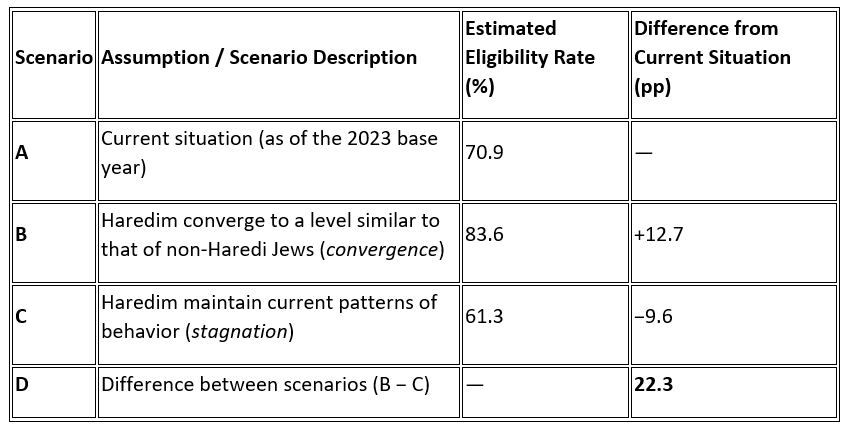
- The matriculation eligibility rate within Haredi society currently stands at only 16%. In the stagnation scenario, the overall matriculation eligibility rate in the total population will fall from 71% today to just 61.5% in 2050.
- In the convergence scenario, the eligibility rate for the total population would be 12.7 percentage points higher than the 2023 level.
- Therefore, the difference between these two scenarios is about 22 percentage points.
Estimated Matriculation Eligibility Rates at Age 18, by Haredi Integration Scenarios, 2050
Higher education
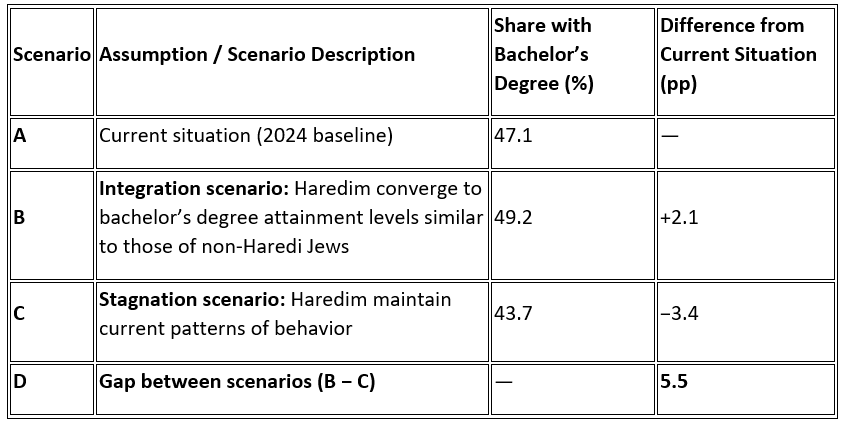
- In the stagnation scenario, the share of individuals aged 35–44 with a bachelor’s degree would be 3.4 percentage points lower than the current level.
- In the convergence scenario, the share of those with higher education in Israeli society would be 2.1 percentage points higher than the current level.
- In other words, full integration of Haredim by 2050 would lead to an increase of 5.5 percentage points in the share of individuals with higher education in Israel, relative to a stagnation scenario combined with demographic growth.
- The gap between the scenarios is driven both by the low level of higher education among Haredi men and by the low level among Haredi women. It should be noted that among ages 35–44, Haredi women are more educated than Haredi men (approximately 38% of women hold a bachelor’s degree, compared to 13% of men).
Share of Individuals with a Bachelor’s Degree (Ages 35–44), by Haredi Integration Scenarios, 2050
Employment
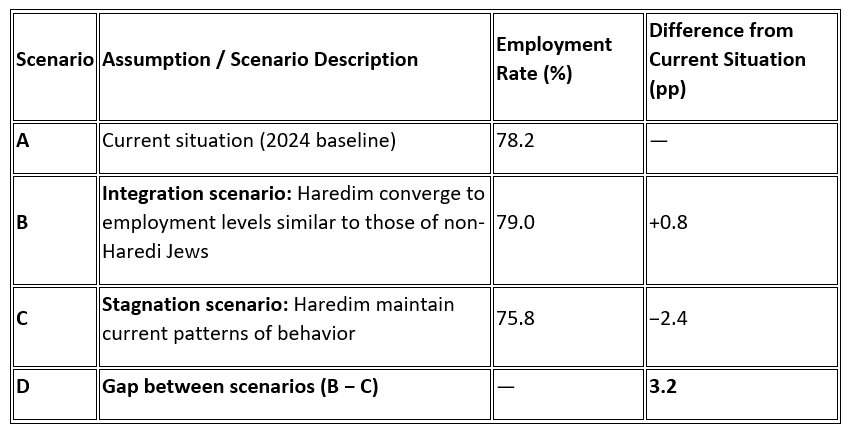
- In the stagnation scenario, the employment rate would be 2.4 percentage points lower than the current level.
- In the convergence scenario the employment rate would be 0.8 percentage points higher than the current level.
- It follows that full integration of Haredim by 2050 would lead to an increase of approximately 3 percentage points in Israel’s employment rate.
- The main gap between the scenarios is driven by the behavior of Haredi men, whose employment rate in 2024 is very low (53.9%) and who would need to increase their employment by more than 30 percentage points in order to match non-Haredi Jewish men.
- Haredi women, by contrast, already exhibit employment rates similar to those of non-Haredi Jewish women, although their employment volume (in terms of monthly working hours) and the quality of their employment are lower relative to the comparable group.
Employment Rate in Israel under Alternative Haredi Integration Scenarios, 2050
Taxes
- In the stagnation scenario, the average monthly net transfers from households to the state—namely, taxes paid by households minus the cost of services and transfer payments—would be lower by 1,000 shekels, or about 25% of the taxes paid today.
GDP
- The loss of potential in terms of GDP per capita resulting from the non-integration of Haredim could reach more than 10%, equivalent to approximately 160 billion shekels in 2023 GDP terms.
- The expected changes in population composition, and the differences between population groups in patterns of education and employment, are expected to translate into changes in average and total income from work, and therefore also into changes in GDP.
IDF Service
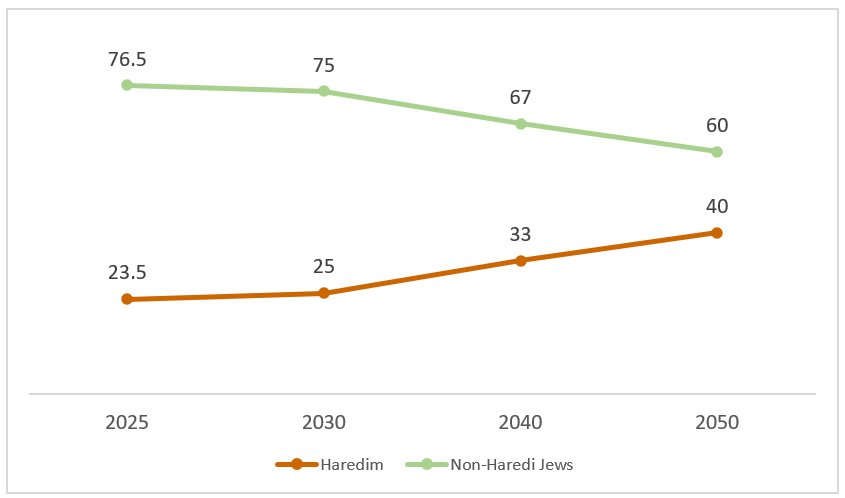
- Today, Haredim constitute 23.5% of all those designated for military service, and their share is expected to rise to 25% by 2030, to 33% in 2040, and to 40% by 2050.
- Mandatory service by Haredi men at levels comparable to those of non-Haredi men (convergence scenario) would allow the shortening of compulsory service by 11 months in 2050.
- Shortening compulsory service would have an economic effect as well – the result of such a change would amount to approximately 1% of GDP per year.
- The economic cost of a reservist is estimated to be 1.8 times that of a regular-service soldier; therefore, the contribution to GDP from replacing reservists with Haredim serving in regular service is substantial and could approach 2% of GDP.
- Due to demographic growth, in the case of continued non-enlistment trends among Haredi men, expected decline in enlistment rates would result in only 45% of 18-year-old men in Israel and about 30% of women being expected to serve in the military.
Projected share of 18-year-olds eligible for military service, by sector (2025-2050, %)
[1] The Meron disaster was a crowd crush in the annual pilgrimage to the Mount Meron in 2021 in which 45 people were killed, some of them children and most of them ultra-Orthodox. The disaster was determined by a state commission of inquiry to be a preventable result of the exceptional and persistent negligence in the security arrangements of the pilgrimage event, partly as a result of political pressures from ultra-Orthodox political interest to resisting any changes to the management of the pilgrimage.