

Women’s Representation in Israeli Politics: Analysis for 2026
The impressive improvement in women's representation in the Knesset that was seen between 1999 and 2015 has halted in the past decade. This is true in government as well, where the representation of women is actually regressing rather than improving compared to the previous government, and is particularly low compared to other democracies.
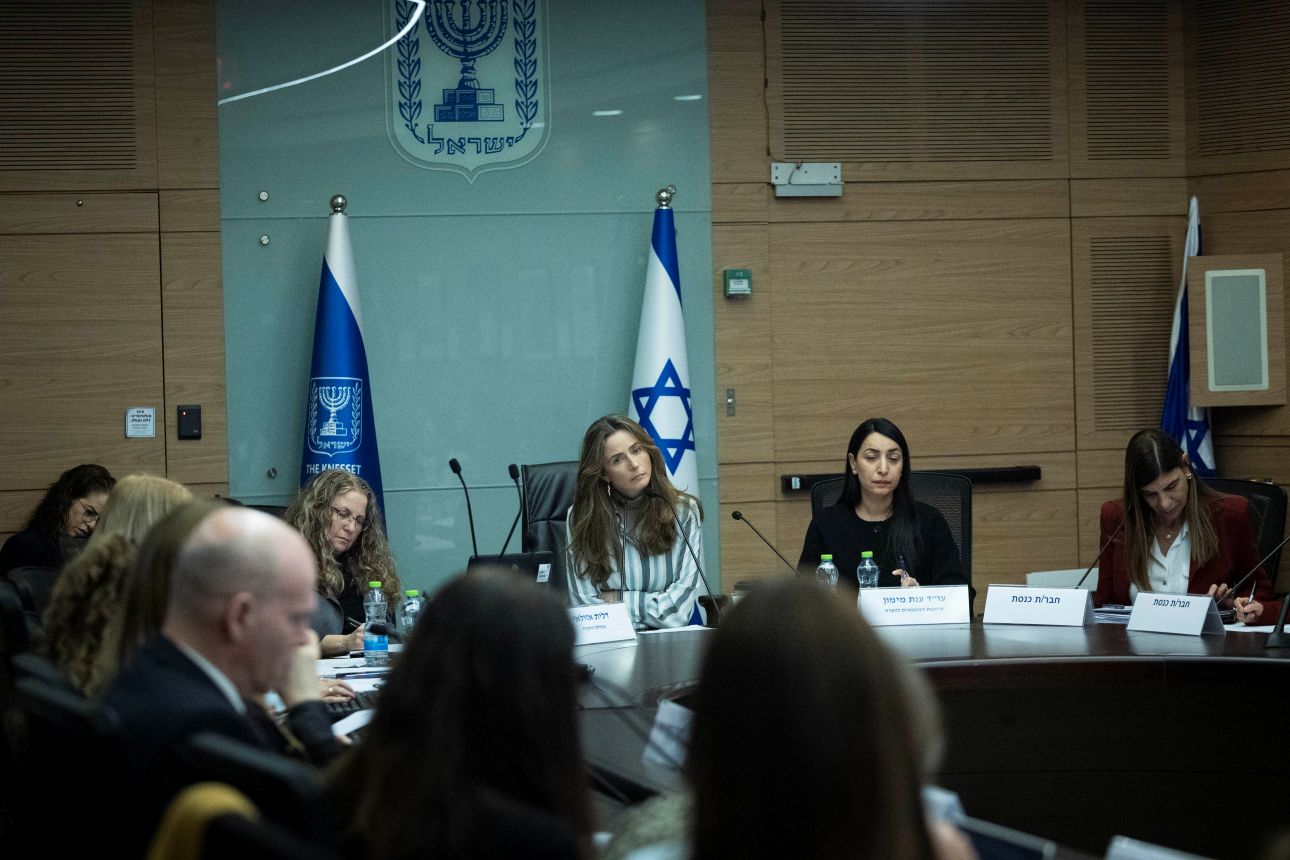
Photo by Yonatan Sindel/Flash90
The topic of women’s representation in the political arena remains a key topic in political science research and literature. The fundamental axiom at the basis of this discourse is the critical importance of a significant presence of women in political roles: it is not just a quantitative matter, but rather an essential building block of a fair, equal, inclusive society. Such representation strengthens the status of women in the public sphere, encourages perceptions of civic equality, and challenges entrenched gender stereotypes.
Moreover, since women constitute about half of the population, from both a democratic and normative perspective, their voice and experience should be equally represented in decision making. The presence and visibility of women in leadership positions also plays an important cultural and educational role, creating role models for girls and young women, inspiring them to take on leadership roles and helping to shape a generation that recognizes women in power as a natural state of affairs.
Many indicators show that women's representation in politics has been continuously improving since the beginning of the 21st century. In 2005, there were only two countries in which the proportion of women among all members of parliament exceeded 40%. Ten years later (2015), there were 13 such countries, and as of the beginning of 2026, there are 30 countries. There has also been increasing cases of cabinets with gender balance, that is, those consisting of an equal (or nearly equal) number of men and women serving as ministers.
Nonetheless, only a few countries have completely closed the gender gap, and the situation in Israel is not promising, to say the least. The increase in the representation of women in Knesset between 1999 and 2005 has halted—in the last decade, the proportion of women in Knesset has remained stagnant at around a quarter of Knesset members. In other political arenas, such as the cabinet and local government, women's representation is also faltering, especially compared to other democracies. The following analysis examines the representation of women in politics in Israel from a comparative perspective.
Women at the Highest Level of Leadership
The number of women who have held their country’s most senior political position, prime minister or president (in presidential systems) has increased significantly over the last two decades. Today, women hold the most senior position in seven of the 38 OECD countries. These include Sanae Takaichi in Japan, Giorgia Meloni in Italy, Claudia Sheinbaum Pardo in Mexico, and Mette Frederiksen in Denmark. As can be seen in the Table, since 2012 more than half of the OECD countries (24 out of 38) have had a woman prime minister or president. This list includes countries where this was the first time that the glass ceiling had been broken (e.g., Italy, Japan, Austria, Sweden), and others where women had previously reached the top (UK, Canada, New Zealand). In 10 of the 38 OECD countries, no woman has yet held the most senior position, including in the United States, where the first two female Democratic presidential candidates lost to Donald Trump: Hillary Clinton in 2016 and Kamala Harris in 2024.
The Last Time a Woman Held a Senior Position* in the 38 OECD Countries
|
Country |
Name |
Year |
|
Italy |
Giorgia Meloni |
Incumbent |
|
Iceland |
Kristrún Frostadóttir |
Incumbent |
|
Denmark |
Mette Frederiksen |
Incumbent |
|
Japan |
Sanae Takaichi |
Incumbent |
|
Latvia |
Evika Siliņa |
Incumbent |
|
Lithuania |
Ingrida Šimonytė |
Incumbent |
|
Mexico |
Claudia Sheinbaum |
Incumbent |
|
Switzerland |
Karin Keller-Sutter |
2025 |
|
Estonia |
Kaja Kallas |
2024 |
|
Finland |
Sanna Marin |
2023 |
|
New Zealand |
Jacinda Ardern |
2023 |
|
United Kingdom |
Liz Truss |
2022 |
|
Sweden |
Magdalena Andersson |
2022 |
|
Norway |
Erna Solberg |
2020 |
|
Germany |
Angela Merkel |
2020 |
|
Belgium |
Sophie Wilmès |
2020 |
|
Austria |
Brigitte Bierlein |
2020 |
|
Chile |
Michelle Bachelet |
2018 |
|
Poland |
Beata Szydło |
2017 |
|
South Korea |
Park Geun-hye |
2016 |
|
Slovenia |
Alenka Bratušek |
2014 |
|
Costa Rica |
Laura Chinchilla |
2014 |
|
Australia |
Julia Gillard |
2013 |
|
Slovakia |
Iveta Radičová |
2012 |
|
Turkey |
Tansu Çiller |
1996 |
|
Canada |
Kim Campbell |
1993 |
|
Portugal |
Maria de Lourdes Pintasilgo |
1980 |
|
Israel |
Golda Meir |
1974 |
|
Never in history |
|
|
|
Ireland |
|
|
|
United States |
|
|
|
Netherlands |
|
|
|
Hungary |
|
|
|
Greece |
|
|
|
Luxembourg |
|
|
|
Spain |
|
|
|
Czech Republic |
|
|
|
France |
|
|
|
Columbia |
|
|
*Includes Prime Ministers or Presidents for presidential democracies (ceremonial presidents are not included in the list).
Israel was one of the first countries in which a woman held the most senior political position. When Golda Meir was named Prime Minister in 1969, she was only the third woman in the world to have reached that position. However, since her resignation in 1974, all ten Israeli prime ministers have been men.
Women in the Knesset
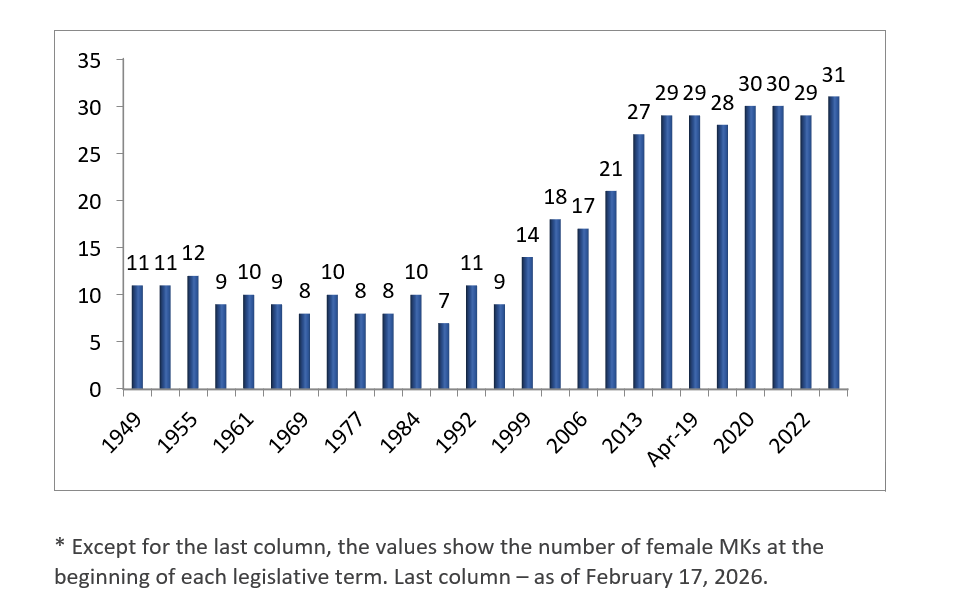
As of today (March 2025) 31 women serve in Knesset. This is a higher level of representation compared to the distant past, but it also reflects stagnation. As can be seen in the figure below, the first three Knesset elections produced a Knesset with about 10% women. After that, over the course of four decades until 1999, the number of women in the Knesset was consistently low, ranging from a low of seven (1988) to a high of 11 (1992). There was a sharp rise in the number of female Knesset members between 1999 and 2015, but since then there has been no significant change. In the last five elections, the number of women elected has ranged between 28 and 30.
Women in the Knesset: The number of Female MKs
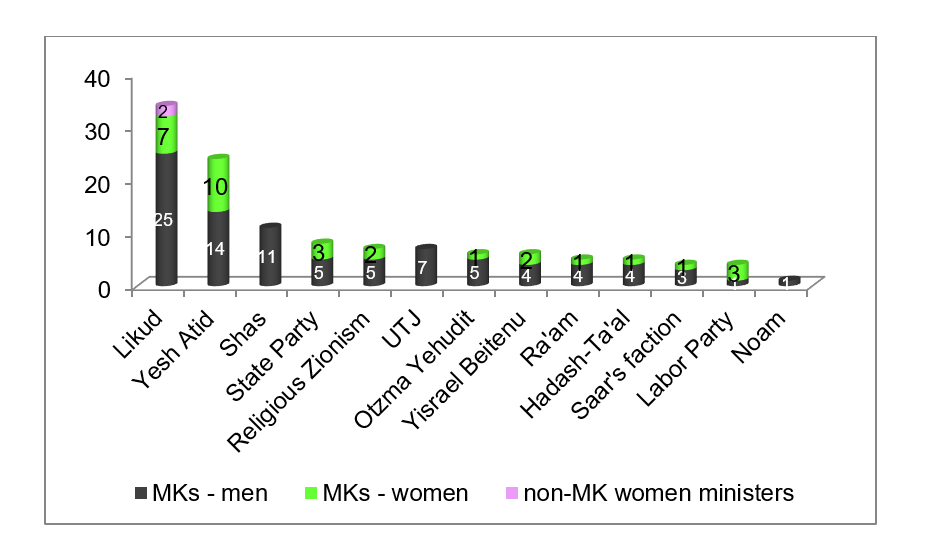
The parliamentary party that currently has the highest representation of women is Yesh Atid, with 10 female MKs. There are 7 women in The Likud, to which we can also add Ministers Miri Regev and Idit Silman, both of whom resigned from Knesset under the "Norwegian Law." In relative terms, the party with the highest proportion of women in Knesset is the Labor Party, in which three of the party's four MKs are women. It's worth noting that at this point in time, and ahead of the upcoming elections, there is not a single woman in the position of party leader. By comparison, just over a decade ago, three women served as party leaders: Tzipi Livni (Hatnua), Zehava Golan (Meretz) and Shelly Yachimovich (Labor).
Women in Israeli Politics by Party
Is the percentage of women in Knesset low or high compared to other countries? A comparison shows that Israel ranks 95 out of 185 countries in such a comparison. If we restrict the comparison to OECD countries, we find that Israel now ranks at 31. This means that only 7 other OECD countries have lower women's representation than Israel.
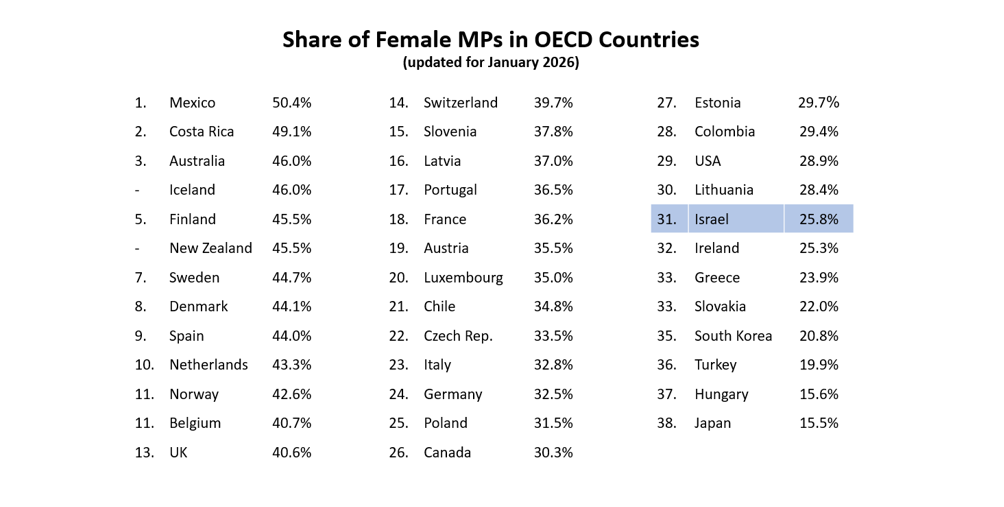
The slowing in the increase of women representation in Knesset over the last decade distances Israel from the rest of the OECD countries, in most of which the increase in female representation continued at an impressive pace during this period. In other words, although female representation in Knesset has not weakened, the gap with the OECD average has actually increased. While in 2015 the gap narrowed to a level of about 5%, today this gap has widened again to about 9%.
Women in Government
Until 1974, Golda Meir was the only woman to serve in an Israeli Government. She was followed by Shulamit Aloni (1974), Sarah Doron (1983), Shoshana Arbeli (1986), and Ora Namir (1992). Thus, only five women have held a ministerial position until 1996. Since then, another 27 women have been appointed to ministerial positions.
Each of the two previous governments recorded a new high in female membership. The 35th Government (the Netanyahu-Gantz Government) formed after the elections in 2020, began its term with a record number of eight women as ministers—double the previous high. Until then, no more than four women had ever served in the Government at the same time. The 36th Government (the Bennett-Lapid Government) broke this mark and included nine women, or one-third of the total ministers. As shown in the table below, the current Government represents a sharp retreat from these peaks: women currently make up only 5 of the 24 members of government (less than 21%). Even this figure is somewhat misleading in the broader political context – until the resignation of the ultra-Orthodox ministers, the proportion of women in government was even lower.
Women in the Last Three Cabinets
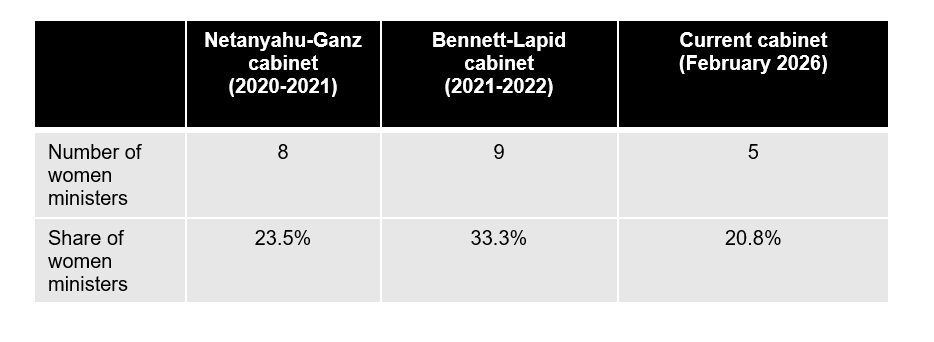
When considering women's representation in the Government, we should go beyond the dry numbers. Even if more women than in the past are appointed to ministerial positions, they are generally not appointed to the more prestigious ministries. Only two women have ever served as Ministers of Foreign Affairs: Golda Meir (1956–1966) and Tzipi Livni (2006–2009). No woman has ever held the other two most prestigious portfolios—Defense and Finance. Over the last 17 years, not a single woman has served in any of Israel's most senior political positions—Prime Minister, Defense Minister, Finance Minister, Foreign Minister.
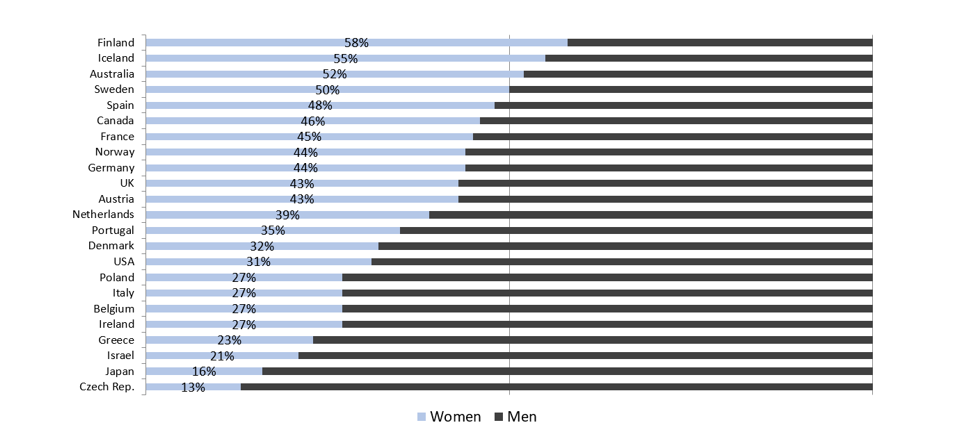
Furthermore, even if there has been an improvement in the number of women in Israeli governments, the change has been slower than that in many democracies. In some, not only has the number of women increased, but there are also instances of gender parity or even a female majority in the government. As can be seen in the figure below, the current governments of Finland, Iceland, and Australia have a female majority. In Canada, Sweden, and Spain, their number is equal or almost equal to that of male ministers. In contrast, there are countries where the government remain mostly men: in the Czech Republic, only 13% of government members are women, and in Japan - only 16% (though there is currently a woman serving as prime minister).
Cabinet Composition – by Gender
Conclusion
After many years of an upward trend, women’s presence in the Israeli political arena is now in a stagnant trend, and the rise in their parliamentary representation has been halted. The peak reached in the Bennett-Lapid Government has been followed by a significant decrease in female membership in the current Government. In other respects as well, female representation is faltering. For example, in local government, the percentage of women elected to the position of head of authority (mayors, heads of local and regional councils) jumped in the 2018 elections to a record level of 5.6%. However, in the recent local elections (2024), this percentage increased only slightly to 5.8%. Finally, despite a High Court of Justice ruling that the government was violating the law by not appointing any women directors general in government ministries, there has been not a single woman has been appointed.