

Executive Summary: Subsidizing the Haredi Sector in the Cost of Military Security and How It Can Be Reduced
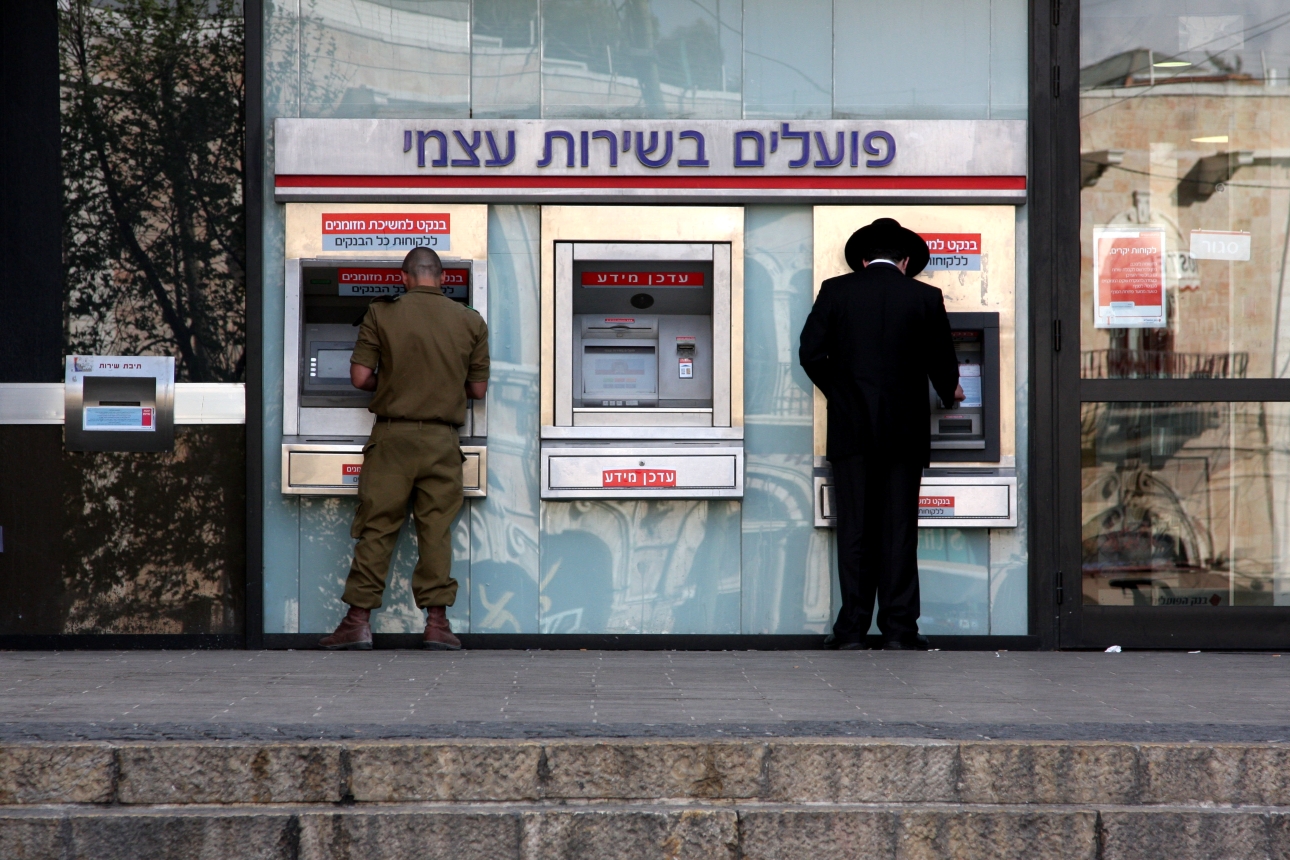
Photo by Daniel Dreifuss/Flash90
This is an executive summary of a study published in Hebrew, to be presented at the Israel Democracy Institute's Eli Hurvitz Conference.
Background and Purpose
Military security is a classic public good: all citizens benefit from it, and no group can realistically be excluded from the protection it provides. Yet the burden of producing and financing this public good is not shared equally. In Israel, the non-Haredi Jewish public bears a disproportionate share of both the fiscal cost of military security and the personal-economic cost of compulsory and reserve service.
This imbalance is part of a broader pattern of inter-sectoral subsidy in Israel, in which the non-Haredi Jewish sector finances public goods and services from which the Haredi sector benefits disproportionately. Previous studies have focused primarily on visible government spending, including the defense budget. The present analysis adds a further dimension: the hidden, non-budgetary costs of military security, especially those borne by compulsory soldiers, reservists, and employers of reservists.
The focus is on the Haredi sector. Although Arab society is also significantly subsidized in relation to military-security spending, its case is not analyzed in depth because the civic, national, and institutional context of Arab non-service differs fundamentally from that of the Haredi population.
Methodological Approach
The calculations proceed in two stages.
First, the total annual cost of military security is estimated by combining visible and hidden costs. The visible cost is defined narrowly as the Ministry of Defense budget and the budget under the Discharged Soldiers Law. Other security-related budgets, such as the Shin Bet, Mossad, Ministry of National Security, and Israel Police, are excluded in order to focus on direct military costs and use a transparent, comparable measure.
Second, these costs are allocated across three population groups: non-Haredi Jews, Haredim, and Arabs. The value of the security benefit is allocated according to each group’s share of the population, because the benefit of protection is assumed to be equal for every person. The cost burden is allocated differently according to the type of cost: visible costs are allocated according to tax contribution, while hidden costs are allocated according to actual participation in compulsory and reserve service and according to the estimated burden borne by employers of reservists.
The hidden-cost calculation includes three main components:
- Underpayment during compulsory service. The actual cost of soldiers during compulsory service is compared with the estimated cost of employing equivalent soldiers under a professional, voluntary army model. This benchmark is methodological rather than normative; it is not presented as a recommendation to move to a professional army.
- Long-term income losses after service. Compulsory service may delay entry into higher education, vocational training, and the labor market, thereby reducing lifetime earnings. The central estimate assumes that this loss applies to half of compulsory soldiers, while the other half either do not suffer such a loss or gain relevant skills from service.
- Uncompensated employer costs from reserve duty. Reservists are generally compensated in relation to their income, but employers are not fully compensated for the loss of capital productivity when employees are absent for reserve service.
The estimates are conservative. Several additional costs are not included, including some long-term employment effects on reservists, harm to spouses’ employment, personal out-of-pocket costs, and the full economic cost of physical and psychological injury.
Key Findings
1. The total annual cost of military security is estimated at approximately NIS 148 billion
The current annual cost of military security is estimated at approximately NIS 147.7–148 billion, equivalent to about 24% of the state budget. This total consists of approximately NIS 117.3 billion in visible annual military-security costs and approximately NIS 30.4 billion in hidden costs.
2. Visible defense costs rose sharply after the Swords of Iron War
Before the war, between 2010 and 2022, the annual cost of military security averaged about NIS 62.5 billion. After the outbreak of the Swords of Iron War, defense costs increased dramatically. The relevant actual or planned figures are NIS 156.3 billion in 2024, NIS 151.9 billion in 2025, and approximately NIS 148.2 billion in 2026 after budget changes.
For the coming decade, the Nagel Committee’s defense-budget trajectory serves as a central reference point, but it is treated as likely to underestimate future costs. The updated projection places visible military-security costs at an average of NIS 117.3 billion per year in 2027–2034, an increase of roughly 88% compared with the pre-war average.
3. Hidden military-security costs are estimated at approximately NIS 30.4 billion annually
Hidden annual costs are estimated at NIS 30.4 billion, or roughly one-fifth of total military-security costs. This figure consists of:
- NIS 18.4 billion from the gap between the actual cost of compulsory soldiers and the estimated market-equivalent cost of employing equivalent soldiers in a voluntary professional model.
- NIS 8.4 billion from long-term income losses due to delayed entry into education, training, and the labor market.
- NIS 3.5 billion from uncompensated capital losses borne by employers of reservists.
A sensitivity analysis places the hidden-cost estimate in a range of NIS 25.5–35.5 billion, depending on assumptions about the size of the standing army, the expected personnel reduction in a professional-army benchmark, the share of soldiers whose future earnings are affected, the discount rate, and future reserve-duty costs.
4. The Haredi subsidy in military-security costs is estimated at NIS 14.9 billion per year
The Haredi sector receives an estimated NIS 14.9 billion annual subsidy in the field of military security alone.
Haredim constitute roughly 14% of the population and, under the equal-benefit assumption, receive military-security protection valued at about NIS 21 billion annually. Their contribution to financing those costs is estimated at only about NIS 6 billion.
The subsidy has two components:
- NIS 11.2 billion in visible budgetary subsidy, stemming from the gap between the Haredi population share and the Haredi share of tax contributions.
- NIS 3.8 billion in hidden subsidy, stemming mainly from low participation in compulsory and reserve service.
5. The visible subsidy equals approximately NIS 51,800 per Haredi household per year
Haredim account for 14.2% of the population excluding foreign residents, but only 4.7% of the tax burden. Since the defense budget is funded through general taxation, this gap produces a visible military-security subsidy of NIS 11.2 billion.
Divided across Haredi households, this equals an average annual subsidy of approximately NIS 51,800 per Haredi household, or about NIS 4,300 per month, in military-security spending alone.
6. The hidden subsidy is borne overwhelmingly by non-Haredi Jewish conscripts, reservists, and employers
Non-Haredi Jews account for 96.1% of compulsory-service personnel, while Haredim account for only 2.8% and Arabs for 1.2%. The long-term income-loss component is assigned fully to non-Haredi Jews, because minority groups such as Haredim and Arabs may benefit economically from service and therefore are not assigned post-service income losses. For reserve-service employer costs, almost all of the burden is assigned to Jewish-owned businesses, with only a small share assigned to Haredi and Arab-owned businesses.
The Haredi sector bears only about NIS 560 million of the hidden cost, while receiving hidden security value estimated at about NIS 4.3 billion. The hidden subsidy is therefore estimated at NIS 3.8 billion annually.
The compulsory-service portion of this hidden subsidy—estimated at NIS 3.3 billion out of the total NIS 3.8 billion hidden subsidy—is projected onto Haredi young people who do not serve. This projection yields an estimated NIS 72,000 per year of service, or approximately NIS 220,000 for a full service period, for each Haredi young man who avoids service or Haredi young woman who is exempt from service.
7. The imbalance is intensified by broader benefit structures
The economic imbalance is especially stark because non-Haredi conscripts and reservists absorb direct and indirect economic losses, while Haredi men who do not enlist may also receive sector-specific benefits. A Ministry of Finance estimate cited in the research places the lifetime value of benefits to a kollel student at up to NIS 1.5 million, including stipends, daycare subsidies, municipal-tax discounts, and other supports.
8. Demography and rising defense needs make the current model increasingly unsustainable
Historically, the subsidy was smaller because the Haredi population was smaller, Haredi male employment was higher, and Haredi exemptions were more limited. Today, Haredim constitute about 14% of the population and about 24% of 18-year-old pre-enlistees, while their tax contribution remains low and their participation in military service remains limited.
Two trends make the issue urgent: the sharp long-term rise in defense costs after October 7, and the rapid demographic growth of the Haredi population. The status quo is therefore not only a matter of civic unfairness, but a structural economic arrangement that is not sustainable.
Policy Alternatives
The analysis presents possible tools in three complementary circles and estimates their likely fiscal impact. It does not select a single preferred package, but rather outlines policy alternatives for reducing the inter-sectoral subsidy.
First circle: Haredi draft evaders
This circle focuses on Haredi men who are legally obligated to serve but do not enlist. Meaningful change requires a general duty of service for Haredi men, with only a narrow exemption for outstanding Torah scholars, together with enforcement, a proposed one-time financial sanction of up to NIS 100,000 for draft evaders, and the cancellation of economic benefits for kollel and yeshiva students who evade service, including public funding linked to yeshiva or kollel status, daycare subsidies, housing benefits, municipal-tax discounts, and related supports.
In an illustrative scenario in which Haredi enlistment reaches half the enlistment rate of non-Haredi Jewish men, the estimated reductions in the subsidy are:
- NIS 820 million from increasing the number of Haredi soldiers.
- NIS 600 million from financial penalties on draft evaders, based on a proposed sanction of up to NIS 100,000 per draft evader in the illustrative scenario analyzed..
- NIS 357 million from denying benefits to draft evaders, including benefits tied to yeshiva or kollel status and other economic supports.
Together, these measures would reduce the subsidy by approximately NIS 1.777 billion.
Second circle: People exempt from service
This circle addresses citizens who are exempt from military or civilian service for non-medical reasons. Two main tools are examined:
- A Military Service Exemption Tax of 3%–5% on income during service-age years, modeled on the Swiss approach. Applied to Haredi women, the potential revenue is estimated at NIS 490–810 million annually.
- Cancellation or reduction of basic income-tax credit points for those who do not bear the service burden. Under current child tax-credit rules, this would add about NIS 170 million from Haredi women; under an earlier child-credit structure, the revenue effect would be substantially larger.
Together, the measures in this circle could reduce the subsidy by NIS 660–980 million.
Third circle: General population and sectoral benefits
This circle addresses the broader fiscal structure, not only service status. Two major tools are presented:
- A general National Defense Tax, structured regressively and tied to the defense budget. As an illustration, a monthly levy of NIS 120 per person would raise about NIS 14 billion, including about NIS 2 billion from the Haredi sector, and would reduce the inter-sectoral subsidy by about NIS 1.3 billion.
- Cancellation of direct Haredi-sector benefits, including yeshiva and kollel funding, daycare subsidies for avrechim, reduced National Insurance and health-insurance payments for yeshiva students and avrechim, and related supports. Excluding benefits already counted under the draft-evader circle, the subsidy reduction is estimated at about NIS 1.36 billion.
Together, the general-circle measures are estimated to reduce the subsidy by about NIS 2.66 billion.
Additional tax and enforcement reforms are also identified, including stronger enforcement against unreported income, conditioning benefits on earning-capacity utilization, reassessing child tax credits, and examining the progressivity of labor-income taxation. These issues require separate treatment in other research.
Overall Policy Impact
Combining the policy tools across the three circles could reduce the Haredi military-security subsidy by approximately NIS 5.1–5.4 billion per year, or about 34% of the total subsidy estimated in the research. In other words, the proposed measures could reduce the subsidy by roughly one-third, but most of the subsidy would remain unaddressed without additional, broader measures.
Bottom Line
Israel’s military-security burden is no longer only a question of civic fairness or military manpower. It is also a major structural economic issue. The Haredi sector receives approximately NIS 14.9 billion per year in military-security subsidy, while the non-Haredi Jewish public bears most of the tax burden, compulsory-service burden, reserve-service burden, and related hidden economic costs.
Reducing this imbalance requires a new policy framework combining three types of measures: enforceable Haredi conscription and sanctions for evasion; targeted taxation or reduced tax benefits for those exempt from service; and broader fiscal reforms that reduce sector-specific benefits and distribute the cost of military security more evenly. Such a framework is necessary for a more sustainable and equitable Israeli civic contract in light of the post–October 7 rise in defense needs and the continued demographic growth of the Haredi population. The measures examined in the research could reduce the subsidy by about one-third, but even after their implementation, most of the subsidy would remain unless additional general fiscal and structural steps are adopted.