

First-Time Voters Ahead of the 26th Knesset Elections
This survey is part of a broader study. Research team: Dr. Tammy Hoffman, Daphna Cahana-Dolev, Meital Baron, and Dani Gigi.
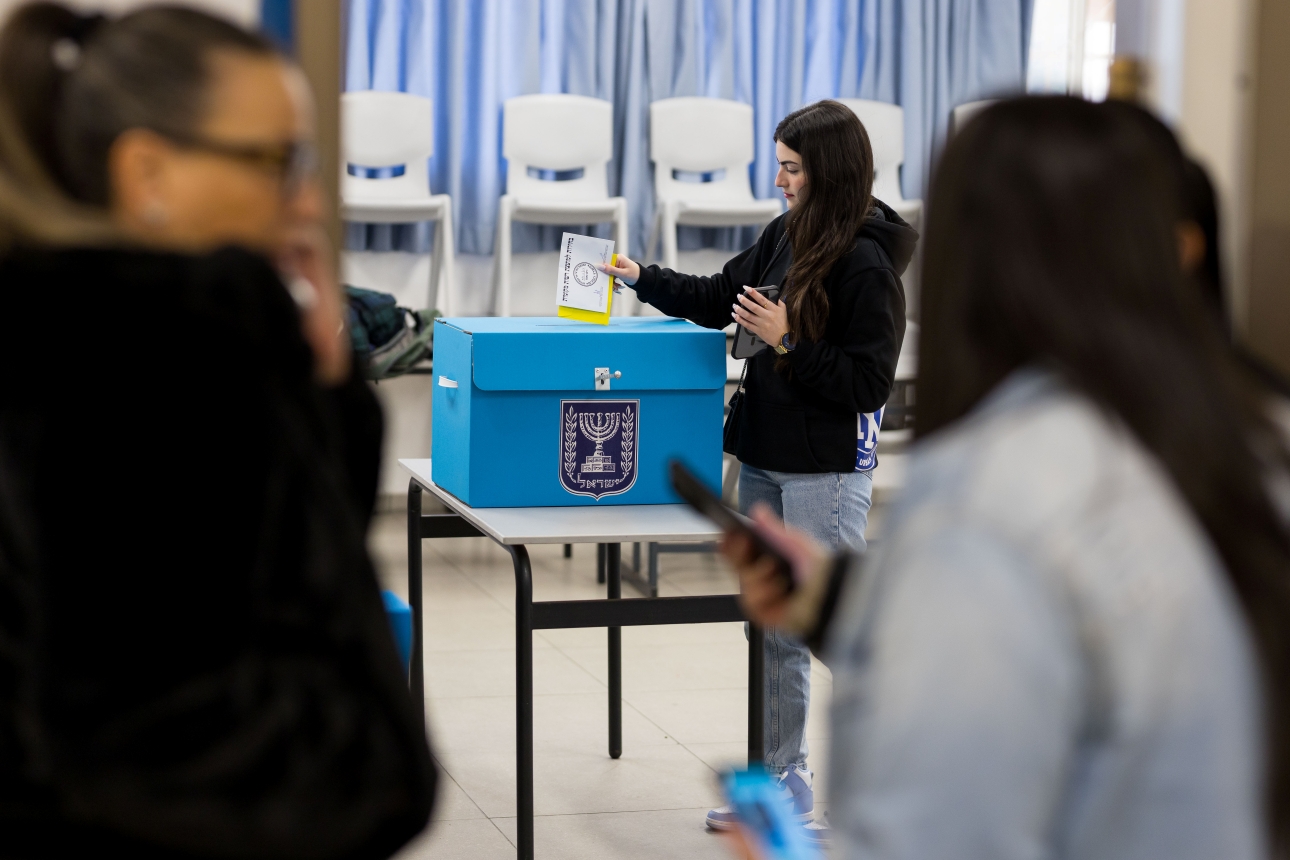
Photo by Liron Moldovan/Flash90
Background and Methodology
In May 2026, the Education Policy for Democracy Program at the Israel Democracy Institute (IDI), with methodological support from the Viterbi Family Center for Public Opinion and Policy Research, conducted a survey examining the attitudes, perceptions, and political engagement of young adults who will be eligible to vote for the first time in the elections to the 26th Knesset, scheduled for October 2026. The target population consisted of young adults aged 18–22 from across Israel whose first opportunity to vote in a Knesset election will be in 2026.
The representative sample included 576 respondents, comprising 443 Jewish respondents (77%) and 133 Arab respondents (23%). Within the Jewish sample, weighting was also conducted by religious self-identification: secular, traditional religious, traditional non-religious, religious, and Haredi. The survey explored three central themes: attitudes toward voting and elections; the development of political literacy and sources of political influence; and perceptions of the state of democracy in Israel.
Key Findings
- Strong Intention to Vote and High Perceived Importance of Voting
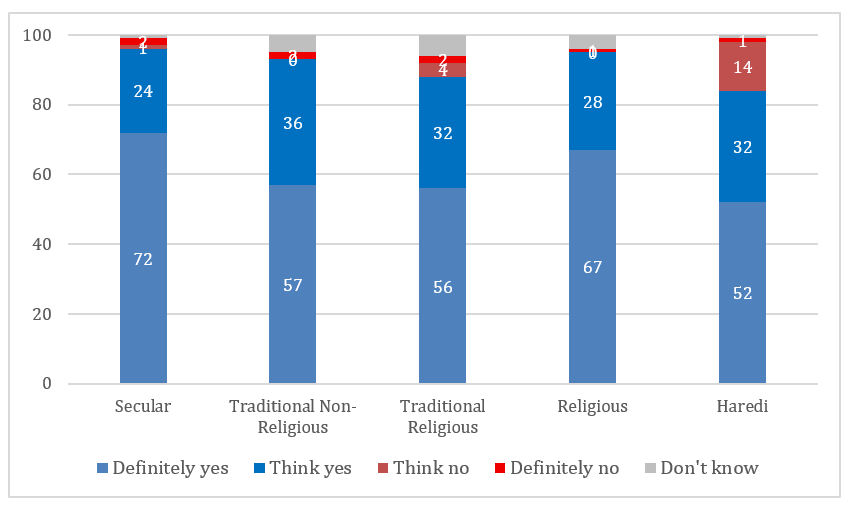
Across all population groups, a clear majority of respondents reported that they intend to vote in the upcoming election. Between 80% and 95% of respondents in every group stated that they either think they will vote or are certain they will vote. Among Jewish respondents, secular youth expressed the highest level of certainty regarding participation. Among Arab respondents, 87% reported that they intend to vote.
Voting is also viewed as highly meaningful. More than four-fifths of respondents described the opportunity to vote as either very meaningful or fairly meaningful. Differences emerged across religious groups within the Jewish population, with Haredi respondents assigning somewhat less importance to voting than other groups. A notable finding is the particularly high importance attributed to voting by Arab women, who expressed stronger feelings about the significance of first-time voting than Arab men.
Figure 1.1 – Do you intend to vote in the upcoming Knesset election? (%)
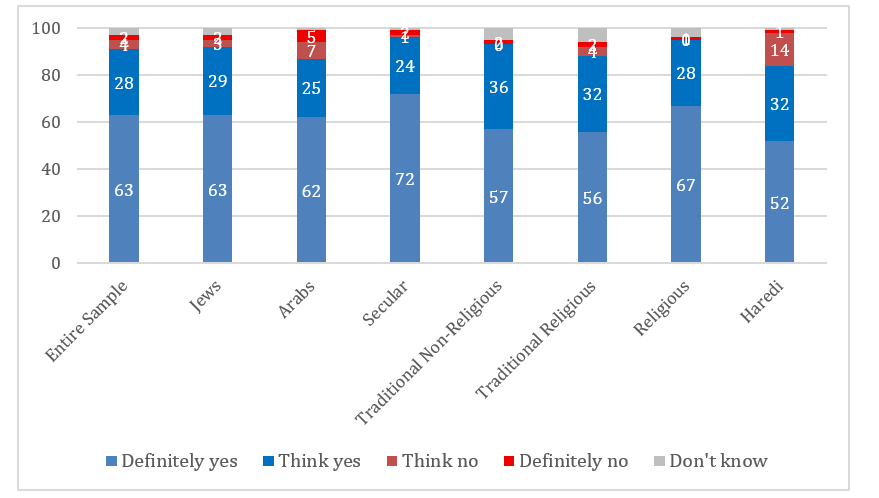
Figure 1.2 – Do you intend to vote in the upcoming Knesset election? (%)
Jews by position on the Haredi–secular spectrum
- Broad Belief in the Power of Elections to Shape Reality
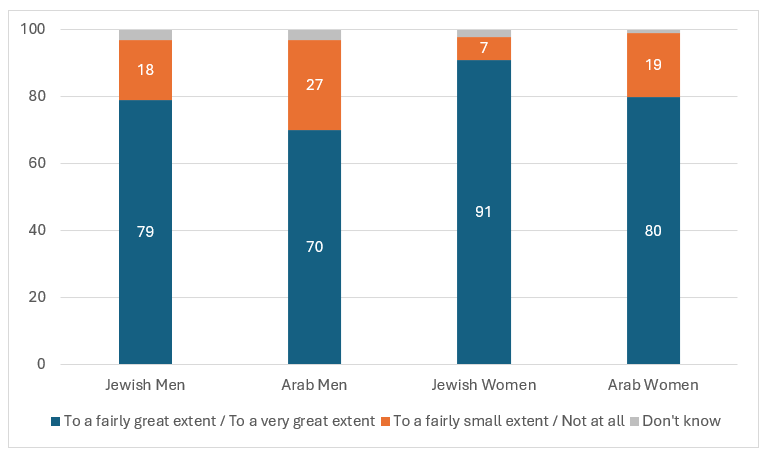
Most respondents believe that voting can influence reality in Israel. More than four-fifths of the overall sample reported that citizens’ votes can affect developments in the country to a fairly great or very great extent. This perception was especially strong among traditional and religious Jewish respondents.
The principal exception was among Haredi respondents. While a majority still believed that voting can have an impact, this group displayed the highest level of skepticism regarding the ability of elections to generate meaningful change. The survey also found that women—both Jewish and Arab—were more likely than men to view voting as an effective mechanism for influencing reality.
- How meaningful is the fact that you will soon be able to vote in an election?
Figure 2.1 – How meaningful is the fact that you will soon be able to vote in an election? (%)
Total sample, Jews, and Arabs
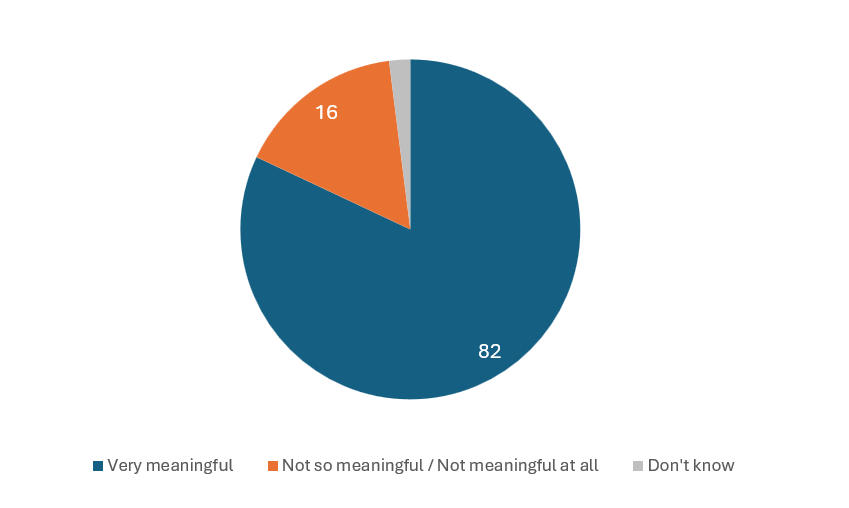
Figure 2.2 – How meaningful is the fact that you will soon be able to vote in an election? (%)
Jews by Position on the Haredi–Secular Spectrum
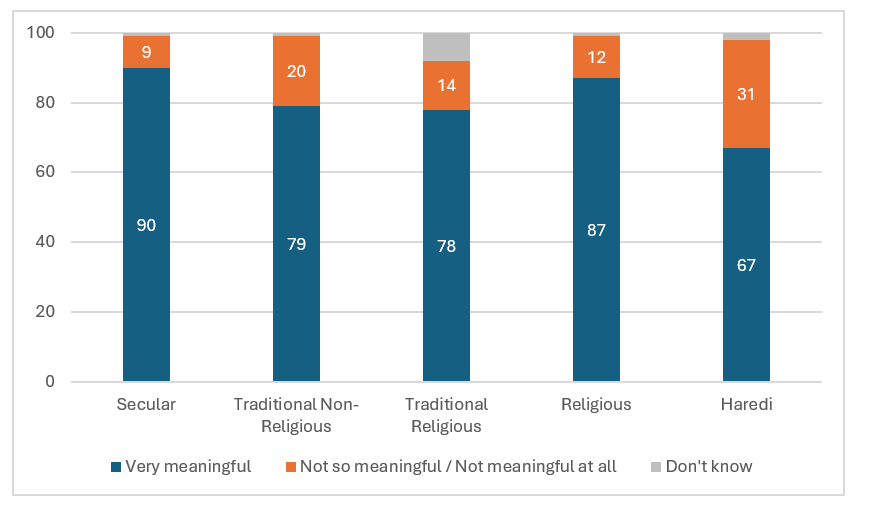
Figure 2.3 – How meaningful is the fact that you will soon be able to vote in an election? (%) – By Gender, Jews and Arabs
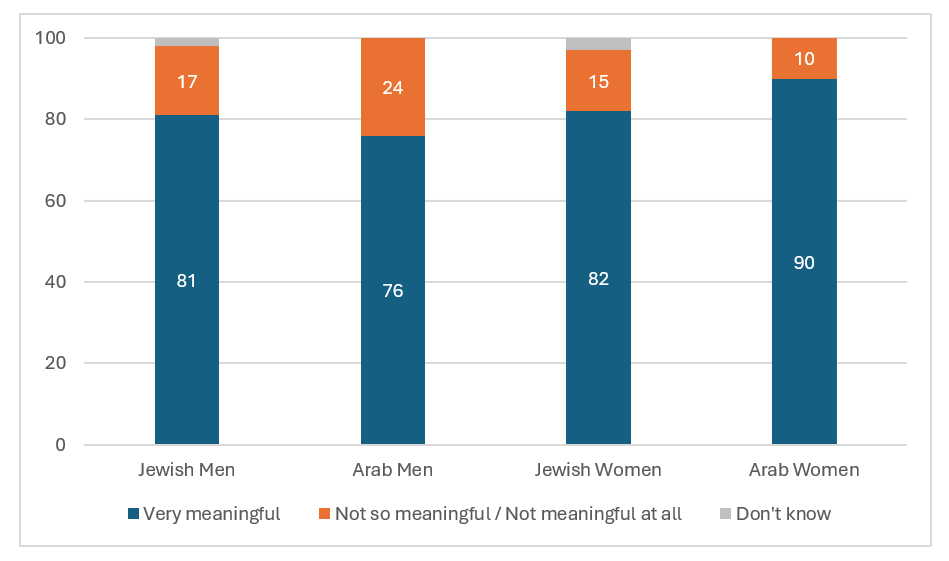
- Different Understandings of Political Participation Among Jewish and Arab Youth
Open-ended responses reveal a shared belief among Jewish and Arab youth that elections are a means of influencing reality. However, the two groups emphasize different dimensions of political participation. Jewish respondents most frequently highlighted democracy, civic responsibility, and the principle of popular sovereignty. Elections were often described as a cornerstone of democratic governance and a mechanism for representation and governmental change.
Arab respondents also viewed elections as part of the democratic process, but placed greater emphasis on political representation, making their voices heard, and advancing social change. For many Arab respondents, voting was connected to the ability of the Arab community to influence public decision-making and improve its social and political standing.
At the same time, both groups expressed doubts regarding the capacity of elections to bring about change. Among Jewish respondents, these concerns were largely linked to distrust of the political system and a sense that political actors are insufficiently responsive. Among Arab respondents, skepticism was more closely tied to perceptions of limited influence and insufficient representation.
Figure 3.1 – To what extent can citizens’ voting influence reality in Israel? (%) – Entire sample, Jews, and Arabs
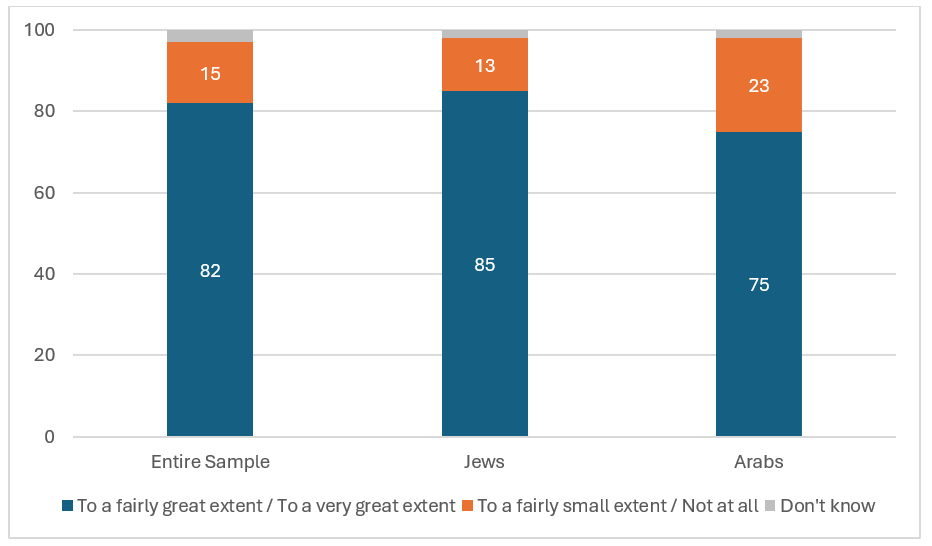
Figure 3.2 – To what extent can citizens' voting influence reality in Israel? (%) – Jews by Position on the Haredi–Secular Spectrum
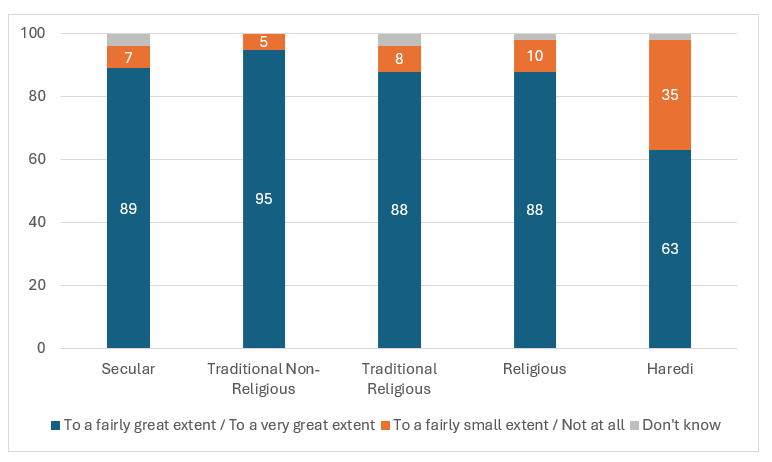
Figure 3.3 – To what extent can citizens' voting influence reality in Israel? (%) – By Gender, Jews and Arabs
- Political Interest Is Relatively High, Especially Among Haredi Youth
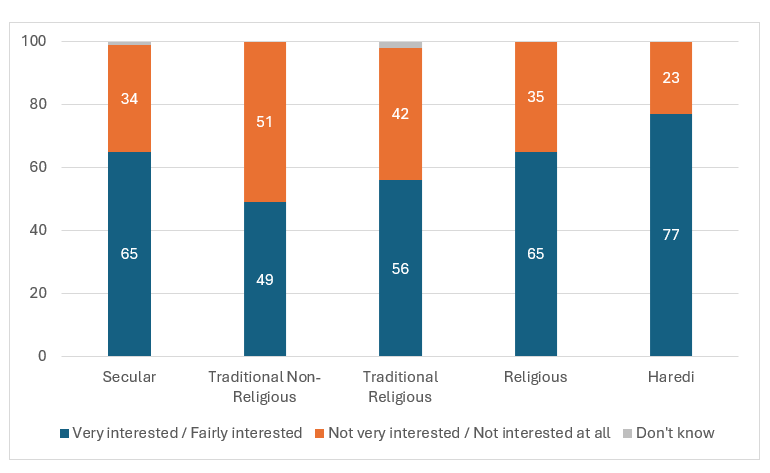
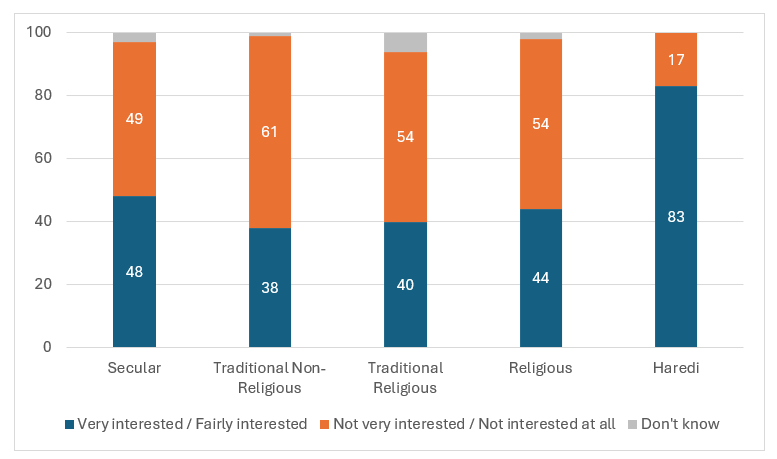
Political literacy begins with political interest. Nearly two-thirds of respondents described themselves as fairly interested or very interested in politics. The highest level of interest was found among Haredi youth, with more than three-quarters reporting strong interest in political affairs.
This finding is particularly noteworthy because Haredi respondents were simultaneously less likely than other groups to believe that voting can influence reality. The report suggests that contemporary debates surrounding military conscription and the status of Torah students may contribute to both heightened political attention and skepticism regarding political effectiveness.
-
To what extent are you interested in politics?
Figure 5.1 – To what extent are you interested in politics? (%) – Jews and Arabs
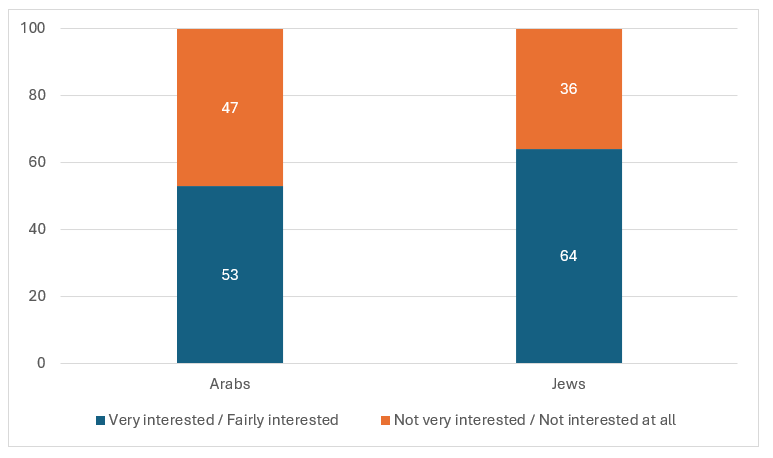
Figure 5.2 – To what extent are you interested in politics? (%) – Jews by Position on the Haredi–Secular Spectrum
6. Family, Friends, and Social Networks Shape Political Literacy
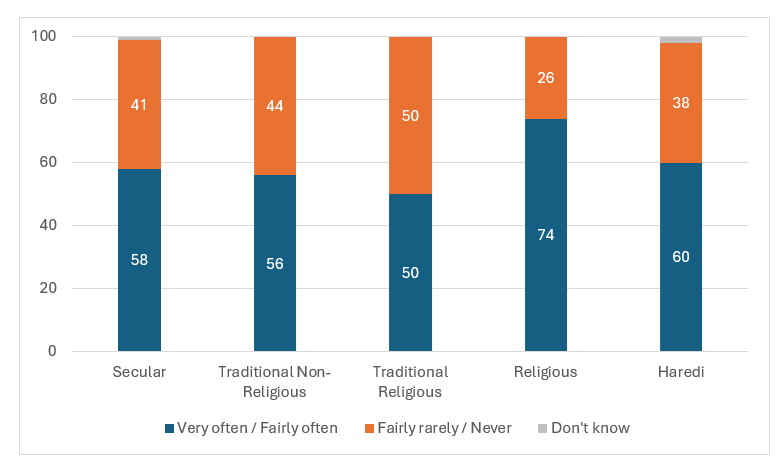
The survey highlights the importance of socialization agents in shaping political literacy. Family discussions about politics are common, particularly among Jewish respondents. Religious Jewish respondents reported the highest frequency of political discussions within the family.
Peer groups also play a significant role. Haredi respondents reported especially high levels of political interest among their friends, while Arab respondents were more likely to say that their peers show limited interest in politics.
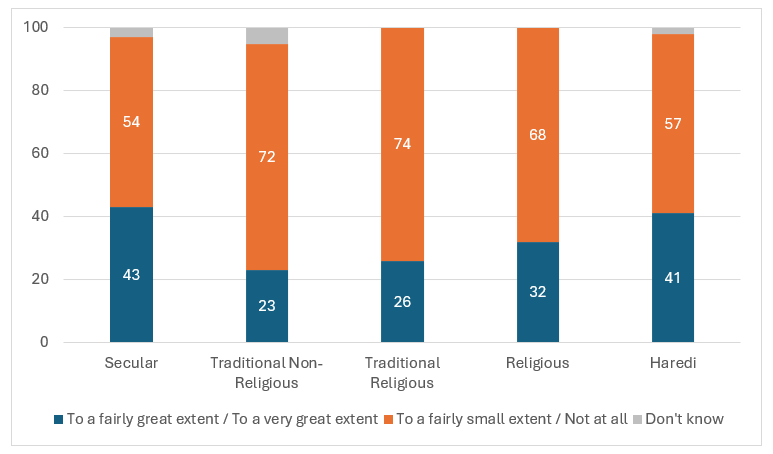
Although social media constitute a central source of information, most respondents do not actively seek political content online. Instead, the findings suggest that young people are often exposed to political information through the content that appears in their social media feeds.
- How often is politics discussed in your family?
Figure 6.1 – How often is politics discussed in your family? (%) – Jews and Arabs (%)Entire Sample, Jews, and Arabs
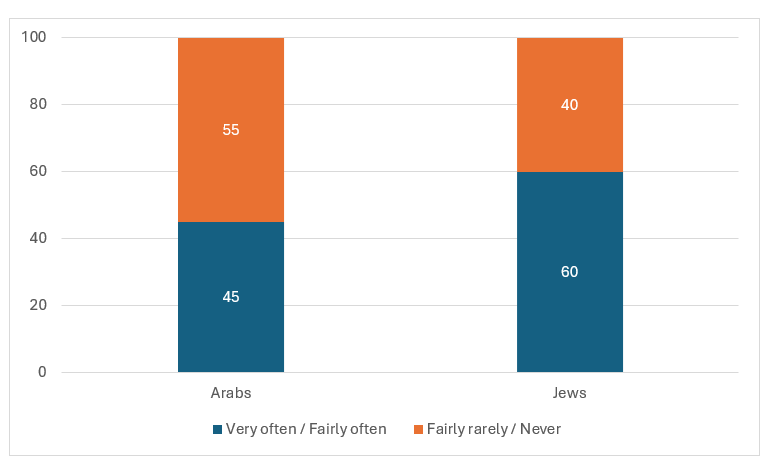
Figure 6.2 – How often is politics discussed in your family? (%) –
Jews by Position on the Haredi–Secular Spectrum (%) – Jews by Position on the Haredi–Secular Spectrum
-
To what extent are your friends interested in politics?
Figure 7.1 – To what extent are your friends interested in politics? (%) – Entire Sample Jews, and Arabs (%)
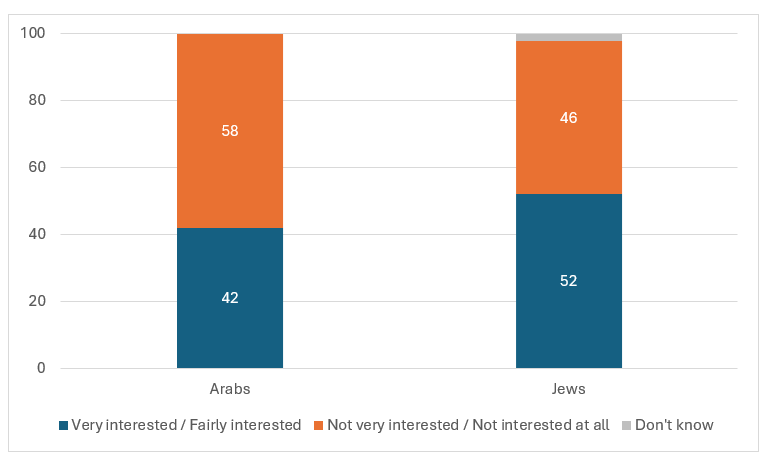
Figure 7.2 – To what extent are your friends interested in politics?
(%) – Jews by Position on the Haredi–Secular Spectrum (%) – Jews by Position on the Haredi-Secular Spectrum
-
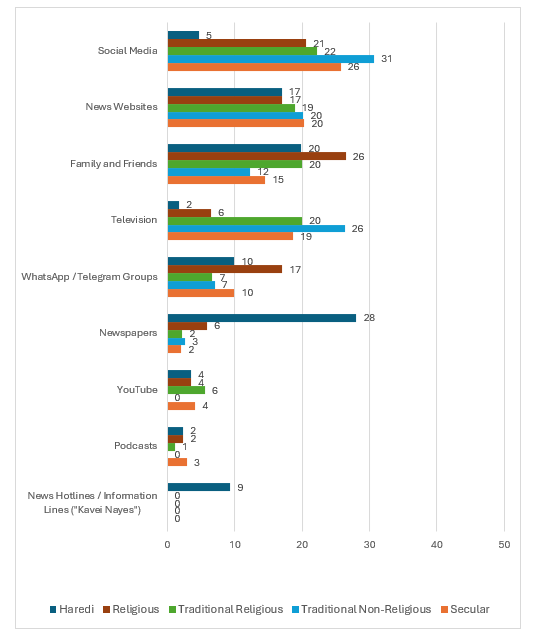
The digital sphere is the primary source of political information.
Social media emerged as the single most important source of political information. When social media platforms are combined with WhatsApp and Telegram groups, the digital sphere becomes the dominant source of political information for a majority of respondents.
Arab respondents rely on social media substantially more than Jewish respondents. Within the Jewish population, important differences also emerged. Religious respondents rely heavily on family and friends, while Haredi respondents place greater emphasis on newspapers and other traditional news sources, reflecting patterns of media consumption within Haredi society.
- To what extent do you seek political content on social media?
Figure 8.1 – To what extent do you seek political content on social media? (%) – Jews by Position on the Haredi–Secular Spectrum
-
What are the two main sources from which you receive political information?
Figure 9.1 – What are the two main sources from which you receive political information? (%) – Jews and Arabs
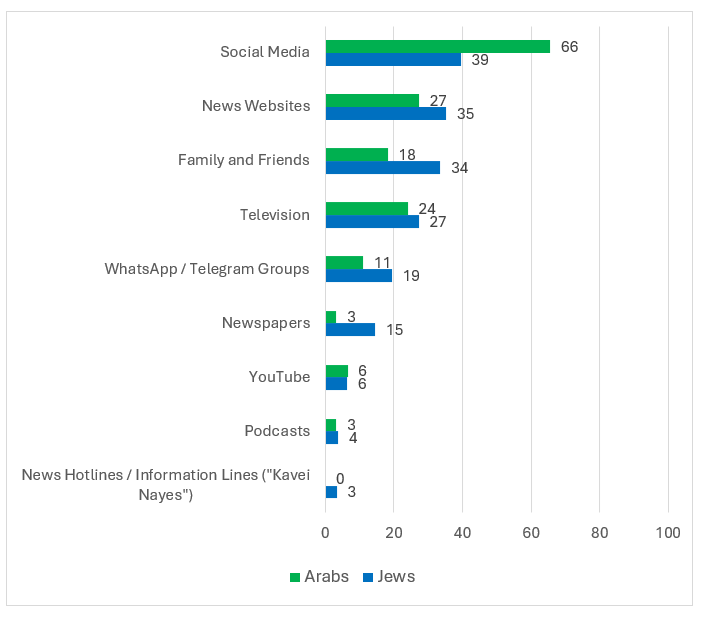
*The options "Other" (0%–2%) and "I do not receive information from any source" (0%–5%) are not shown in the chart.
Figure 9.2 – What are the two main sources from which you receive political information? (%) – Jews by Position on the Haredi–Secular Spectrum
-
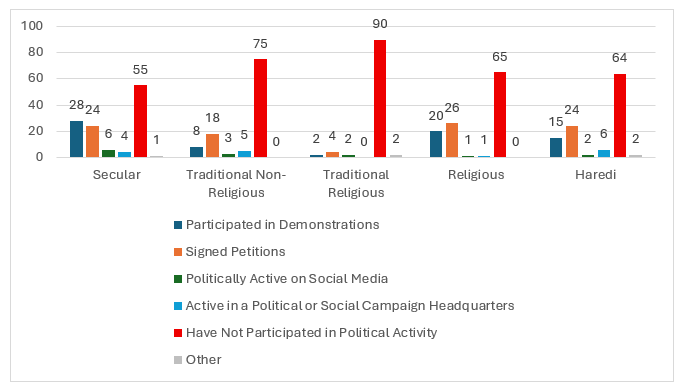
Limited direct political participation.
Despite widespread interest in politics and a strong intention to vote, most respondents reported that they have not participated in political activities such as demonstrations, petition campaigns, political headquarters, or political activism on social media. This pattern was evident across virtually all groups.
Among Jewish respondents, demonstrations and petition-signing were the most common forms of participation, although participation rates remained relatively modest. The findings therefore point to a generation that is attentive to politics and values participation, but whose engagement is expressed more through information consumption and voting intentions than through organized political activism.
-
Have you ever participated in any political activity? More than one answer could be selected.
Figure 10.1 – Have you ever participated in any political activity? (%) – Jews and Arabs
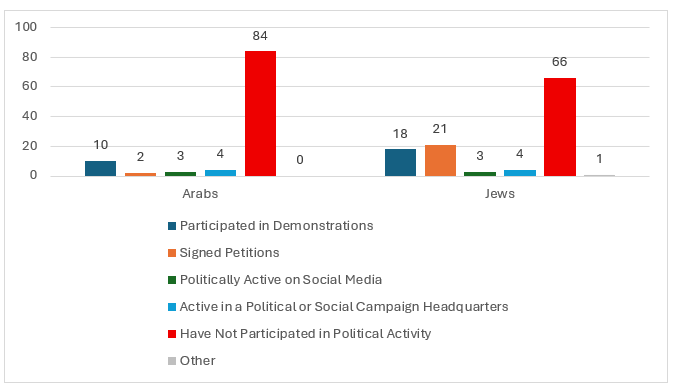
*Respondents could select more than one answer; therefore, percentages total more than 100%.
Figure 10.2 – Have you ever participated in any political activity? (%) – Jews by Position on the Haredi–Secular Spectrum
-
National security and the cost of living are the dominant public priorities.
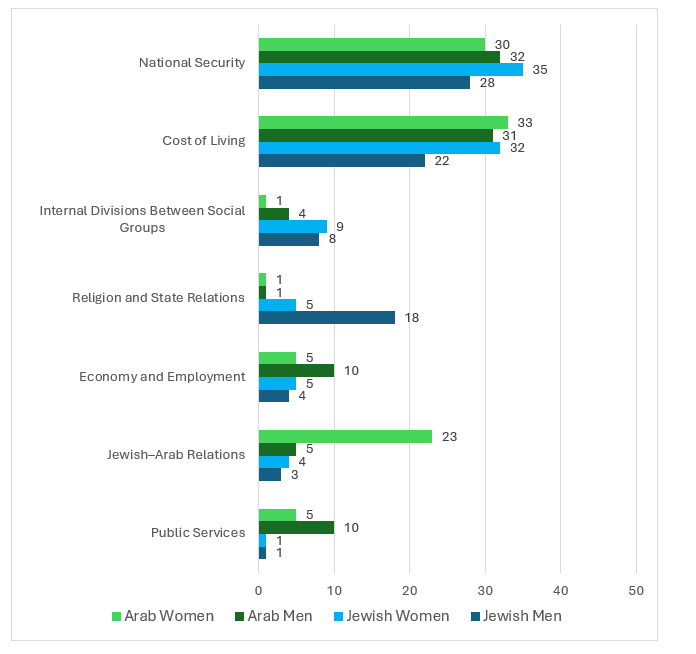
When asked to identify the most important issue the government should address, respondents across groups consistently prioritized national security and the cost of living. When economic issues and employment are considered together, economic concerns become even more prominent.
The issue of military conscription emerged as a major concern primarily among Haredi respondents. Among Arab women, relations between Jews and Arabs stood out as a considerably more important issue than among other groups.
-
In your opinion, what is the main issue the government should address today?
Figure 11.1 – In your opinion, what is the main issue the government should address today? (%) – Jews and Arabs[1]
The issues of health and welfare, the conscription law, education, and other do not appear in the figure, as they appeared across all groups at rates of 0%–5%.
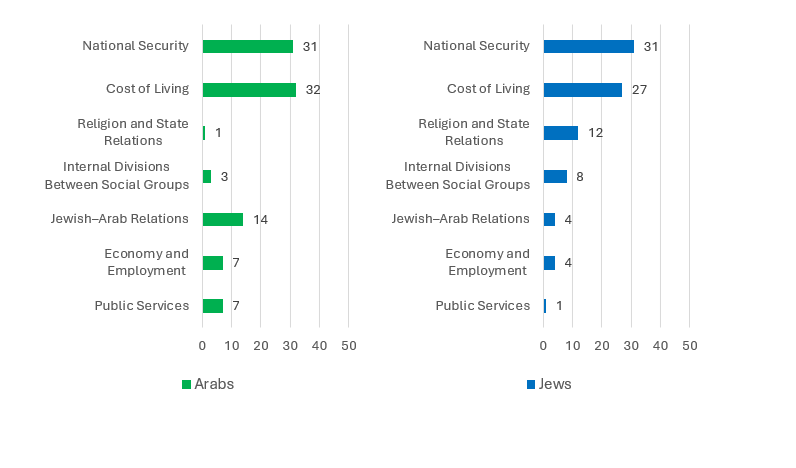
Figure 11.2 – In your opinion, what is the main issue the government should address today? (%) – Jews by Position on the Haredi–Secular Spectrum[1]
The issues of health and welfare, public service, and other do not appear in the figure, as they appeared across all groups at rates of 0%–5%.
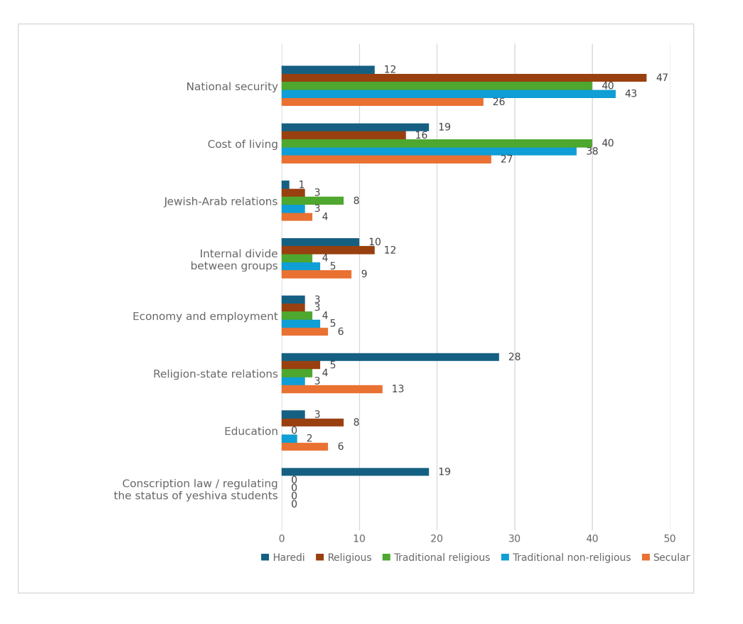
Figure 11.3 – In your opinion, what is the main issue the government should address today? (%) – By Gender, Jews and Arabs
-
Mixed assessments of the state of Israeli democracy.
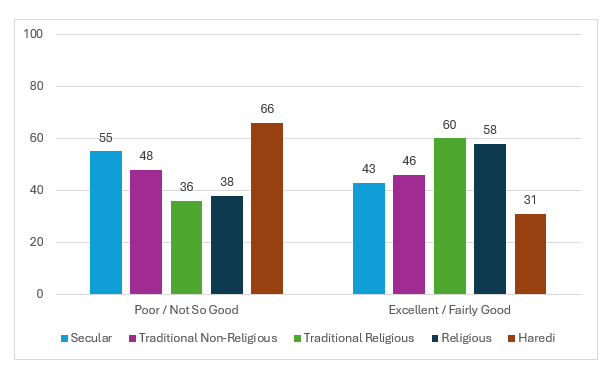
Assessments of the state of democracy in Israel were divided. Arab respondents and Haredi respondents were substantially more likely than other groups to describe the state of democracy as poor or not very good. The report suggests that these assessments may be influenced by the extent to which respondents feel that the state recognizes their needs, identities, and ways of life.
-
On a scale from 1 to 4, where 1 = Poor and 4 = Excellent, how would you assess the state of democracy in Israel today?
Figure 12.1 – On a scale from 1 to 4, where 1 = Poor and 4 = Excellent, how would you assess the state of democracy in Israel today? (%) – Jews and Arabs
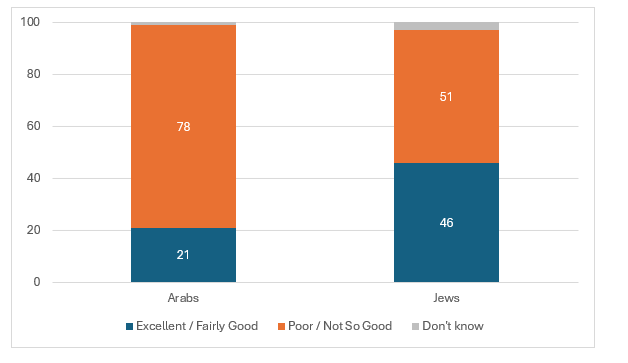
*Between 1% and 6% of respondents in all groups answered "Don't know."
Figure 12.2 – On a scale from 1 to 4, where 1 = Poor and 4 = Excellent, how would you assess the state of democracy in Israel today? (%) – Jews by Position on the Haredi–Secular Spectrum
Conclusion
The survey presents a complex portrait of Israel’s future electorate. First-time voters generally view voting as meaningful and believe that political participation can influence public life. At the same time, many express skepticism toward political institutions and question whether elected officials and political parties can deliver meaningful change. The findings point to a clear distinction between support for democratic principles and confidence in the institutions responsible for implementing them.
A comparison between Jewish and Arab youth reveals a shared commitment to the importance of voting, alongside different understandings of its purpose. Among Jewish respondents, voting is often framed as an individual act of civic influence within a democratic system. Among Arab respondents, voting is more frequently associated with collective representation, social influence, and improving the standing of the Arab community. Despite these differences, both groups share a desire to shape reality through democratic participation while demonstrating varying levels of trust in the political system.