
The Israel Police’s Responsibility for the Proper Conduct, Fairness, and Integrity of the 26th Knesset Election
Israel’s 26th Knesset elections, scheduled for October 27, 2026, will be held against the backdrop of deep public disagreements, including over the October 7 investigation, ultra-Orthodox conscription, the judicial overhaul, and the political neutrality of state institutions and security agencies.
The Israel Police does not administer voting or count ballots; those functions belong to the Central Elections Committee and polling station committees. However, the police play a pivotal role in upholding the proper conduct, fairness, and integrity of elections. Police responsibilities during elections include maintaining public order and security; protection of candidates, voters, polling stations, and election materials; investigation of election offenses; and enforcement of orders issued by the Central Elections Committee’s chair. For decades, Israel’s elections have generally remained orderly and their integrity has been preserved. We do not call into question the fairness and integrity of the upcoming elections or their results. There is, however, cause for concern that today’s political, social, security, and technological circumstances may make established police duties harder to perform.
The purpose of this research is to lay out the preparations required of the Israel Police for the 26th Knesset elections. It details the police’s areas of responsibility and the policies, procedures, and practices employed by the police over the years to ensure the fairness and integrity of elections. This research further highlights challenges and risks that could hinder the police in fulfilling their responsibilities during the upcoming elections and proposes a series of practical recommendations to address these challenges and prevent associated risks.
The research includes operational information that has not been published before. It relies on the professional knowledge of one of the authors, Deputy Commissioner (ret.) Moti Levi, formerly the commander of Lahav 433, the national crime-fighting umbrella organization of the Israel Police, commonly known as the “Israeli FBI,” as well as on interviews conducted with former senior police commanders involved in previous elections. Their knowledge and insights are of particular importance given that some of the relevant police standing operating procedures are classified and have not been released to the public (while Investigations and Intelligence Division Procedure No. 300.02.252, on election offenses, is published, Operations Division Procedure No. 221.101.04, on election preparations, is not; a freedom-of-information request by the Israel Democracy Institute (IDI) was denied; an appeal produced partial information).
As a general note, it is assumed that just as the police faithfully fulfilled their role in previous election campaigns, they will do so in the upcoming elections as well, despite the challenges facing them. This research, and the recommendations it contains, is intended to assist them in this endeavor.
The risk environment
Several challenges can be identified that might create difficulties for the Israel Police in fulfilling its responsibility to safeguard the proper conduct, fairness, and integrity of the upcoming elections. First, the environment of deep polarization over recent years has led to efforts by violent protestors to disrupt demonstrations, as well as violent actions by citizens against political candidates and demonstrators.
Furthermore, recent years have seen increased political interference in the police, taking place in a broader context of measures advanced during this government’s term that weaken democratic institutions and politicize security agencies. Attempts to influence police activity politically have been identified also in the context of protest policing and deployment of police forces, and can create risks of over-policing or under-policing, which impacts Israel’s Arab minority in particular.
In addition, public confidence in the police is already low: according to IDI’s 2025 Israeli Democracy Index, only 39 percent of Jewish respondents and 25 percent of Arab respondents trusted the police. Among Jewish respondents, levels of trust were 47 percent on the Right, 32 percent in the Center, and 20.5 percent on the Left. An additional challenge is that thousands of new police officers received abbreviated academy training and, given their recent recruitment, many have yet to participate in previous elections. Hundreds of the new recruits joined the paramilitary Border Police-National Guard. There is also concern relating to professional disparities in how some police officers, both in the field and at the station, exercise their discretion. This is evident, for instance, in the use of arrest and body-search powers – in some instances seemingly without legal grounds.
Moreover, since the last Knesset elections, the number of private firearm licenses rose from about 155,000 in 2022 to 351,000 by March 2026. This expansion also brought in younger and less experienced license holders. According to IDI surveys, 40 percent of Jewish respondents and 81 percent of Arab respondents said they would not feel secure if many citizens carried weapons in the public sphere. This issue could become even more significant in sensitive locations, such as demonstrations, election events, or polling stations.
Furthermore, the activities of formal and informal security bodies have expanded since the October 7 attack, including the Border Police-National Guard, hundreds of police emergency response volunteer squads, municipal security patrols, and independent civilian groups; some operate under incomplete regulation or supervision. It is prudent to take note of their presence on the ground during the upcoming election period.
In addition, a severe violent-crime crisis in Arab communities also presents a risk to the upcoming elections. Police recorded 241 Arab homicide victims in 2025, while two civil-society organizations recorded 252 and 258 victims. According to IDI surveys, 80 percent of Arab respondents fear that they or a family member might be harmed by serious violence or gunfire in a criminal dispute. These figures highlight the depth of the personal security crisis in Israel and are likely to impact both actual security and the sense of security during the election period – whether in the context of protests, election events, or voting on election day.
Finally, technology-based tools, publications, and influence operations that could compromise the proper conduct and integrity of elections present a serious challenge. This is due to recent technological developments that enable the rapid dissemination of election-related disinformation and the conduct of other election-related offenses, gaps in relevant technological regulatory frameworks, and the fact that even where legal countermeasures exist, their effectiveness is questionable given the speed at which information spreads across various platforms.
The findings and recommendations are organized around three stages of the electoral process: the period leading up to election day, election day itself, and the period immediately following the election. This structure reflects the different responsibilities and challenges facing the Israel Police at each stage.
Internal organizational preparations and political independence
Existing law and practice. As the election period begins, the police establish an Election Task Force, headed by a senior officer, intended to focus exclusively on planning, instructions, coordination, oversight, and the interface with the Central Elections Committee. Additional preparations are conducted in different divisions of the police, including the Operations Division, the Investigations and Intelligence Division, and the Training Division.
Proposed measures. We suggest establishing a new team, led by the deputy police commissioner, which would provide strategic, cross-force supervision above the Election Task Force’s operational work. This new team should include senior representatives of relevant divisions and districts and the head of the task force, and should meet frequently to identify preparedness and resource gaps, resolve barriers, and monitor implementation of the deputy police commissioner’s instructions.
Additional steps should be taken that address the police’s internal organizational preparations, aimed at effectively enshrining the principle of independence of the police throughout the upcoming elections. Rapid consultation channels should be bolstered in order to connect commanders with police legal advisers and, when needed, relevant representatives of the attorney general’s team and the Central Elections Committee chair. In addition, we suggest implementing a framework in which it is required to refer any election-related request from a political actor, for example, to change the deployment of police forces on election day, to the police commissioner, with the committee chair and attorney general informed of the request and its disposition. Furthermore, we recommend that the police commissioner issue in advance instructions that clarify the values by which police officers are required to operate, particularly during the election period. Such values ought to include, for example, professional independence and equal enforcement. It should also be made clear that the police will not take part in events or activities that support any party’s political campaign.
Campaign events and the protection of public figures
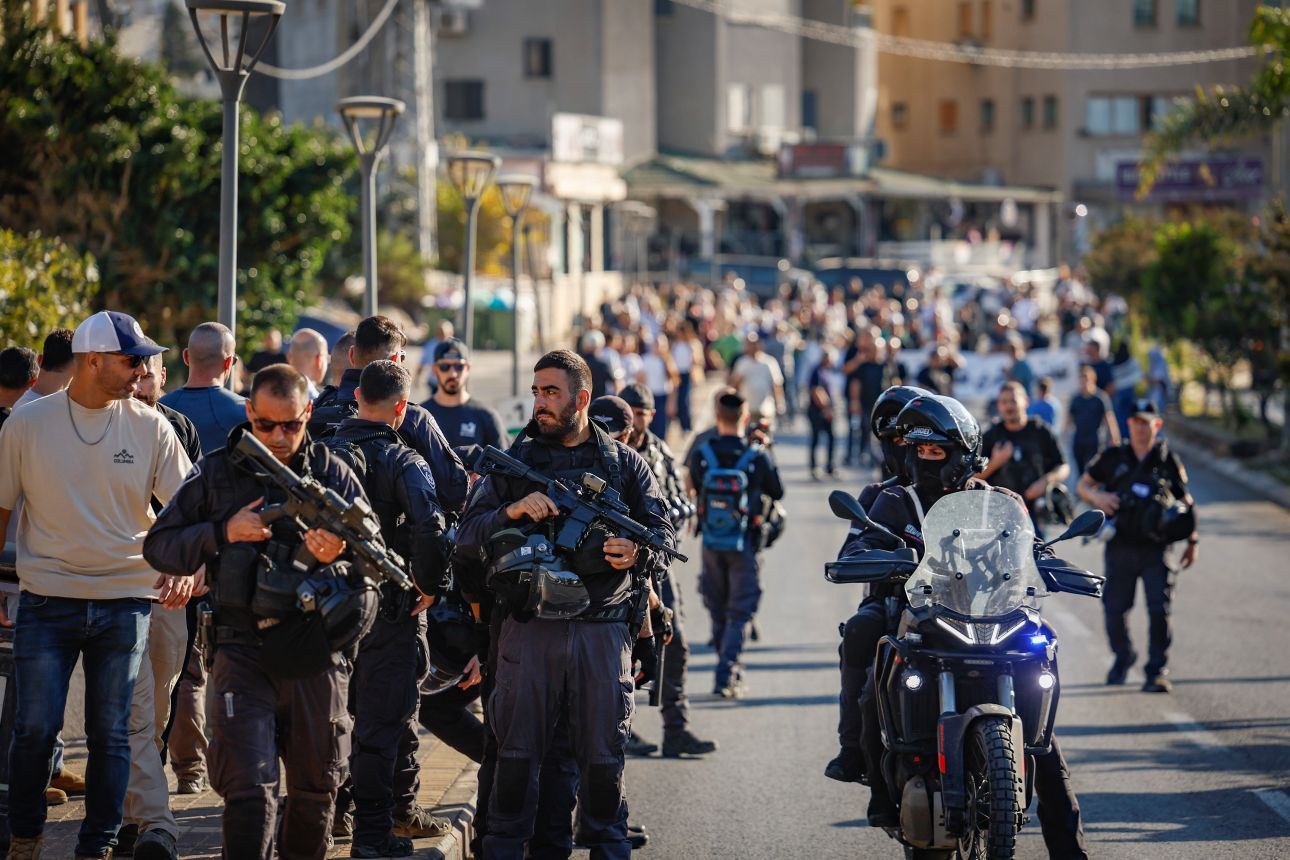
Existing law and practice. Political expression enjoys especially strong protection during the election period. As a general rule, the police are required to allow the public to hold any rally, assembly, gathering, or demonstration during the election period, subject to the provisions of the Police Ordinance, other relevant legislation, and case law. Decisions regarding a specific protest event are a matter for the professional discretion of the Israel Police and must not involve the political echelon. A license is generally required only for a procession of 50 or more people, or a gathering of 50 or more involving a speech on foreign affairs or state security. Restrictions require a near certainty of serious harm; a complete ban also requires concrete evidence and no reasonable alternative. Police must protect lawful, controversial demonstrations and cannot allow a hostile audience to halt them. Existing guidance favors restoring lawful conditions rather than dispersal. Members of Knesset in a lawfully commenced protest also receive specific protection against detention, arrest, and movement restrictions, subject to narrow exceptions.
Police are to assess campaign events based on public atmosphere, prior incidents, and escalation potential. The result determines command level and force size.
In addition, candidate protection is divided among the police, the Israel Security Agency (Shin Bet), and the Knesset Guard. Police threat levels run from 1 to 6, with a protective package for each, while the police retain responsibility for public order in election events and demonstrations.
Proposed measures. Police decision-making regarding election-related events must be conducted without political involvement and assessed without regard to political ideology. Police legal advisers should be integrated into this process of decision-making, and station operations officers should contact and coordinate with demonstration organizers in advance. The police must ensure that intelligence and operational preparations are duly made, both in advance and in real time, to protect lawful demonstrations and their participants, including by allocating the necessary personnel and equipment. Violent disruptions to demonstrations and election events should receive high-priority investigations, even when no complaint has been submitted. Any unavoidable dispersal of a protest should be ordered by a senior commander under equal criteria formulated with the attorney general and published in advance. Municipal security patrols must remain excluded from protest policing, as existing law requires, while police volunteers should only be able to assist in distant locations and not act in direct connection with the demonstration.
Every public appearance by a candidate or official, for instance at an election event, should receive a current intelligence and operational assessment, including relevant online monitoring and, where justified, coordination with the Israel Security Agency. Regular channels with party representatives should facilitate advance planning. It is essential to protect candidates and officials during events and to allocate forces of the required scope for this purpose. Violent attacks, property damage, and credible threats should receive rapid, intensive investigation, according to police and state attorney guidelines.
Technology-based election offenses
Existing law and practice. There has been a steady increase in recent years in the use of various technology-based platforms to impersonate others, disseminate false and misleading information, and create fictitious profiles. Election-related influence campaigns also involve the use of digital tools and platforms, some of which may utilize anonymous sources, various forms of manipulative information, and other tactics that could compromise the integrity of the elections. The Israel Police, the Israel Security Agency, the National Cyber Directorate, and the State Attorney’s Office coordinate on digital threats, with the Cyber Unit of Lahav 433 leading police enforcement efforts. Before publication, or while an offense remains preventable, the ordinary remedy is an application to the committee chair for an injunction; after the offense has been committed, a police complaint may be filed. Israeli legislation outlines several offenses concerning the fairness and integrity of Knesset elections in general, and election campaigning in particular, that require police intervention. Several categories of offenses can be identified where police involvement is particularly required to safeguard the fairness and integrity of elections in the digital sphere:
Transparency of campaign advertising – According to the Knesset Elections Law (Propaganda Methods), election advertisements must identify the person responsible for commissioning them and provide relevant contact information. This obligation covers social media, paid promotion, text messages, and partisan material disguised as another source. Party-directed pseudonymous accounts may also implicate the Computers Law’s ban on deceptive information.
Obligation to disclose the use of deepfakes – A temporary amendment to the Knesset Elections Law (Propaganda Methods), valid until one year after the 26th Knesset election, requires prominent disclosure when visual or audio election advertisements are digitally created or materially altered to appear authentic.
Unfair interference via election advertisements – The Knesset Elections Law (Propaganda Methods) prohibits one party from unfairly interfering with another’s campaign. This is intended to ensure a “level playing field” among the lists contesting the Knesset elections and to enable voters to exercise their right to vote freely and in an informed manner, with the most accurate factual picture possible before them. This prohibition has chiefly covered formal deception, for instance distorting another party’s messages or falsely claiming another party’s candidate’s withdrawal.
Cyber operations and foreign interference in elections – Cyber operations in the period leading up to an election may involve offenses defined in the Computers Law, such as disrupting computer operations, deleting or altering computer data, transmitting false information via a computer, or gaining unauthorized access to computer data or a computer system in order to commit another offense (e.g., leaking information). Furthermore, instances of external interference in elections may occur through influence networks on digital platforms or via cyber operations. In such cases, the Israel Security Agency leads the investigation and works, together with other security organizations, to uncover the identities of the perpetrators.
Proposed measures. Under police procedures, complaints regarding offenses under the Knesset Elections Law (Propaganda Methods) are handled by police election investigation teams. According to the attorney general’s guidelines, law enforcement regarding these offenses is of paramount importance especially during the election period. Therefore, effective enforcement requires expedited handling of the matter. Trained election teams must handle complaints immediately under national supervision.
Accordingly, police investigation teams should promptly investigate complaints regarding violations of the Knesset Elections Law (Propaganda Methods). That said, investigation of allegations relating to unfair interference via election advertisements (an offense which is more open to interpretation) should be conducted according to the interpretation of the chair of the Central Elections Committee.
Although a petition concerning offenses under the Knesset Elections Law (Propaganda Methods) can be submitted to the chair of the Central Elections Committee, if the violation has already occurred, a complaint may also be filed with the police. A decision prohibiting the continuation of the election propaganda will not necessarily constitute grounds for closing the investigation. In serious cases, such as organized, systematic dissemination or use of foreign communications companies to conceal the sponsor, we believe that the relevant investigation team should approach the chair of the committee and seek the removal of the election propaganda. In addition, the police are required to address complaints regarding violations of decisions by the chair of the committee.
The police are also required to effectively investigate cyber-related offenses that could compromise the fairness and integrity of the elections. Regarding foreign interference in the elections, police cooperation with other security and law enforcement agencies operating in this field is essential.
Finally, it is important that the police consult with the attorney general in advance for guidance on how the aforementioned election offenses, as well as other offenses, apply to activities involving advanced technologies. It is also critical for the police to remain updated on, and act in accordance with, the decisions and directives of the chair of the Central Elections Committee. Such directives address the legality of activities in the digital sphere – for example, it is prohibited for polling station committee members or observers to transmit real-time information to parties regarding an individual’s presence at a polling station or the fact that a voter has cast a ballot.
Training and deployment
Existing law and practice. On election day, police officers are deployed in 12-hour shifts and nonurgent work is deferred. In the previous election, a police command center operated alongside the Central Elections Committee’s control center, a national police forward command post was activated, and the police commissioner held assessments every few hours. Approximately 17,500 police officers were deployed, as were 5,000 private security guards who were stationed near the police in order to secure polling stations. Preparation generally consisted of several hours of training, and police officers were equipped with a digital pocket guide.
Proposed measures. In light of the challenges presented above, preparations for the 26th Knesset elections require training that is more extensive than in the past, both in terms of duration (spanning days rather than hours) and content. Such training should be focused on clarifying and instilling the ethical and legal framework that governs police conduct on election day. Private security guards should receive instructions on their limited authority and should be subject to active police supervision. The training of police officers (and, with the necessary adjustments, that of private security guards) must address, among other things, the importance of free elections in a democratic state; the principles of election integrity, secrecy, procedural propriety, and equality; and the role of the police and other officers in upholding these principles.
Deployment decisions should remain exclusively in the hands of the police, with no political interference. Any decision to move (or not move) forces in response to allegations of violence or fraud should be reported to the chair of the Central Elections Committee. The importance of this safeguard was demonstrated in the 2022 Knesset election, when Likud representatives pressed for urgent reinforcements at all polling sites in Arab localities, citing violence and fraud. An immediate inquiry by the committee chair, together with the police, found the claims baseless. The former committee chair later warned that such a deployment could have triggered an uncontrollable chain reaction.
It is also our recommendation that no paramilitary police officers be stationed at polling stations. In Arab communities, in particular, a paramilitary police presence may deter voting, and checkpoints should generally be avoided. In addition, the regular police are the primary authority responsible for maintaining order at the polling station: police volunteers and municipal security patrols should not police polls, and we suggest that municipal security patrols should be prohibited from operating on election day.
Authority at polling stations
Existing law and practice. The local polling station committee controls voting and the count. Police functions primarily include security, order, protection of election materials, and prevention of and enforcement against offenses such as election fraud or obstruction. Officers retain their ordinary powers but receive no special authority over the vote. Decisions to suspend, resume, or extend voting belong solely to the Central Elections Committee chair and the chair’s deputies.
Proposed measures. Every exceptional incident involving voters or polling station officials requiring police involvement at the polling stations should be reported to the national police forward command post. When local polling station officials request an action whose legality is uncertain, police officers should refer the matter to their commander (and, where needed, to the national police forward command post). If a police officer exceeds his or her authority, the relevant police commander should address the incident immediately, and the incident should be reported upward.
Existing law and practice. With regard to demonstrations and other gatherings, the police are responsible for maintaining public order on election day. From 7:00 p.m. on the evening before the election through election day, campaigning done by assemblies, processions, loudspeakers, radio, or television is prohibited by law. However, a protest whose dominant purpose is not electoral persuasion generally remains permitted. By contrast, unlawful assemblies and conduct using force, violence, threats, or obstruction to disrupt voting must be addressed by the police. In addition, any attempt to block a voter on the way to a polling station requires an immediate police response.
Furthermore, the Israel Police is the primary authority responsible for maintaining public order in the vicinity of the polling stations. In recent years, there has been an increase in the activity of civilian groups operating outside the police framework – in some cases, members of these groups carry licensed personal weapons and have, on occasion, assumed police-like functions and even unlawfully exercised policing powers over citizens. The risk posed by these groups could be particularly acute on election day. A prominent example of this phenomenon occurred around the elections for the 22nd Knesset: activists declared their intention to station “hundreds of guards at polling station entrances on election day to support our observers across the country,” in order to “protect the Jewish observers in Arab localities.” Election laws prescribe a limited list of individuals permitted to be present at the polling station or voting area during voting hours. This list does not include civilian “guards.”
In addition, the question of the legality of placing cameras at polling stations to document the overall voting process has arisen in the past. The issue surfaced during the elections for the 21st Knesset, after it was revealed that representatives of the Likud party at several polling stations across the country, particularly in localities with Arab populations, were carrying cameras to document voting processes at the polling station and during the vote-counting process. According to previous decisions by the chairs of the Central Elections Committee, only election integrity inspectors appointed by the committee are authorized to document and film specified irregularities, such as attempted multiple-envelope voting, impersonation, or voter intimidation at polling stations, and only subject to the conditions established by the committee’s chair.
Proposed measures. In order to clarify the procedures regarding demonstrations on election day, the attorney general and the chair of the Central Elections Committee should be consulted in advance of election day, and instructions should be issued to commanders accordingly. At the same time, gatherings on election day which are prohibited by law must be prevented and dispersed, particularly if they are likely to compromise the integrity of the elections, for example, by disrupting voting procedures or disturbing the peace of the voting public. The police should further identify areas at heightened risk of provocation. It is important to note that only police officers, not municipal security patrols or police volunteers, should manage election-day protests.
In addition, as mentioned above, independent civilian groups have no general right to “guard” polls. During the elections for the 22nd Knesset, the chair of the Central Elections Committee issued a limited injunction prohibiting a group of activists from being present within the polling station area, filming the polling station, or deviating from the instructions in the guideline document drafted by the activists themselves (which stated, among other things, that activists were prohibited from carrying firearms or cold weapons). For the 2026 elections, we propose that the police approach the attorney general and the chair of the Central Elections Committee in advance to clarify the boundaries of what is permitted and prohibited regarding this type of activity on election day.
More generally, we suggest that the police examine the possibility of restricting the entry of civilian firearms into polling stations altogether, given the sensitive nature of these premises and concerns regarding potential voter intimidation or disruption. Should the police nevertheless permit the carrying of weapons at polling stations, it is recommended that licensed weapon holders be provided with a leaflet outlining safety guidelines for the polling station area.
In addition, in the absence of legislation regulating the use of cameras at polling stations, and given the secret nature of the ballot, the police have the authority to prevent any attempt by unauthorized parties to photograph or record voters, in accordance with the directives of the chair of the Central Elections Committee. It is important for the police to identify, prior to election day, any initiatives to conduct filming at polling stations by unauthorized parties and to preemptively prevent such activity. This prohibition should also be clearly communicated in advance to voters, polling station officials, and observers. Police may detain or arrest violators and seize devices where legally justified.
Attempts to suppress voting or mislead voters using technological systems
Existing law and practice. A situation could arise in which messages containing false information are disseminated online on election day and could, among other things, suppress voter turnout or mislead voters. For instance, on the night of the previous election, a message circulated claiming that the Likud party had urgently asked the police and the Central Elections Committee to reinforce every polling site in Arab communities because of “severe violence and threats” at the polls. The committee and police checked the allegation and quickly announced that it was baseless.
Proposed measures. In addition to the aforementioned measures necessary for police to safeguard the integrity of elections in the digital sphere prior to election day, additional measures should be taken on election day itself. In certain cases in which dissemination of election-related content online interferes with the election process or voter access, a police investigation into the offense of interfering with the election should be initiated.
Cooperation between the police and the Central Elections Committee is crucial in addressing, through public messaging, baseless claims that could suppress voter turnout or mislead voters. As has been done in the past, it is especially important during the upcoming elections for the police to assist the committee in countering unfounded allegations and ensuring the facts are accurately presented. Complaints about unlabeled campaign materials and unlawful interference would receive immediate treatment and, where necessary, police-initiated removal requests; investigations would continue after polling.
Experts emphasize that scenarios relevant to the post-election period are primarily centered on attempts to undermine the legitimacy of the results, employing various methods and varying degrees of severity, such as baseless claims of a “stolen election.” In an extreme case, such attempts could lead to an event akin to the “storming of the Capitol.” To avoid any doubt, we raise this matter to promote preparedness, not as a prediction or suggestion that such an outcome is likely.
In our view, the police must be prepared to handle potential protests and public disturbances following the announcement of the election results. As part of this preparation, it is important to establish channels of communication with protest organizers, in the hope that dialogue and trust among the parties involved will help de-escalate tensions. In this context, the rapid and effective refutation of disinformation regarding a “stolen election” is essential to mitigating the risk of serious post-election unrest. At the same time, preparations must be made to deploy forces to handle violent or extreme scenarios, to build a comprehensive intelligence picture, and to seriously examine reports and calls for violence. Justice should be served swiftly and effectively for any offenders.
Moreover, police responsibility continues after election day until fraud and other election-offense investigations are completed. For instance, after the 2022 election, the Central Elections Committee chair, the police commissioner, and the attorney general agreed to pursue rapid indictments and seek actual imprisonment in fraud cases.
Knesset election day and the period that surrounds it put Israeli democracy to the test. In today’s reality, they also put the Israel Police to the test. A professional and independent police force is critical to ensuring the fundamental right of all citizens to vote for their leaders. We cannot have general, equal, and secret Knesset elections without the Israel Police fulfilling its role with professionalism and independence from any political interference.
Given the unique challenges and risks surrounding the upcoming elections, which could hinder the Israel Police in fulfilling its responsibility to safeguard the proper conduct, fairness, and integrity of the elections, this research proposes a series of practical recommendations to avert and respond to potential threats. We conclude with the hope that the police will rise to the challenge and faithfully execute their role in preserving the integrity of the elections, as they have done in the past.
