

Minority Governments: A Possible Way Out of Political Deadlock?
Does political deadlock mean a new election? Not necessarily. Israeli law actually allows the formation of a minority government. Although rare in Israel, this type of government exists in parliamentary democracies and could help Israel avoid repeat elections – the question is whether it would be able to govern effectively.
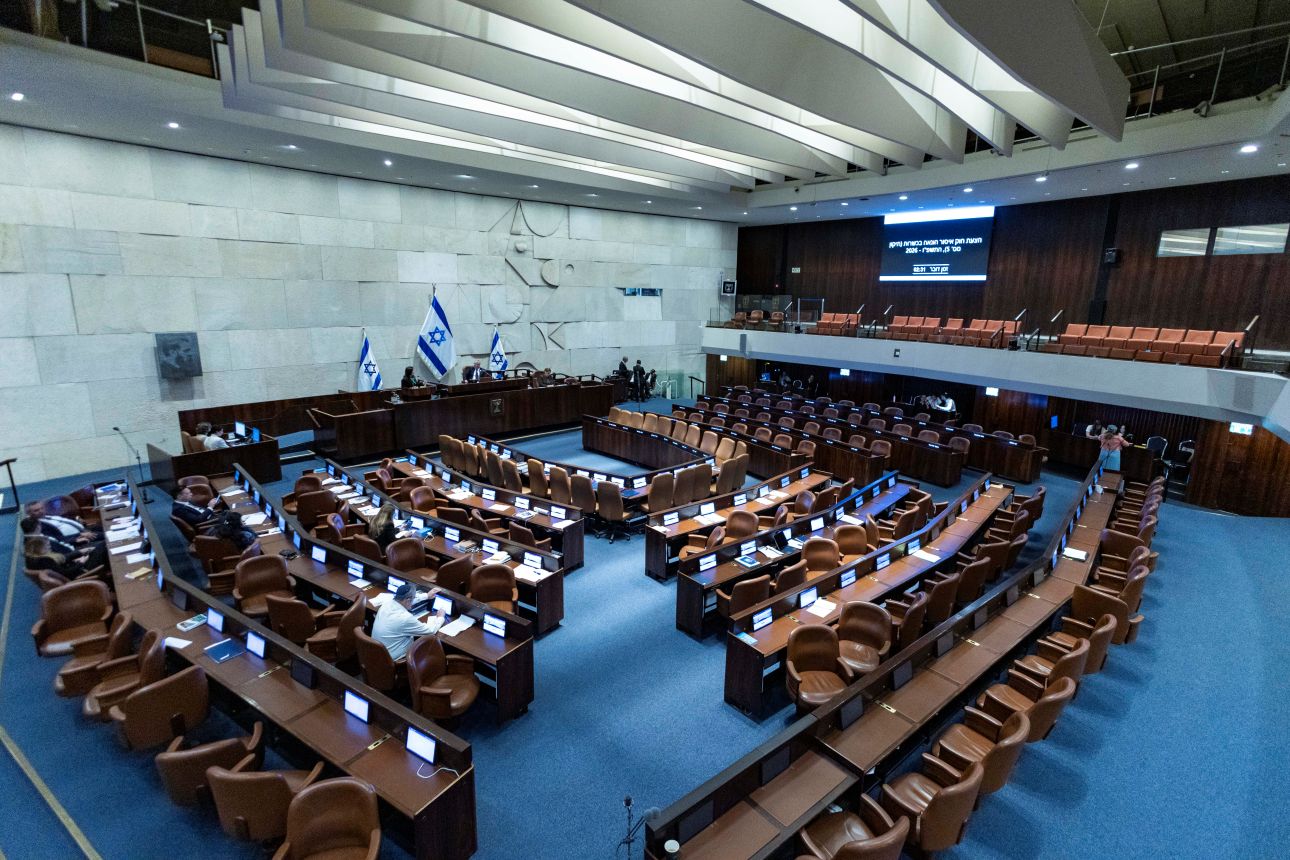
Photo by Chaim Goldberg/Flash90
According to the latest polls projecting the election results, and given statements by various parties ruling out cooperation with some of the other parties, there is a real possibility that no “bloc” will reach the coveted 61-seat majority in the Knesset. Following both elections in 2019, a similar situation prevented the formation of a government and sent Israel back to the polls for a third time in less than a year.
But this is not the only possible outcome of indecisive election results. Basic Law: The Government stipulates that “the Government is constituted when the Knesset has expressed confidence in it.” This means that forming a government does not require a majority of at least 61 Knesset members. A simple majority is sufficient: more votes in favor than against.
Parties that do not join the government as formal members can still help it take office by supporting it in the investiture vote, abstaining, or not taking part in the vote.
For example, a government could be sworn in with 54 Knesset members voting in favor, 52 against, and another 14 abstaining or absent. This is, at the very least, a plausible scenario, and various media reports suggest that political actors have already discussed it. Although rare in Israel, minority governments may, in certain circumstances, be considered the lesser of two evils.
A minority government is one where the members of parliament (MPs) who support it hold fewer than half the seats in parliament.
Minority governments are far from unusual in parliamentary democracies. A study examining types of government in parliamentary democracies between 1990 and 2020 found that roughly one-third were minority governments.[1] As of August 2026, most parliamentary democracies in the OECD (18 out of 26) have majority governments, while eight countries (31%) have minority governments: Norway, Estonia, Denmark, the Netherlands, Portugal, Slovenia, Spain, and Sweden. A minority government may consist of a single party or a coalition of two or more parties. Of the eight minority governments in OECD parliamentary democracies, seven are coalitions; only Norway has a single-party government.
The prime minister usually comes from the largest parliamentary party but may also come from the second- or third-largest. As of August 2026, for example, the prime ministers of Austria, Slovenia, Spain, and Sweden do not come from the largest parties in parliament. In Latvia, the prime minister is not even the leader of the largest party in the coalition (see Table 1 below).
A minority government can rely on formal external support or seek an ad hoc majority for each vote. With external support, sometimes referred to as “confidence and supply,” a party that does not join the government as a formal member undertakes to support it on key matters relating to its survival. These primarily include confidence votes and the passage of the budget, and sometimes additional policy issues. In return, the supporting party may receive policy commitments, funding, or other concessions, without receiving ministerial posts. These arrangements vary in how formally they are agreed. Without formal external support, the government must secure a parliamentary majority on an issue-by-issue basis. This requires ongoing negotiations with different parties in parliament. Such arrangements are much rarer and depend on a political culture of cooperation between the coalition and the opposition.
Table 1. Governments in Parliamentary Democracies: A Current Snapshot (August 2026)
|
|
Parliamentary status |
Composition |
Does the prime minister come from the largest party in parliament? |
|
Australia |
Majority |
Single party |
Yes |
|
United Kingdom |
Majority |
Single party |
Yes |
|
Greece |
Majority |
Single party |
Yes |
|
Canada |
Majority |
Single party |
Yes |
|
Austria |
Majority |
Coalition |
No |
|
Italy |
Majority |
Coalition |
Yes |
|
Iceland |
Majority |
Coalition |
Yes |
|
Ireland |
Majority |
Coalition |
Yes |
|
Belgium |
Majority |
Coalition |
Yes |
|
Germany |
Majority |
Coalition |
Yes |
|
Japan |
Majority |
Coalition |
Yes |
|
Israel |
Majority |
Coalition |
Yes |
|
Latvia |
Majority |
Coalition |
No |
|
Lithuania |
Majority |
Coalition |
Yes |
|
New Zealand |
Majority |
Coalition |
Yes |
|
Slovakia |
Majority |
Coalition |
Yes |
|
Finland |
Majority |
Coalition |
Yes |
|
Czechia |
Majority |
Coalition |
Yes |
|
Norway |
Minority |
Single party |
Yes |
|
Estonia |
Minority |
Coalition |
Yes |
|
Denmark |
Minority |
Coalition |
Yes |
|
Netherlands |
Minority |
Coalition |
Yes |
|
Portugal |
Minority |
Coalition |
Yes |
|
Slovenia |
Minority |
Coalition |
No |
|
Spain |
Minority |
Coalition |
No |
|
Sweden |
Minority |
Coalition |
No |
Factors enabling the formation of a minority government
The formation of minority governments depends on institutional rules, the structure of the party system, and parties’ incentives. A political culture of cooperation between the coalition and the opposition, or a history of minority governments, also matters.
Some countries require a new government to win the support of more than half of all members of parliament, known as an “absolute majority.” This is a strict requirement. Israel’s simple-majority requirement is less stringent. For example, in 2021, the new government won the Knesset’s confidence with 60 votes in favor, 59 against, and one abstention.
Other countries make it even easier for a government to take office. In Sweden, it can do so unless an absolute majority votes against it. This is known as “negative parliamentarism.” In Canada and Norway, no initial confidence vote is required. Even so, in any parliamentary system, parliament can later bring down or replace a government through a vote of no confidence.
Some countries, including Germany and Spain, begin by requiring an absolute majority in the first round or rounds of voting, then relax the requirement in later rounds.[2] A minority government can take office more easily where no initial confidence vote is required.
When parliamentary seats are divided among many parties, especially when there are no clear large parties, assembling a majority can be difficult. Ideological differences or disagreements over fundamental issues can also deter parties from joining a majority coalition. In these circumstances, a minority government can offer a compromise: parties may allow a government to form without joining it and taking on the full responsibilities that serving in government entails.
For much of the period since Spain’s transition to democracy, regional parties representing national minorities (Catalans and Basques) have provided external support to minority governments. These parties faced ideological difficulties in joining the national government, but sought gains for their regions. In return for parliamentary support, they secured resources or powers at the regional level, exercising influence without assuming direct responsibility for running the central government.
The growing strength of extreme parties on both the right and the left over the past two decades, at the expense of mainstream parties, has also encouraged the formation of minority governments. It has become harder to form a majority government without these parties, yet moderate parties have ruled out full cooperation with them. A minority government allowed them to rely on a certain party’s support to form or sustain a government without giving it ministerial posts or full involvement in running the government.
In Sweden, for example, following the 2022 election, moderate center-right parties formed a minority government without the Sweden Democrats, which was larger than any of the three coalition parties. The party, considered to be on the far right, provided external support to the government. The four parties signed the Tidö Agreement, which set out the terms of their cooperation and parliamentary support for the government. In Denmark, following the election held earlier this year, a minority government was formed with external support from the Red–Green Alliance, considered to be on the far left of the political spectrum.
Minority governments can also give parties representing disadvantaged groups or minorities a role in decision-making through external support, even when those parties find it difficult to join the government.
An Arab parliamentary party has never formally been a member of the government in Israel, but on at least two occasions, minority governments have relied on external support from Arab parties. The Rabin and Peres governments of 1993–1996 are one example. The same was true for at least part of the tenure of the “government of change” (2021–2022), when Ra’am was formally a member of the coalition but not of the government.
The traditional view is that a minority government is likely to be less stable because it cannot automatically rely on a majority in parliament. Parties supporting it externally are not necessarily as committed to it as parties within it and can withdraw their support more easily.
However, government stability also depends on which parties make up the coalition, how divided parliament is among different parties, and the rules governing the political system. For example, a minority government may be stable when it can rely on clearly agreed external parliamentary support, while a majority coalition government may face substantial internal disagreements.
The more stringent the conditions for bringing down a government or calling an early election, the more scope a government has to remain in office even without a regular majority supporting it. In Israel, replacing a government through a vote of no confidence requires at least 61 Knesset members to actually support an alternative government. This is known as a “constructive vote of no confidence,” and it may help a minority government remain in office.
However, 61 Knesset members can bring down the government without forming an alternative one by passing a law to dissolve the Knesset. A minority government’s survival therefore requires regular external support to prevent a situation in which it faces 61 clear opponents in the Knesset.
Lacking a majority in parliament should, in principle, make it harder to pass legislation and advance policy. Experience in other countries, however, shows a more complex picture.
When there is regular external support, the difference between a minority government and a majority government may be relatively small. By contrast, when support must be secured anew on each issue, the outcome of parliamentary votes is less certain.
Regional or sectoral parties may seek gains for the groups they represent, while ideologically driven parties may condition support on agreement on a limited number of policy issues. When the government must seek a different majority from among many parties for each vote, negotiations may become more demanding.
The absence of a coalition majority does not, in itself, make a government unstable, just as a parliamentary majority does not necessarily guarantee stability. Stability and the ability to advance policy depend on, among other things, on the structure of the party system, the identity of those supporting the government, the arrangements between them, and the rules governing the removal of a government.
A minority government is no magic solution to the absence of a parliamentary majority, but neither is it necessarily incapable of governing or merely a temporary “stopgap.” Where the rules allow it to take office, and especially where a clear support arrangement can be reached with parties outside the government, it may offer an alternative when a majority coalition cannot be formed.
In Israel, the absence of a 61-seat majority does not necessarily require another election: the law allows a minority government to be formed. Its ability to take office and govern, however, depends on the parties’ positions and their ability to reach agreements on external support.
[1] Bonnie N. Field and Shane Martin, eds. (2022). Minority Governments in Comparative Perspective. Oxford University Press.
[2] See a study detailing these models and proposing a reform of the government formation process in Israel (in Hebrew).
