

The President’s Role in Assigning the Task of Forming a Government
The results of Israel’s 2026 elections have left unresolved the question of who will be able to form a government that can secure the confidence of the Knesset. Against this backdrop, the president’s role in deciding which candidate to task with forming a government has taken on greater significance, with far-reaching public and political implications.
Photo by Oren Ben Hakoon/Flash90
After the election results are published, the president summons representatives of the parliamentary factions (i.e., the political parties and their joint lists) for consultations. Within seven days of the official publication of the results, the president must assign the task of forming a government to a Member of Knesset (MK) who has agreed to undertake it (the first assignment). That MK then has 28 days to form a government, and the president may grant extensions totaling no more than 14 additional days. The only statutory requirements are that the person entrusted with the task be a Member of Knesset and agree to accept it. The law also stipulates that the person who forms the government will head it.
If the candidate fails to form a government, informs the president that they are unable to do so, or presents a government that fails to win the confidence of the Knesset, the president must decide within three days whether to assign the task to another MK who has agreed to accept it (the second assignment), or to notify the Speaker of the Knesset that the president sees no possibility of forming a government. Before reaching a decision, the president may, but is not required to, consult again with representatives of the factions. The second candidate has 28 days to form a government, with no possibility of an extension.
If the second attempt also fails, or if the president decides not to assign the task to another candidate, at least 61 MKs may, within 21 days, ask the president to assign it to a particular MK who has agreed in writing. The president must grant the request within two days, and the candidate then has 14 days to form a government. If no such request is submitted, or this attempt also fails, the process leading to the dissolution of the Knesset and new elections is set in motion. The Knesset can also enact a law dissolving itself earlier, thereby terminating the government-formation process.
It is important to note that the president’s room to maneuver differs at each stage. On the first assignment, the president is required to consult the factions but has discretion over which MK to choose. On the second assignment, the president has somewhat greater latitude: the decision whether to consult the factions again is discretionary, as is the choice between assigning the task to another candidate and notifying the Knesset that there is no prospect of forming a government.
By contrast, when a majority of MKs submit a request to the president to assign the task to a particular MK, the president has no discretion and must assign it to the MK specified. This was clarified by the court in 2020 when it considered the assignment of the task to Benjamin Netanyahu at the request of 72 MKs. At this stage, the law gives the president two days, which, according to the court’s interpretation, are intended solely to allow the president to verify that the procedure is proper and that the signatures are authentic and were obtained lawfully. (HCJ 2592/20, Movement for Quality Government in Israel v. Attorney General, May 6, 2020.)
The law does not prescribe criteria for or impose limits on the president’s choice of candidate. However, because the purpose of the process is to form a government that can win the confidence of the Knesset, the president is expected to entrust the task to the candidate most likely to achieve that objective. This consideration is grounded in the purpose of the procedure: to establish a government as quickly as possible, in accordance with the balance of power in the Knesset, which reflects the will of the voters.
When the election produces no clear outcome, as in the current election, the president must assess the various possibilities for forming a government. This may include assigning the task to a candidate capable of forming a minority government—that is, a government supported by a coalition of fewer than 61 MKs but backed by factions outside the coalition, or one whose opponents do not constitute a majority. This is possible because the investiture vote (the vote expressing confidence in the incoming government) requires only a simple majority (that is, more votes in favor than against), rather than 61 votes in favor. Alternatively, the president may seek to facilitate informal talks among different factions to help them reach an agreement on forming a government.
Recommendations from the factions are central to the president’s decision-making because they indicate a candidate’s chances of forming a government. The law requires the president to consult the factions. However, the term “recommendations” does not appear in the law, which refers only to the obligation to consult with the factions’ representatives. By convention, the president consults every faction, although the wording of the law does not require this. Nor does the law oblige the president to assign the task to the candidate who receives the most recommendations.
Thus, the candidate receiving the most recommendations may not be the one the president considers most likely to form a government. For example, if one candidate has the support of 55 MKs and another has the support of 54, but only the second can form a unity government or minority government that wins the confidence of the Knesset, the president may choose the second candidate, despite having received fewer recommendations.
Following the 2021 election, Netanyahu received more recommendations and led the largest faction, yet he was unable to form a government. Ultimately, Yair Lapid, who led the second-largest faction and had received fewer recommendations, succeeded in doing so.
The law provides that the president may assign the task to any MK who agrees to undertake it, and that whoever forms the government will head it. It does not require the task to be assigned to the leader of the largest faction emerging from the election. This was the case in 2009: Kadima, led by Tzipi Livni, won 28 seats, while Likud, led by Netanyahu, won 27. Nevertheless, President Shimon Peres assigned the task to Netanyahu, having concluded that he had a better chance of succeeding. Netanyahu did indeed form a government that won the confidence of the Knesset.
Indeed, the wording of the law does not even require that the person chosen lead a parliamentary faction, although in practice presidents have chosen faction leaders since the law established that the person assigned the task would head the government. In theory, if consultations indicate that an MK who does not head an electoral list has a better chance of forming a government, the president may lawfully assign that person the task. Ahead of the election to the 21st Knesset (April 2019), speculation arose in political circles that the president might assign the task to MK Gideon Sa’ar of Likud, rather than Benjamin Netanyahu, who headed the same faction. A proposed bill dubbed the “Gideon Sa’ar Law” sought to stipulate that only faction leaders could be assigned the task, but the bill was ultimately not passed.
In any event, such a decision, even if permitted under the wording of the law, would place the president at the center of a political and public storm.
This question is at the heart of the debate over the limits of presidential discretion: Should the president confine the decision to an assessment of a candidate’s chances of forming a government, or may the president also consider whether that candidate is fit to lead it? The issue could arise, for example, when a candidate faces a pending criminal indictment, incites racism, or poses a threat to democracy.
Two opposing positions follow from the conception of the president as a state institution that stands above party politics. According to one, the president should discharge the role in the formation of a government in accordance with the election results and the positions expressed by the factions during the consultations, leaving value judgments to the public and its elected representatives. According to the other, it is precisely the president’s nonpartisan, institutional standing that imposes a duty to protect the state’s fundamental values and, in certain circumstances, to take normative considerations into account, even if they outweigh the primary consideration of forming a government.
Between these two positions is an approach holding that the primary consideration should be the purpose of the process, but that exceptional circumstances may warrant taking other considerations into account. Justice Hanan Melcer expressed a view along these lines:
“An examination of the above provisions (Sections 7 and 9 of Basic Law: The Government) and the length of time allocated to the president to conduct consultations before reaching a decision [...] indicate that the decision as to which Member of Knesset should be assigned the task of forming a government rests, by virtue of those provisions, with the president and is subject to the president’s exclusive discretion. [...] This is also why Section 12 of Basic Law: The President of the State provides that the president’s signature in this context of forming a government does not require a countersignature (by the prime minister or another minister designated by the government). When exercising the powers conferred by these provisions, the president is expected to assign the task of forming a government to the Member of Knesset with the greatest chance of succeeding. However, in exceptional circumstances, the president may also consider additional factors by virtue of the broad discretion vested in the office.”
(HCJ 2592/20, Movement for Quality Government in Israel v. Attorney General, May 6, 2020.)
Under this conception, it follows that presidential discretion should be guided primarily by considerations consistent with the purpose of the law—respecting the voters’ will and establishing a government—while normative considerations should be reserved for the most exceptional circumstances, as a measure of last resort.
To date, in most elections it has been clear which candidate had the best chance of forming a government. In a number of cases, however, the president has had to make a choice amid a tie between political blocs or a political deadlock.
In 1990, after the Knesset passed a vote of no confidence in the government, Shimon Peres and Yitzhak Shamir received recommendations from an equal number of MKs. President Chaim Herzog assigned the task to Peres, who at the time led the largest faction and whose faction had initiated the no-confidence motion, principally because he judged Peres more likely to form a government. Peres failed, and the president subsequently assigned the task to Shamir, who successfully formed a government. At the time, the no-confidence procedure differed from today’s, which requires a vote of confidence in an alternative government.
During the 2019–2021 political crisis, President Reuven Rivlin exercised his discretion at several junctures. Following the September 2019 election, he transferred the task from Netanyahu to Gantz. In 2020, he granted Gantz an extension of just 48 hours (rather than two weeks); when that period ended without a government having been formed, he decided not to assign the task to another candidate, but instead to place the next stage of the process in the hands of MKs, with the aim of encouraging them to agree quickly on a candidate. In 2021, after Netanyahu failed to form a government, Rivlin assigned the task to Yair Lapid. All these decisions were guided by the president’s assessment of which candidate was most likely to form a government that could win the Knesset’s confidence. Following the 2022 election, President Herzog assigned the task of forming a government to Benjamin Netanyahu because he had the best chance of succeeding, and Netanyahu did indeed form a government.
Presidential Assignments to Form a Government (2019–2022)
(Green = successful attempts; yellow = unsuccessful attempts)
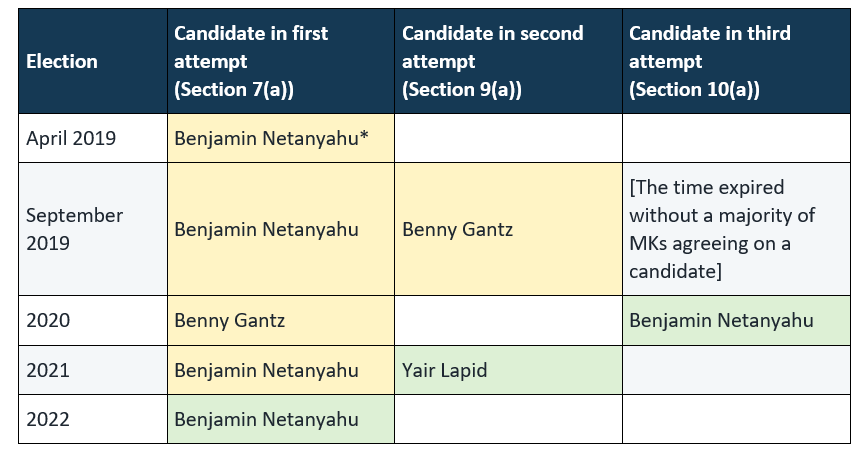
* Following the election, President Reuven Rivlin assigned the task of forming a government to Benjamin Netanyahu, but coalition negotiations reached an impasse. As the deadline for forming a government approached, the Knesset voted to dissolve itself early (pursuant to Section 12 of Basic Law: The Government), thereby depriving the president of any opportunity to consider assigning the task to another candidate.
Source: Blander and Kenig (2024), p. 137.
When no clear outcome emerges, the president may also seek to facilitate dialogue, propose solutions, and call on parties to reach agreements. Indeed, there have been cases in the past in which Israeli presidents played a role in finding solutions to politically inconclusive situations.
After the 1984 election, President Chaim Herzog played an active role in promoting the unity government and the rotation arrangement between Shimon Peres and Yitzhak Shamir. Following the September 2019 election, President Rivlin attempted to propose a framework to resolve the political impasse, but it was not accepted, and another election was held. President Isaac Herzog likewise used this informal form of mediation between opposing sides during the dispute over the judicial overhaul, even proposing his own framework, which was not accepted by the parties.
This option rests on the president’s nonpartisan standing as head of state and ability to mediate between the sides. Its success depends on political actors’ willingness to reach agreement and on the respect they have for the presidency as a national institution. It illustrates how a largely ceremonial, informal presidential role can acquire substantive significance in times of political crisis.
In many parliamentary democracies, the head of state plays a role in the government-formation process, but it is generally formal. The guiding consideration is the likelihood that the candidate can form a government that will win the confidence of parliament. Nevertheless, in a small number of exceptional cases, heads of state have also weighed normative considerations, primarily in connection with the appointment of ministers—a power the president of Israel does not possess.
In Italy, for example, in 1994 the president refused to appoint Silvio Berlusconi’s personal lawyer as justice minister due to a conflict of interest. In 2018, President Sergio Mattarella opposed the appointment of Paolo Savona as finance minister because of his views on the eurozone and concerns about economic stability. In Austria in 2000, the president objected to the appointment of two ministers from the Freedom Party against the backdrop of a criminal affair and extremist statements.
As noted, Israel’s president has no authority to approve ministerial appointments, so these cases are not directly comparable to assigning the task of forming a government in Israel. They do, however, sharpen the question of the scope of normative discretion available to a head of state occupying a nonpartisan office and whether, as a symbolic authority, the president should also consider factors related to the protection of fundamental democratic values, the public interest, and social cohesion. Such exercises of discretion by ceremonial heads of state are rare and often controversial.
The president enjoys immunity in the exercise of presidential functions, but case law has recognized that presidential acts may be reviewed indirectly. Thus, although the president does not personally respond to petitions challenging presidential decisions, those decisions may be subject to judicial review. In rulings concerning the president’s powers, particularly the power to grant pardons, the court has emphasized that intervention in the president’s discretion should be extremely limited, in light of the office’s unique status and symbolic character.
In petitions involving the assignment of the task of forming a government, the courts have attached weight to whether the president followed the legally prescribed procedure—namely, conducting consultations—and reached a decision that served the purpose of that procedure by assigning the task to the person the president considered most likely to form a government. For example, in a petition challenging the decision to assign the task to MK Benjamin Netanyahu following the election to the 21st Knesset, the court held:
“There is no dispute that the president complied with the provisions of the law, met with the heads of the factions, exercised his discretion, and assigned the task of forming a government to the Member of Knesset whom he considered to have the greatest likelihood of doing so. In so acting, he properly exercised the authority vested in him, and we have found neither grounds nor reason to intervene.”
(HCJ 2848/19, Shachar Ben-Meir et al. v. Benjamin Netanyahu et al., April 23, 2019.)
Further Reading
Dana Blander and Ofer Kenig, The Presidency in Israel, Israel Democracy Institute, 2024, especially Chapter 6, pp. 129–145.
Dana Blander, Ofer Kenig, and Assaf Shapira, “The Role of Heads of State in the Government Formation Process,” Israel Democracy Institute website, March 15, 2020.
