






Standard of Living and Quality of Life
Fully 95% percent of Israel’s Arab localities are ranked in the four lowest socioeconomic clusters (out of ten). More specifically, 11% of Arab localities are ranked in cluster 1, 21% in cluster 2, 44% in cluster 3, and 19% in cluster 4. By contrast, only 17% of Jewish localities are ranked in the four lowest clusters (1–4), while 68% are in the five highest clusters (6–10).
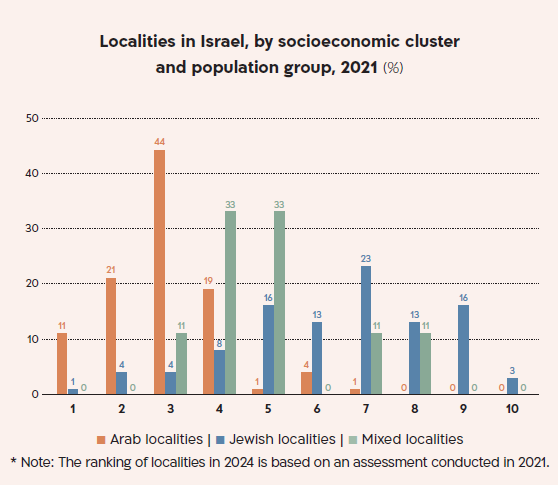
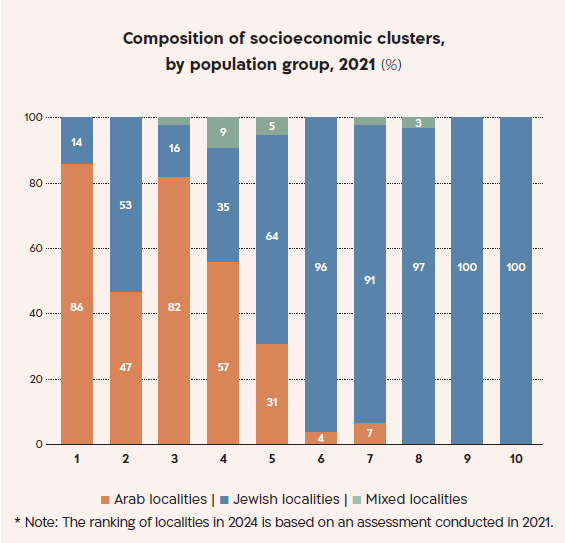
Arab localities are in the lowest socioeconomic clusters, while Jewish localities are in the highest clusters: 86% of the localities in cluster 1 are Arab and 14% are Jewish; 47% of the localities in cluster 2 are Arab and 53% are Jewish; and fully 82% of the localities in cluster 3 are Arab, while 16% are Jewish, and 2% mixed. By contrast, 100% of the localities in clusters 9 and 10, which are at the top of the scale, are Jewish, and these clusters do not contain any Arab or mixed localities.
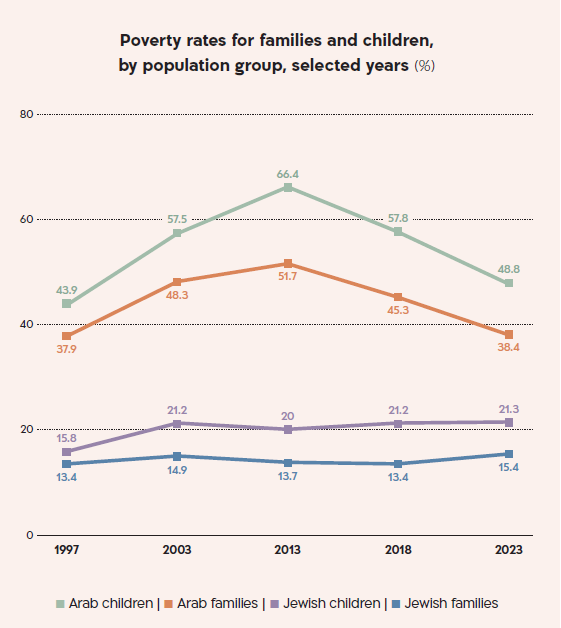
According to data from the National Insurance Institute for 2023, poverty rates in Arab society for both families (38.4%) and children (48.8%) have been on a downward trend over the past decade. However, poverty rates in Arab society are still more than twice as high as those in Jewish society for both families (15.4%) and children (21.3%). As noted, the trend within Arab society is one of steady improvement, but the gaps relative to Jewish society have remained.
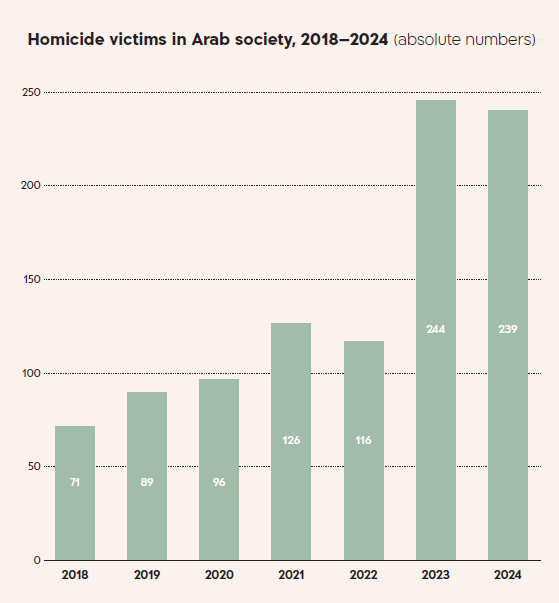
The murder rate in Arab society has been on the rise for the past two decades. Since 2000, more than 2,000 Arab civilians have been killed by internal violence. In 2024, the elevated levels observed in 2023 persisted, with 239 victims.
In this context, it should be noted that only 36 of the huge numbers of cases in which Arab civilians were murdered and injured have been solved. Despite the steady increase in the number of deaths and injuries, the majority of such cases and files are not solved by the Israel Police.