








Employment and Wages
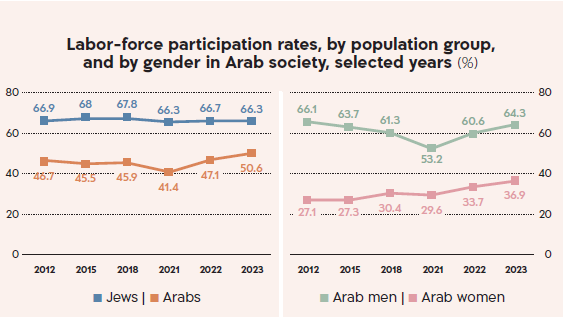
According to Central Bureau of Statistics data for 2023, 64.3% of Arab men participate in the labor force, a slightly lower rate than that of Jewish men (67.2%). Among women, there is a large difference: the labor-force participation rate among Arab women is 36.9%, much lower than the corresponding rate among Jewish women (65.4%). However, the rate among Arab women has increased by 10 percentage points over the past decade. In the primary labor force age group (25–54 years old), the participation rate of Arab women reached 50% in 2023.
Until the outbreak of the Swords of Iron War, the average monthly share of Arab job seekers out of all job seekers in Israel was 30.8%—larger than the share of Arabs in the country’s population. This proportion declined slightly over the first months following the outbreak of the war (down to a monthly average of 27.8%), due to the sharp increase in the number of job seekers in Israeli society as a whole. Toward the end of 2024, however, the number of job seekers in Arab society and their share of all job seekers in Israel returned to the levels observed before the war.
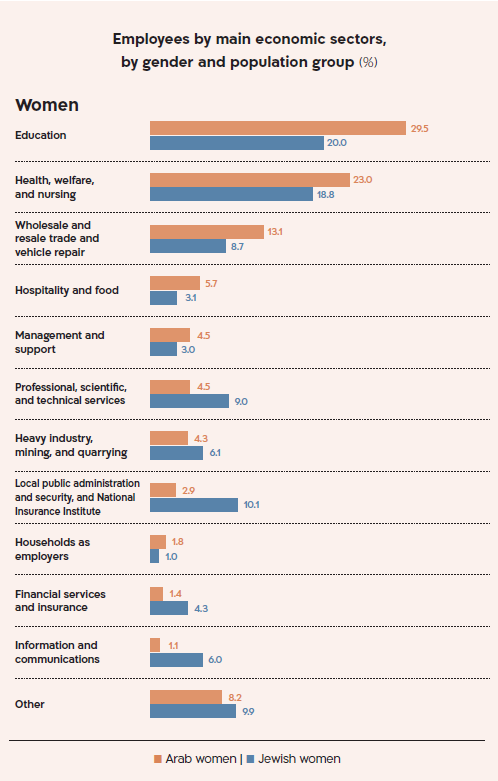
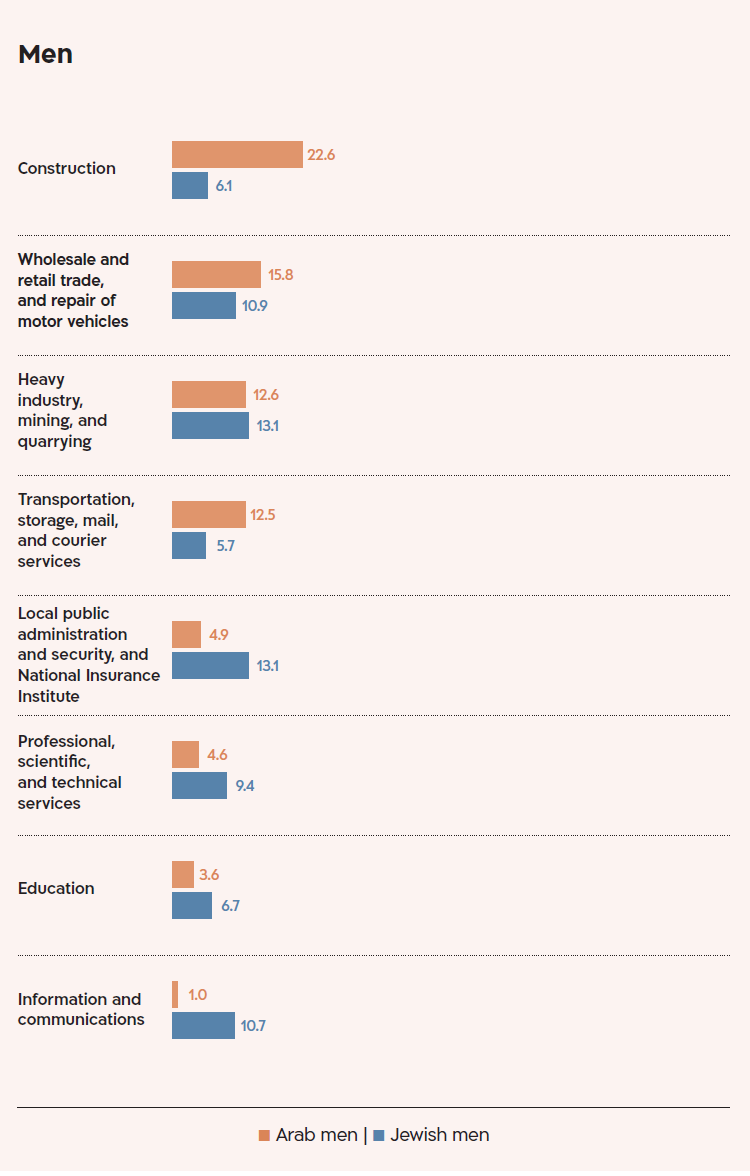
The Arab labor force is characterized by a relatively high concentration of employees in certain economic sectors (such as construction for men and education for women), while the Jewish labor force is more diverse. Furthermore, the Arab labor force is concentrated in economic sectors in which wages are lower than the average wage in Israel, while the Jewish labor force is concentrated in employment sectors with above-average wages.
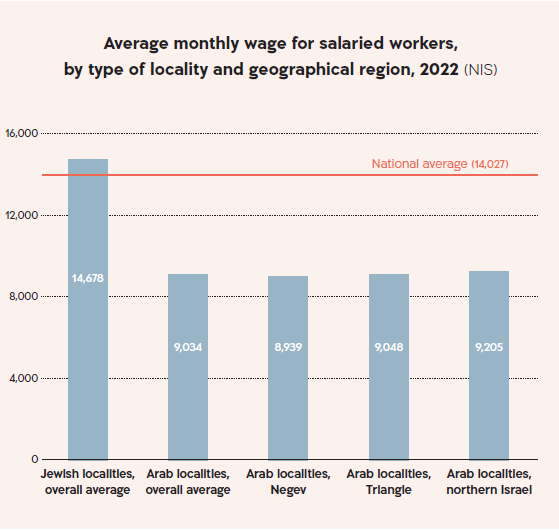
According to National Insurance Institute data, the average monthly wage of a salaried worker in a Jewish locality (NIS 14,687) is 63% higher than that of a salaried worker in an Arab locality, which is just NIS 9,034 (2022 data, updated to the end of 2024).
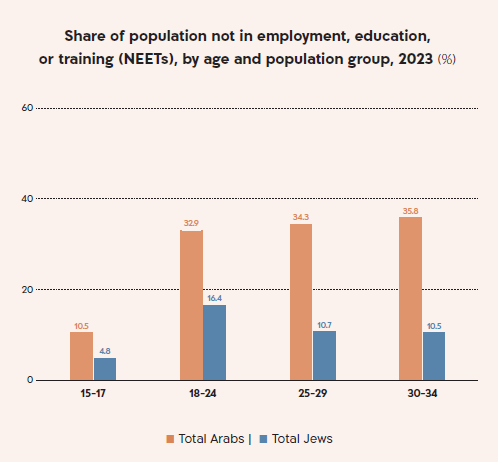
According to 2023 data, 32.9% of the 18–24 age group in Arab society are classified as NEETs (not in employment, education, or training). This percentage remains stable even in the next age groups up (covering ages 25–34), meaning that this is a chronic condition—particularly among women in Arab society—rather than a passing phase. By comparison, in Jewish society, only 16.4% of the 18–24 age group are classified as NEETs, and this proportion declines in later age groups (25–34) as they enter the labor market.
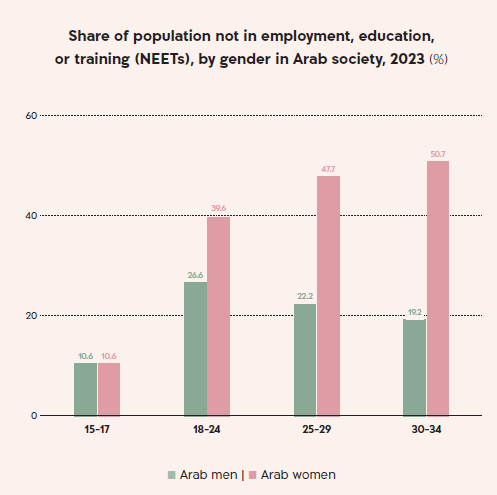
The proportion of Arab women defined as NEETs is significantly higher than that of Arab men in all age groups, and between the ages of 25 and 34, this percentage is more than twice as high among Arab women than among Arab men.