








Education
According to the data for the 2023–24 school year, there was an increase relative to the previous year in terms of the physical infrastructure of educational institutions. The number of schools in the Arab education system in Israel stands at 1,146, with 18,511 classrooms, and the number of students in grades 1–12 in the Arab education system is 453,011.
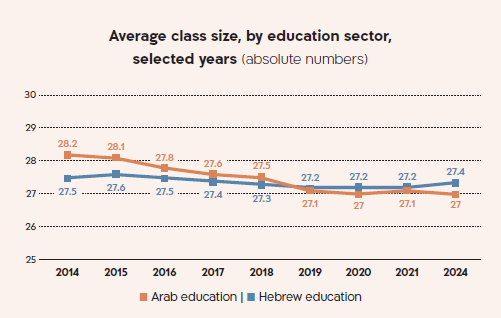
It should be noted that the changes in the Arab education system reflect a mix of both demographic changes and conceptual changes, according to which education has become a central tool for socioeconomic mobility. In this context, it is worth noting that up until a decade ago, the average number of students per class in the Arab education system was higher than the average in the Hebrew education system. Over the years, there has been a steady fall in the average number of students in both education systems, but the rate of decline in Arab education has been higher. Thus, the average number of students per class in the Arab education system in recent years has been slightly lower than the average in the Hebrew education system.
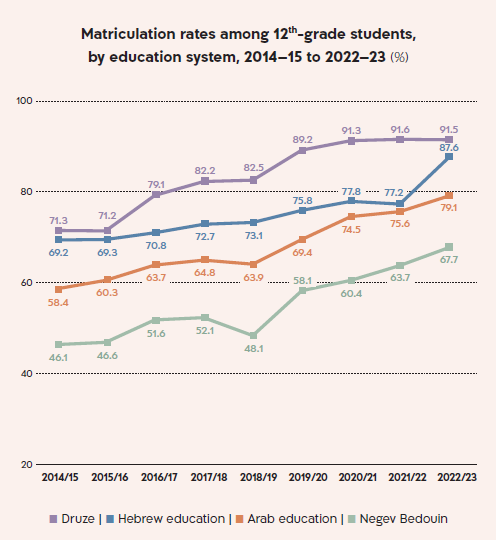
Similar to other indicators in this field, the matriculation rate (proportion of graduating students eligible for a bagrut certificate) in Arab education has also been rising steadily, and in recent years the gap between Arab and Hebrew education has narrowed. Though differences still remain, the matriculation rate in Arab education was 79.1% in the 2022–23 school year, while the matriculation rate in Hebrew education reached 87.6%. Within the Arab education system, matriculation rates are particularly high in Druze schools, and particularly low in Bedouin schools in the Negev.
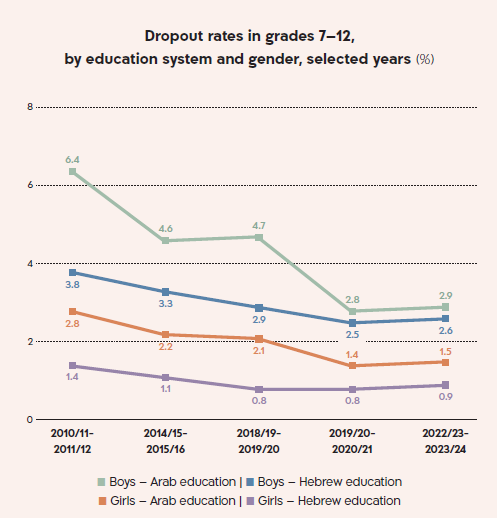
Rates of school dropouts are affected by social, gender, and geographic factors. In both Arab and Hebrew education systems, dropout rates are higher among boys than among girls, with the highest dropout rates among boys in Arab education. At the same time, the dropout rates among boys in the Hebrew education system are higher than those of girls in the Arab education system. Dropout rates are lowest among girls in Hebrew education. While the difference in dropout rates between the two education systems is narrowing, the overall gender gap between boys and girls remains stable.
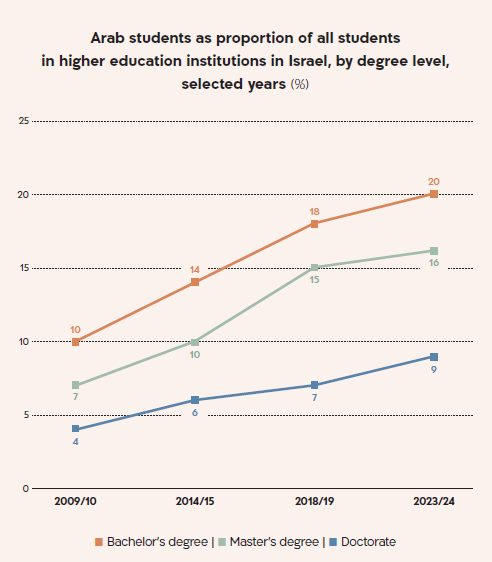
Arab society is experiencing a “higher education revolution.” Over the past decade, both the number of Arab students studying in institutions of higher education in Israel and the relative share of Arab students in the overall population of students in higher education have risen significantly. Both the number and proportion of Arab students at all degree levels doubled between the 2009–10 academic year and the 2023–2024 academic year, bringing the total number to over 60,000 students.
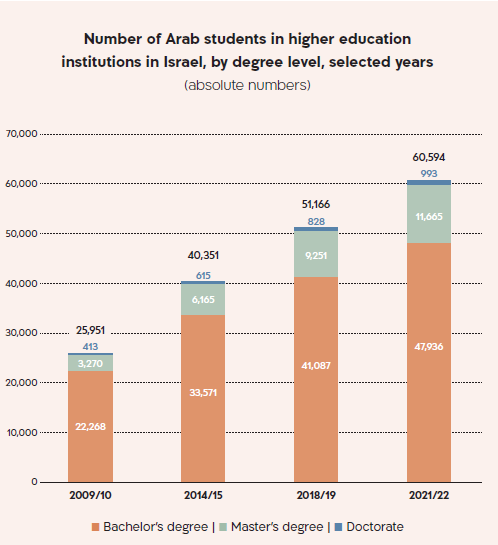
As can be seen in the figure below, the share of Arab students in the total population of undergraduate students in Israel has reached a record 20.4%. This proportion then falls to 16.3% for master’s degree students, and to 9.1% for doctoral students. Although the share of degree recipients declines as the level of education rises from bachelor’s to doctorate, these trends demonstrate the increase in the importance and value of education and how it affects other economic and social aspects.