

What Motivates Haredi Voters?
Haredi society features an unusually strong link between communal affiliation and voting patterns. Over the years, various mechanisms and motivations have been created to ensure that Haredi voters turn out to vote and to dictate which party they vote for. Will the conscription crisis and the events of recent years weaken these systems?
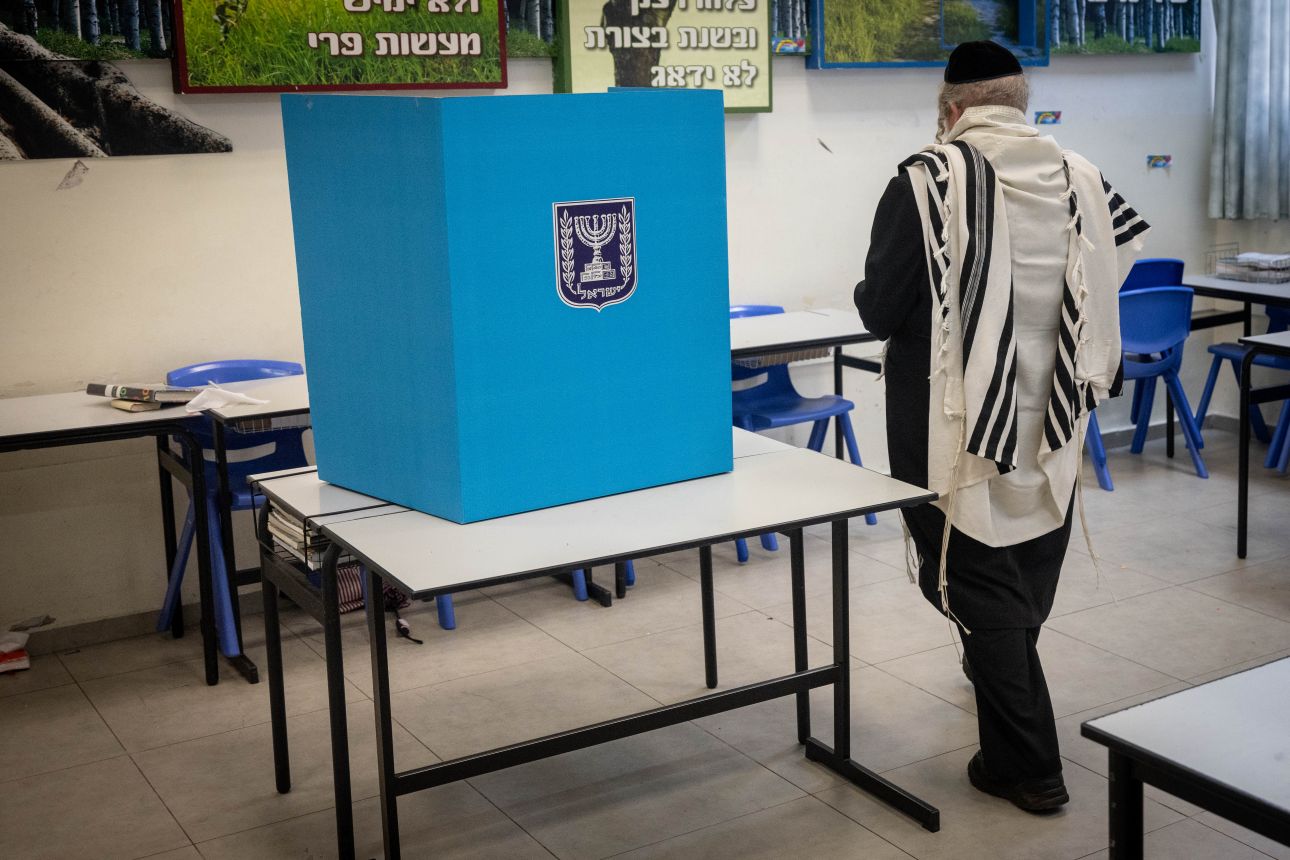
Photo by Chaim Goldberg/Flash90
Introduction: Will the Haredi “Voting Lock” Be Broken in 2026?
Are the Haredi parties expected to increase their political power in the upcoming elections? In theory, the rapid demographic growth of the Haredi sector should guarantee United Torah Judaism its eighth Knesset seat, but the Conscription Law crisis and changes within Haredi society could prevent this. Will Haredi voters “punish” their representatives in the 2026 elections, as has already happened several times in the past, or is their vote for Haredi parties guaranteed? To answer this question, it is necessary to examine in detail the voting motivations that are unique to this sector, and to assess whether the events of recent years have weakened them.
Haredi society features an unusually strong link between communal affiliation and voting patterns. The high levels of party loyalty have led researchers to define United Torah Judaism as a “cult party” that appeals exclusively inward, and Shas as a “church party” that also appeals to traditional audiences, but relies on a Haredi core with similar patterns of loyalty (Fischer & Beckerman, 2001).
Data from the 2025 Democracy Index reveal the dramatic gap between the approaches of Haredi and secular voters: 41% of Haredim reported that parties’ positions on issues of religion and state are the most influential factor in their decision-making (compared to 17% of non-Haredim), while 36% said that in any case, they will vote for the same party they have voted for in the past (compared to only 7% of the general public). By contrast, classic issues such as foreign affairs and security (5%), the economy (3%), or the identity of the party leader (4%) barely feature at all in Haredi voter considerations, in stark contrast to non-Haredi voters (22%, 21%, and 19%, respectively) (Hermann et al., 2025).
In order to fully appreciate the power of these voting patterns, they must be examined through the theoretical prism commonly used in political science, which distinguishes between rational and emotional motivations. The rational approach in political analysis differentiates between instrumental motivation (focused on material benefits) and expressive voting (based on identity expression) (Brennan & Lomasky, 1993). Political psychology, on the other hand, emphasizes emotional motivations of hope versus fear and threat (Marcus, Neuman, & MacKuen, 2000). However, while the issue of motivation and polarization has been examined extensively in relation to the general population of voters in Israel (Shamir & Arian, 1999; Shamir, Dvir-Gvirsman, & Ventura, 2017), the unique motivations of Haredi voters have not yet been comprehensively reviewed.
The following overview first maps out the three traditional drivers for “locking in” Haredi voters—communal, religious, and institutional motivations—and then presents a current analysis of three structural changes that are challenging existing patterns and worrying the Haredi parties ahead of the elections.
Voter Motivations in the Haredi Community
- The Communal Motivation: Safeguarding Interests and Collective Threat
From an early age, Haredi voters internalize the idea that the Haredi way of life represents absolute divine truth (Brown, 2017; Engelman, 2020; Belfon, 2020). The community’s autonomous education systems and deeply rooted socialization processes translate the strong identification with this absolute religious outlook and with the community into the practice of voting for Haredi parties (Stern et al., 2021). That is, Haredi voters have a deeply internalized sense that voting for these parties is the only way of achieving three critical sectoral goals (Galnoor & Blander, 2018; Horowitz, 2002; Kenig & Rahat, 2023):
- Securing resources: Ensuring public funding for community institutions in order to maintain existing norms.
- Consolidating autonomy: Preventing interference by state institutions in the Haredi way of life.
- Shaping the public space: Imposing Orthodox values at a national level.
Under the communal motivation, the individual is set aside in favor of the collective, mainly because the Haredi way of life is framed as being under constant external threat (Bick, 2002; Kenig and Rahat, 2023). Because the self is deeply intertwined with the Haredi community and its worldview (Engelman, 2020), threats to communal autonomy are experienced as existential threats to the life of the individual, evoking powerful feelings of fear that drive action (Belder, 2023).
Haredi individuals experience political attacks on their values as a symbolic threat to their identity, and they are mobilized to defend the group’s status against rival outgroups, which are usually framed as the Left, the Israeli media, and the judicial and law enforcement systems (Brown, 2012; Horowitz, 2002). Importantly, this sense of threat translates into unwavering voter support for a specific party (United Torah Judaism for Ashkenazi Haredim and Shas for Mizrahi Haredim), in contrast to the diverse voting patterns we are familiar with among other social groups (Ozzano, 2013).
Furthermore, voting serves as a tool for validating sectoral identity, especially for voters on the margins of the community, such as modern Haredim (Zicherman and Cahaner, 2012). Even when they are critical of the Haredi leadership, their actions at the ballot box declare to themselves and those around them: “We are part of the Haredi camp.”
2. The Religious Motivation: The Doctrine of “Da’at Torah” and the Obligation to Obey
The sole and supreme source of authority for Haredi voters in public decisions lies with the rabbinical leadership, which is perceived as possessing ultimate religious wisdom (Brown, 2012, 2014). Since the establishment of the State of Israel, the historic decision made by the Haredi “great sages” has been to engage in active participation in Israeli politics in order to fortify Haredi society and Torah observance and study (Belder, 2023; Brown, 2002; Friedman, 1990).
The rabbinic ruling that it is obligatory to vote for the Haredi parties has a decisive effect:
- Denial of alternatives: The ruling by the “great sages” denies individuals any legitimacy for breaking ranks - abstaining from voting or voting for a different party (Bick, 2002; Brown, 2011; Cohen & Lazar, 2019; Friedman, 1991; Kenig & Rahat, 2023).
- Positive motivation and religious satisfaction: The normative link between voting and religious obligation turns the act of voting into a clear religious commandment (“And you shall do as you are instructed”), which yields the voter deep personal satisfaction from the act of obedience (Brown, 2011).
As a result, this motivation may be even stronger than the community motivation.
3. The Institutional Motivation: Social and Technological Oversight
Alongside the ideological and religious motivations, the Haredi system leaves no room for public deviation and employs strict social and communal pressure mechanisms (Bergman et al., 2017; Engelman et al., 2020), which manifest in full force on election day. These include not only normative pressures, but also close mutual supervision by the immediate environment and communal institutions (such as yeshivot and Hasidic courts).
In recent years, this supervision has been marked by rising use of technology:
- Digital management in real time: The community operates computerized headquarters that cross-check voting data online (Azoulay et al., 2020).
- Direct and aggressive pressure: Designated community members call those who have not yet voted, and even physically send activists to voters’ homes (Nahshoni, 2019).
As a result, environmental pressure makes abstention or deviation from communal dictates almost impossible, and “locks in” Haredi voters at the ballot box, even if their own internal motivations to vote are low at the time.
The 2026 Test: Fractures in the Haredi “Voter Lock” Mechanisms
The three motivations described above have created an almost hermetically closed voting model over the years. However, in several cases in the past, damage to one of the first two motivations (defense of Haredi identity and obedience to rabbis) has led to a decline in voter turnout for United Torah Judaism. In 2009, internal Haredi disputes led to a loss of voter confidence and to the only case in which the party lost a Knesset seat. In the 2015 elections, part of the Jerusalem Faction (Peleg Yerushalmi) abstained from voting on the instructions of its rabbis, and United Torah Judaism suffered a fall in its voter share in strongly Haredi locations. In the 2021 elections, which were held during the COVID-19 pandemic, there was also a decline in the share of voters for United Torah Judaism as a result of internal resentment toward the Haredi parties over their conduct during the health crisis (Malach, 2025). The current 2026 elections are being held at a unique point in time, when, for the first time, these two motivations have both suffered considerable damage:
- The Conscription Law Crisis
The resounding failure of the Haredi political representatives to secure the legal status of yeshiva students has created resentment on the Haredi street. Haredi voters are asking: What is the point of voting for the Haredi parties if yeshiva students were harmed to an unprecedented degree on their watch? The June 2026 Israeli Voice Index Survey found that only 28% of Haredim award a high score to the success of the Haredi political leadership in advancing the interests of their voters (Hermann et al., 2026). This frustration may translate internal public disappointment into active abstention from voting
2.The Crisis of Rabbinical Authority
The doctrine of “da’at Torah” (according supreme authority to the “great sages” of the generation) works perfectly when there is a clear rabbinical consensus. Over the past two years, however, there has been harsh criticism from the Jerusalem Faction and from Sephardi and Hasidic Torah sages regarding the Haredi parties’ willingness to advance a “conciliatory” conscription law. This may result in erosion of the ability to formulate a unified rabbinic ruling - a clear Da'at Torah - requiring all Haredim to turn out and to vote for the Haredi parties.
3. The Rapid Growth of the Modern Haredi Sector
The events of the October 7 war dramatically accelerated the development of the “modern Haredim” as a group with characteristics distinct from mainstream Haredim (Gado, 2024). The cultural and ideological divide that has opened up between this group and the leadership of the official parties, especially on the question of conscription and burden-sharing, creates an unprecedented potential for votes to leak away from the Haredi camp, especially given the current initiatives to establish new political lists to represent modern Haredim.
Conclusion
The combination of the three traditional motivations—communal, religious, and institutional—has over the years ensured the exceptional level of voter turnout in the Haredi sector and created a rigid “locking” mechanism between sectoral affiliation and party loyalty. Through the prism of the rational and emotional approaches, this mechanism operates on two levels: at the individual level, it relies on deep expressive-emotional motivation (pride in identity alongside fear of an external threat), while at the collective level it functions as an effective instrumental tool for ensuring autonomy and resources for the group. When internal drivers have been weakened in the past, institutional and digital oversight mechanisms have been successful in “locking in” the voter at the ballot box and preventing a leakage of votes.
However, as shown by the historical precedents of 2009, 2015, and 2021, the Haredi locking mechanism is not completely immune to internal and external shocks. The current election campaign of 2026 is presenting the Haredi parties with major challenges. The profound damage to the communal motivation caused by the failure to pass the Conscription Law, along with the erosion of unified rabbinical authority and the consolidation of the modern Haredi sub-sector following the events of October 7, have created considerable cracks in the two basic engines of the sectoral vote.
In these circumstances, the electoral equation for the upcoming elections is drastically changed: After a decade in which the number of Knesset seats held by United Torah Judaism has remained stable, the cumulative demographic growth since the 2013 elections (when the party won seven seats) has the potential to finally bring an eighth seat. But if the current cracks are translated on election day into active abstention from voting, or into leakage of votes from modern Haredim to non-Haredi parties, then the Haredi parties may end up with a weaker hand after the elections, at the very time when demographic growth promised them greater political power.
To combat this possibility, the religious and political Haredi leadership will attempt to activate the mechanisms that remain least affected by the current crisis. First, it will seek to emphasize the significant threat posed by out-groups to the Haredi community and its way of life, translating Haredi feelings of persecution into a sense of urgent existential and spiritual danger, with the familiar rhetorical style of “Jews, the town is burning!” Second, the campaign is expected to appeal to the identity-based emotional mechanism by reinforcing the communal expectation that Haredim vote in accordance with the community's directive, especially in time of a clear external threat on the Haredi group’s status. The goal will be to appeal particularly to modern Haredim and foster the perception that preserving their Haredi identity requires them to vote “as Haredim.”
The leadership’s success in these attempts will be measured by the extent to which it is able to bring home the community’s “lost children,” despite the strong criticism, and thus realize its electoral potential.
Sources
Hebrew:
Azoulay, M., Karni, Y., Ataly, A., Nahshoni, K., & Sha’alan, H. (2020). Volunteers, Signs, and Videos: Parties Prepare for Election Day. Ynet, March 1. https://www.ynet.co.il/articles/0,7340,L-5686637,00.html
Brown, B. (2002). From Political Separation to Cultural Entrenchment: The Chazon Ish and the Determination of the Path of Haredi Judaism in the Land of Israel. In M. Bar-On & Z. Tzameret (Eds.), The Two Sides of the Bridge: Religion and State in the Early Stages of Israel (pp. 364–414). Jerusalem: Yad Yitzhak Ben-Zvi.
Brown, B. (2011). Toward Democratization in Haredi Leadership? The Doctrine of “Daat Torah” at the Turn of the Twentieth and Twenty-First centuries. Jerusalem: Israel Democracy Institute.
Brown, B. (2012). Trembling at the Word of the People: Haredi Critique of Israeli Democracy. Jerusalem: Israel Democracy Institute. https://www.idi.org.il/books/5730 Brown, B. (2017). The Haredim: A Guide to their Beliefs and Sectors. Tel Aviv and Jerusalem: Am Oved and the Israel Democracy Institute.Fischer, S., & Beckerman, Z. (2001). Church or Cult? In Y. Peled (Ed.), Shas: The Challenge of Israeliness (pp. 321–342). Tel Aviv: Yedioth Ahronoth.
Friedman, M. (1990). The State of Israel as a Religious Dilemma. Alpayim, 3, 24–68.
Friedman, M. (1991). The Haredi Society: Sources, Trends and Processes. Jerusalem: Jerusalem Institute for Israel Studies.
Gado, T. (2024). The New Haredi Rabbinical Leadership in Times of War. In S. Ravitzky Tur-Paz (Ed.), And You Will Be Silent: Has Haredi Society Changed During the War? (pp. 176–179). Jerusalem: Israel Democracy Institute.
Horowitz, N. (2002). Jews – The Town is Burning! United Torah Judaism Between the 1999 and 2001 Elections. Jerusalem: Floersheimer Institute.
Kenig, O., & Rahat, G. (2023). Political Parties in Israel, 1992–2021. Jerusalem: Israel Democracy Institute. https://www.idi.org.il/books/49902
Nahshoni, K. (2019). Like a Religious Commandment: Shas and United Torah Judaism Aspire to 100% Voter Turnout. Ynet, September 15. https://www.ynet.co.il/articles/0,7340,L-5589095,00.html
Stern, Y. Z., Yaffe, N., Malach, G., & Malchi, A. (2022). Jewish, Haredi, and Democratic: The State of Israel and Democracy Through Haredi Eyes. Jerusalem: Israel Democracy Institute. https://www.idi.org.il/books/38285
Zicherman, H., & Cahaner, L. (2012). Modern Ultra-Orthodoxy: The Emerging Haredi Middle Class in Israel. Jerusalem: Israel Democracy Institute.
English:
Belder, F. (2023). Societal Security: A New Conceptual Framework to Analyse Haredi (Haredi) Politics in Israel. Ankara Üniversitesi SBF Dergisi, 78(3), 561–581. https://doi.org/10.33630/ausbf.1206745
Belfon, D. (2020). Leaving Orthodox Judaism. In Handbook of leaving religion (pp. 142-153). Brill.
Bergman, Y. S., Horenczyk, G., & Abramovsky-Zitter, R. (2017). Perceived Discrimination and Well-Being Among the Haredi in Israel: The Mediating Role of Group Identity. Journal of Cross-Cultural Psychology, 48(9), 1320–1327. https://doi.org/10.1177/0022022117722859
Bick, E. (2002). The Shas Phenomenon and Religious Parties in the 1999 Elections. Israel Affairs, 7(2–3), 55–100. https://doi.org/10.1080/13537120108719599
Brennan, G., & Lomasky, L. (1993). Democracy and Decision: The Pure Theory of Electoral Preference. Cambridge University Press.
Brown, B. (2014). Jewish Political Theology: The Doctrine of Daʿat Torah as a Case Study. Harvard Theological Review, 107(3), 255-289.
Cohen, A., & Lazar, M. (2019). Electoral Choice and Religion: Israel. In Oxford Research Encyclopedia of Politics. https://doi.org/10.1093/acrefore/9780190228637.013.796
Engelman, J., Milstein, G., Schonfeld, I. S., & Grubbs, J. B. (2020). Leaving a Covenantal Religion: Orthodox Jewish Disaffiliation from an Immigration Psychology Perspective. Mental Health, Religion & Culture, 23(2), 153–172. https://doi.org/10.1080/13674676.2020.1744547
Galnoor, I., & Blander, D. (2018). The Handbook of Israel’s Political System (1st ed.). Cambridge University Press. https://doi.org/10.1017/9781316160978
Hermann, T., Yohanani, L., Kaplan, Y., & Sapozhnikova, I. O. (2025). The Israeli Democracy Index 2025. Jerusalem: Israel Democracy Institute. https://en.idi.org.il/media/30427/the-israeli-democracy-index-2025-full-english-version.pdf
Hermann, T., Yohanani, L., & Kaplan, Y. (2026). The Israeli Voice Index: June 2026 Survey. Jerusalem: Israel Democracy Institute. https://en.idi.org.il/articles/64918
Malach, G. (2025). Does the Increase in the Power of United Torah Judaism’s Electoral Strength Correspond to Haredi Population Growth? In G. Rahat, N. Gidron, & M. Shamir (Eds.), The Elections in Israel 2022 (pp. 371–405). London: Routledge.
Marcus, G. E., Neuman, W. R., & MacKuen, M. (2000). Affective Intelligence and Political Judgment. Chicago: University of Chicago Press.
Ozzano, L. (2013). The many faces of the political god: A typology of religiously oriented parties. Democratization, 20(5), 807–830. https://doi.org/10.1080/13510347.2013.801253
Shamir, M., & Arian, A. (1999). Collective Identity and Electoral Competition in Israel. American Political Science Review, 93 (2): 265–277.
Shamir, M., Dvir Gvirsman, S., & Ventura, R. (2017). Taken Captive by the Collective Identity Cleavage: Left and Right in the 2015 Elections. In M. Shamir & G. Rahat (Eds.), The Elections in Israel 2015. London: Routledge.