
The Rise in Voter Turnout in Arab Society in the Elections for the 26th Knesset
The elections for the 26th Knesset were marked by extraordinary electoral mobilization among Israel’s Arab minority, reflected in a sharp rise in voter turnout. What explains this increase?
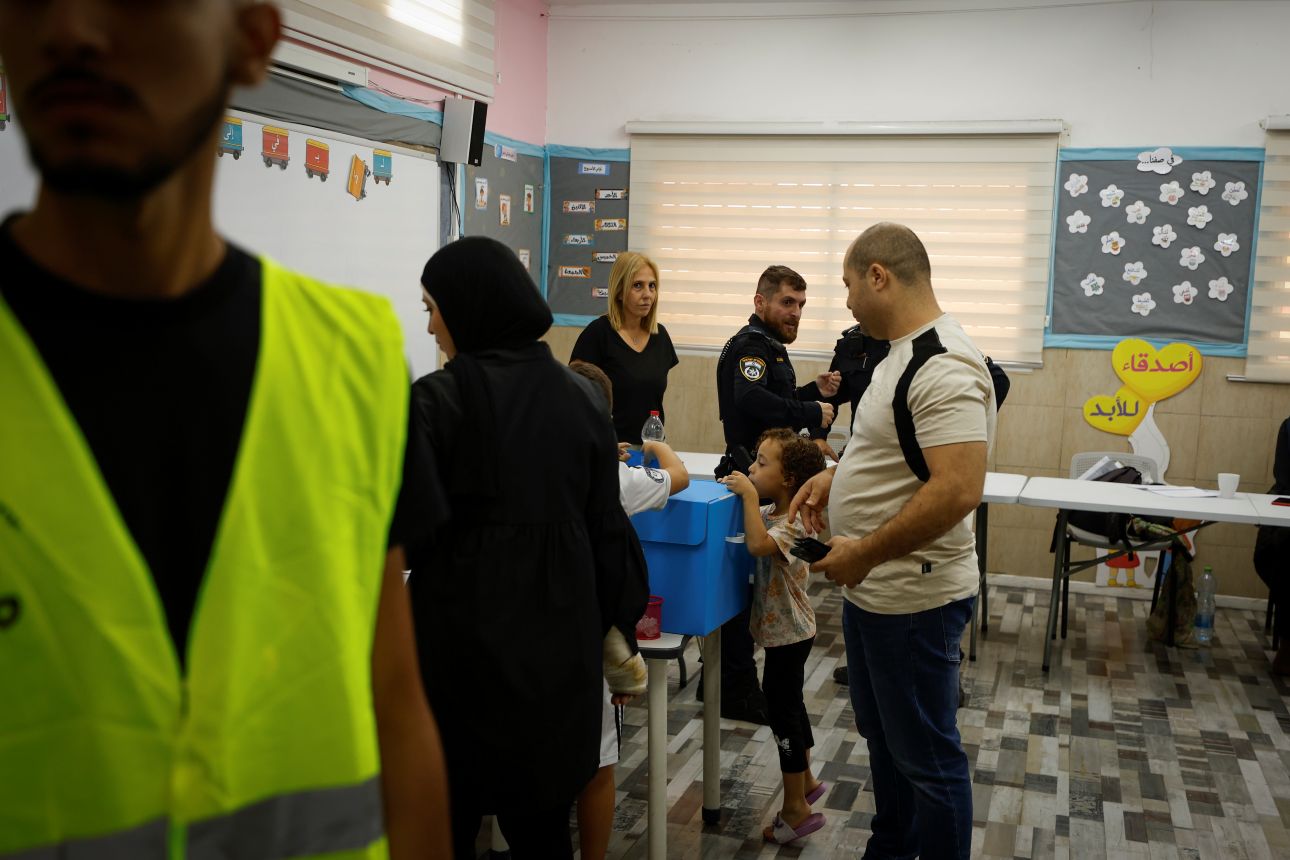
Photo by Jamal Awad/Flash90
With all votes counted, including double-envelope ballots, the Joint List (11) and Ra’am (8) won a combined 19 seats in the 2026 elections—an exceptional number in the history of Israel’s Arab minority. The substantial expansion in electoral participation in Arab society includes populations that have historically recorded low turnout in previous elections.
According to an analysis of polling station data from Arab and Druze localities, which, at the time of writing this piece, does not include Arab voters in mixed cities, turnout in Arab society in the 2026 elections stands at approximately 77%. This is close to the turnout recorded in the 1996 elections (79.3%) and among the highest levels in the past three decades. Compared with the turnout rate of 53.2% in the 2022 elections for the 25th Knesset, the figures indicate an increase of approximately 24 percentage points—a substantial shift in electoral participation in Arab society.
The increase is particularly striking among the Bedouin population in the Negev. Voter turnout is approaching 80%, compared with approximately 51% in the 2022 elections. In the unrecognized villages in the Negev, turnout has also risen significantly, reaching approximately 74%, compared with approximately 38% in the previous elections. A similar trend is emerging in other regions. In the Arab and Druze localities in the Galilee and northern Israel, 463,824 of the 608,362 eligible voters cast their ballots—a turnout rate of 76.24%, compared with 54.24% in 2022, an increase of 22 percentage points. In the Triangle, 180,629 of 230,512 eligible voters cast their ballots—a turnout rate of 78.36%, compared with 52.49% in the previous elections, an increase of approximately 26 percentage points.
What explains the high voter turnout?
One of the main explanations lies in the cumulative experiences of the Arab minority over the past four years under the current government. Certain government policies, racist remarks from members of the government, and a sense that the status and rights of Arab citizens have been undermined have deepened feelings of alienation and the perception that their ability to exert influence is steadily diminishing. These feelings were clearly reflected in the latest Israeli Voice Index survey, published about two weeks before the elections: 78.5% of Arab respondents said they were pessimistic about the future of democratic governance in Israel, while only 20% expressed some degree of optimism.[1] The large gap between Arab and Jewish respondents on this question—45% of Jewish respondents were pessimistic about the future of democratic governance, while 51% were optimistic—demonstrates the marked difference between the two groups in how they envisage the country’s future democratic character. More broadly, following the events of October 7, feelings of being silenced and fears of expressing opinions intensified among Arab citizens, alongside the perception that the rhetoric and conduct of some officials in government have lent legitimacy to violations of rights and democratic principles. These views were reflected in an in-depth survey conducted by the Israel Democracy Institute among Arab citizens of Israel in December 2025, more than two years after the start of the war: only 13% of respondents reported feeling comfortable expressing themselves freely on social media, and only about half (47%) said they felt comfortable speaking to one another in their native language, Arabic, in the presence of Jews. At the same time, the overwhelming majority expressed concern about their future physical or economic security (85% and 79%, respectively). These feelings were fueled by frustration and despair at the government’s failure to address violence and crime in Arab society, which had become the issue of greatest concern to the Arab public during this period: 75% of respondents identified it as the most significant internal threat they faced.[2]
Against this backdrop, participation in the elections can be understood as an expression of the desire to break the cycle of silence and powerlessness, make their voices heard, and work toward change. Voting reflects more than a party preference; it can also be seen as an effort to defend their civic standing and exercise their ability to influence the political reality through democratic means. In this context, the motivation to vote among young people in Arab society who were eligible to vote in Knesset elections for the first time merits attention. According to a large-scale survey conducted by the Israel Democracy Institute among Jewish and Arab first-time voters, 87% of Arab respondents said they intended to vote; 62% said they were certain they would do so. The share of Arab respondents who intended to vote was similar to the overall figure of 91% for the full sample. One of the takeaways from this survey was that this finding might indicate an increase in voter turnout in Arab society in the Knesset elections—a conclusion that subsequently proved correct.[3]
At first glance, there appears to be a contradiction between Arab citizens’ growing alienation from state institutions and their deep concern about the country’s democratic character, on the one hand, and their exceptionally high participation in Knesset elections, on the other. High turnout, after all, indicates confidence in the democratic process, while the Knesset is the state’s highest representative institution and its composition is determined by that process. This development should therefore be understood as an effort by Arab citizens to make full use of the democratic right afforded to all citizens: voting in elections. The message that all citizens enjoy full equality at the ballot box, regardless of who they are, and that every vote counts equally, whether cast in an Arab or a Jewish locality, was emphasized repeatedly in the Arab lists’ election campaigns. The results indicate that this message reached the Arab public and instilled a sense of political efficacy. It is still too early to determine whether this marks a turning point in how Arabs in Israel understand the nature of their citizenship, or whether their turnout in Knesset elections will remain higher than in the past. Nevertheless, the Arab vote in the 2026 elections will stand as a prominent milestone in the history of Arab politics in Israel.
A second explanation for the increased turnout is the effective campaigns conducted by the parties. Ra’am strongly promoted participation in government, persuading Arab voters that their interests would be advanced only if an Arab party became part of the governing coalition. To this end, it also placed Yoav Segalovitz second on its candidate list. This was intended both to signal to the Jewish parties that Ra’am was serious about joining the government formed after the elections, and to present Segalovitz to the Arab public as a professional capable of addressing crime in Arab society from within the government, as he had done as deputy national security minister in the Bennett–Lapid government in 2021–2022. The Joint List presented Arab voters with two objectives: first, to form a bloc that would deny a Netanyahu-led bloc a majority in the Knesset and prevent it from forming the next government; and second, to provide a parliamentary safety net for a government that includes the change bloc, ensuring that even if Arab citizens were not represented in the government, they would still have a say in determining which government takes office. At the many public gatherings held during their election campaigns, the Arab lists focused their messages on the range of issues troubling Arab citizens, including the acute need to combat crime and violence, prevent home demolitions, particularly in the Negev, and address the housing shortages affecting Arab localities across the country. These messages found a receptive audience. A survey conducted by the Israel Democracy Institute one week before the elections found that 44% of Arab respondents said they would vote for a party that could successfully address the cost of living. This was their leading consideration, ahead of other issues they regarded as less important. In the same survey, 21.5% of Arab respondents said they would vote for a party that could successfully address divisions within Israeli society, while only 19% said they would vote for a party that could successfully address foreign policy and security challenges.[4]
A third explanation for the increase in voter turnout lies in the exceptional consensus that emerged within Arab society around participation in Knesset elections. Over the past three decades, every election campaign has been accompanied by a political debate within the Arab community over whether voting offers any real benefit and whether participation can be justified from a Palestinian perspective. Until these elections, grassroots groups advocating an election boycott had rejected participation on ideological grounds, arguing that it was unacceptable to confer legitimacy on the parliament of the Jewish state. This time, however, the picture changed. For the first time, voices within these circles also argued that the benefits of participation outweighed any potential harm or drawbacks. Replacing the right-wing government, they contended, could benefit not only Arab citizens of Israel but also Palestinians in Gaza and the West Bank. Moreover, a new government established with the direct or indirect support of the Arab parties could change its policies toward both Israel’s Arab citizens and Palestinians who are not Israeli citizens.
What can we learn from Arab voters’ participation in the elections?
The increase in voter turnout points to widespread political mobilization among Israel’s Arab minority and may also indicate a heightened awareness of its status in the country, its rights, and its ability to influence the political reality. The circumstances described above can be understood as factors that heightened the sense of urgency and the desire for change, reflected in a greater willingness to participate in elections. Choosing the ballot box as a means of expressing the desire for change signals a continued willingness to work within the democratic framework and an expectation that such participation can yield tangible influence. Even against the backdrop of feelings of exclusion and alienation in recent years, there is a clear demand for a role in shaping the country’s future and for the realization of equal citizenship. In this sense, the high turnout carries a political message: Arab citizens want their voices to be reflected in decisions affecting their lives, rights, and status.
This mobilization presents both an opportunity and a test for Israeli democracy: will its commitment to equality for all its citizens also be reflected in a willingness to allow Arab citizens and their representatives to play a meaningful role in shaping the agenda, forming the government, and making decisions.
The survey conducted by the Israel Democracy Institute shortly before the elections found broad support among the Arab public for the inclusion of Arab parties in the next coalition: 71% of Arab respondents said they supported a coalition of center and left-wing parties with outside support from, or participation by, the Arab parties. A total of 58% of Arab respondents supported Ra’am joining the next coalition, while 14% were prepared to settle for Ra’am providing a parliamentary safety net for the government without joining it. Similar, though not identical, figures emerged for the Joint List: 51% supported its inclusion in the next coalition, while 26% were willing for it to provide a parliamentary safety net from outside the coalition. These findings indicate that the positions presented by both Arab lists to their voters during their election campaigns found a receptive audience and public support, and that both lists therefore faithfully represent their voters’ political aspirations.[5]
The high turnout and broad mobilization show that the Arab public is now placing full responsibility on the representatives of the Arab parties elected to the Knesset. This mobilization can be seen as an expression of a desire for a change in government, accompanied by expectations for practical solutions to the most pressing problems facing Arab society: crime and violence, social hardship, home demolitions, and the status of the unrecognized Bedouin villages in the Negev. Those who turned out to vote expect the political power they have entrusted to their representatives to translate into improvements in their personal security, living conditions, and ability to exercise their rights. The Arab public’s views, as reflected in surveys conducted in recent years and especially in voting patterns in these elections, make clear that it expects its Knesset representatives to work toward a political partnership and seriously consider ways of advancing these goals—either by joining the coalition or by providing a parliamentary safety net for the next government. The Arab public has made its voice heard: the broad support it has given the Arab lists requires them to demonstrate public responsibility, political flexibility, creative thinking, and a willingness to consider new courses of action to improve the situation of Arab citizens.
[1] Tamar Hermann, Lior Yohanani, and Yaron Kaplan, “Israeli Voice Index: September 2026 Survey,” Israel Democracy Institute website, October 13, 2026: https://www.idi.org.il/articles/66458
[2] Khader Sawaed, “Public Opinion in Arab Society in Israel after Two Years of War and amid Increasing Violence,” Israel Democracy Institute website, May 27, 2026: https://www.idi.org.il/articles/64512
[3] Tammy Hoffman and Meital Baron, “First-Time Voters Ahead of the 26th Knesset Election,” Israel Democracy Institute website, June 21, 2026: https://en.idi.org.il/articles/64746
[4] Tamar Hermann, Lior Yohanani, and Yaron Kaplan, “2026 Elections—Flash Survey,” Israel Democracy Institute website, October 23, 2026: https://en.idi.org.il/articles/66620
[5] See note 4 above.
- Tags:
- National Elections 2026,
- Elections and Parties,
- Arab citizens of Israel,
- Arab-Jewish relations,
- democracy,
- Election Results,
- Elections,
- Elections in Israel,
- equal opportunity,
- Israeli political system,
- Israeli society,
- political participation,
- political parties,
- Arab Society in Israel
