









Lifestyles
Lifestyles in the ultra-Orthodox community are in constant flux, and serve as a good source for understanding the relations between ultra-Orthodox society and the general Israeli society. The war that followed the October 7 attack has impacted both the relations within the ultra-Orthodox community and between Haredim and the rest of Israeli society This has intensified tensions between ultra-Orthodox and non-Haredi society, as a large portion of non-Haredi Israelis continue to shoulder the primary burden of military and reserve duty. For example, recent years have seen a decline in military and civilian service among the ultra-Orthodox—in 2024, only 2,560 ultra-Orthodox men entered military service, and just 500 entered national civilian service. At the same time, however, within ultra-Orthodox society, community engagement appears to be far more prevalent than in the rest of Israeli society, particularly in terms of volunteer activities and financial contributions within the community.
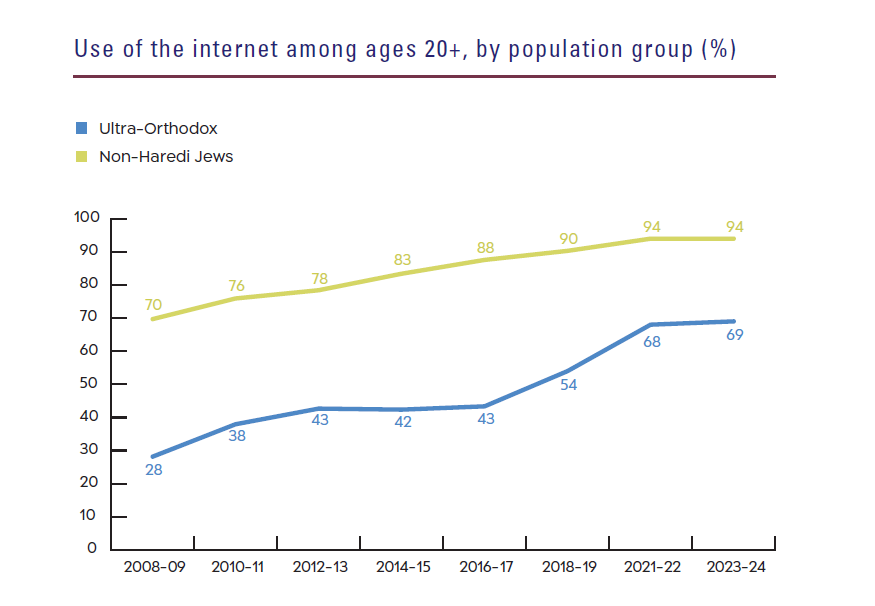
Beyond military matters, we see promising trends in the use of technology. The gaps in internet usage between the ultra-Orthodox and the rest of the Israeli public have narrowed, with 69% of the ultra-Orthodox and 94% of other Jews reporting that they are regular internet users.
Over the past decade, the growing numbers of ultra-Orthodox Israelis in higher education and the growing numbers of women who are employed, are generating greater disposable income, awareness of consumer and leisure culture, and a modern discourse among the growing middle class in ultra-Orthodox society. The communal and social characteristics of the ultra-Orthodox sector find expression in volunteer activity (40% of the ultra-Orthodox volunteer, as compared with 23% of other Jews) and in making major financial contributions to the community (89% of the ultra-Orthodox ages 20 and over versus 61% of other Jews). Note that these data do not account for the rise in volunteerism seen following the October 7, 2023 attack.
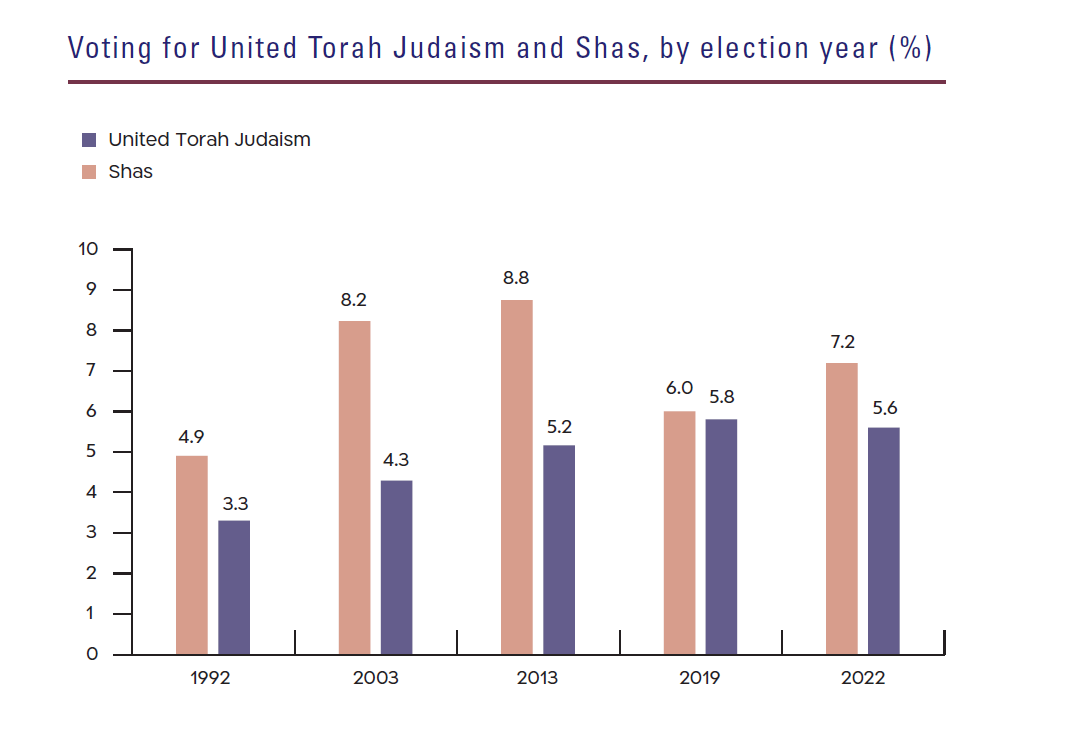
We also analyzed voting patterns for the United Torah Judaism and Shas electoral lists in Knesset elections, which are indicative of the political power of the ultra-Orthodox parties, the geographical distribution of the ultra-Orthodox public in Israel, and the internal composition of the population residing in locales with heavy concentrations of Haredim.
Between 1992 and 2022, the overall share of the vote gained by Shas and United Torah Judaism rose from 8.2% to 14.1%. In addition, there has been a change in the geographical distribution of voters for these lists, reflected in the growing population of the ultra-Orthodox satellite cities and the declining of Jerusalem and Bnei Brak.